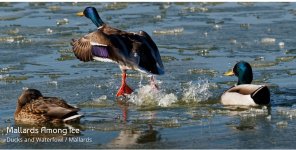
Nisqually NWR, December. Puddle ducks and allies. At this time of year, ducks and geese have EVERY reason to be wary when they encounter humans. On a recent visit to Tokeland, a flock of mallards and American wigeons burst into flight from 100 yards away. At Ridgefield NWR, the geese and ducks typically stay several hundred feet from the Auto Route. But I am often able to be quite close to ducks and geese at Nisqually NWR. And yet outside the refuge, Nisqually Reach is open for hunting (never mind the sounds of the machine guns from Fort Lewis).
There may be several reasons for this lack of caution. First, in this cold weather the birds may be balancing safety vs. feeding. They will sacrifice safety in the absence of an acute threat; they are watchful while voraciously feeding. Second, the ducks and geese may simply become acclimated to the steady flow of non-threatening walkers and birders along the trails. Third, bald eagles may represent a more acute threat and the presence of humans may provide some protection against eagle attacks.
In any event, close proximity translates into great images.
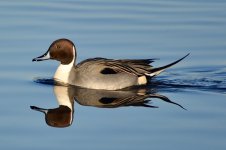
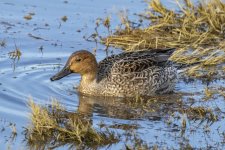
Drake pintails are one of my favorites, but they, especially the drakes, can be quite skittish. During a recent high-tide visit, several pintails had followed the incoming high tide out of the saltwater canal that parallels a section of the dike trail. They were vigorously feeding on the intertidal vegetation covering the bank shelf, perhaps 30’ away from the dike trail. Like this drake
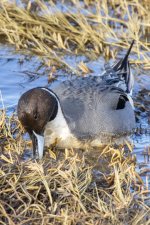
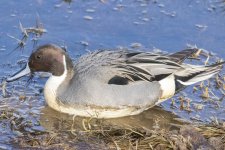
and this hen.
They were joined by several green-winged teals, including this drake.
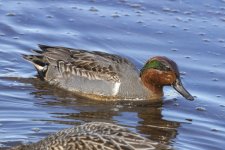
I would say that the most common duck species at Nisqually is either the green-winged teal or the American wigeons.
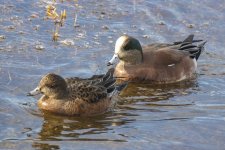
species are the least skittish ducks at the refuge.
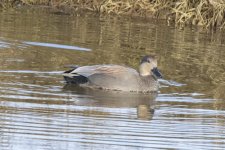
It has been a good year to see gadwalls at Nisqually. They intermingle with the pintails, mallards, and shovelers that dominate the flooded grasslands and seasonal freshwater marsh. This drake and a hen were even feeding in the saltwater canal.
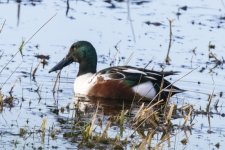
Shovelers tend to stay in the freshwater marsh.
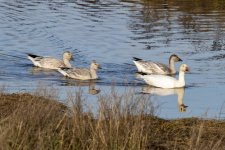
The family of snow geese (adult and three juveniles) has been hanging around the dike trail for the last several weeks. They even went for a family excursion in the same saltwater canal.
However, that outing (and the feeding of the puddle ducks) was interrupted when a bald eagle cruised by
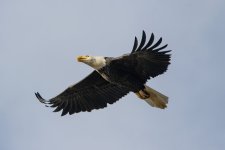
and all the ducks and geese blasted into the air. But once the threat passed, they settled back down and resumed feeding.
In my last visit on Thursday, the snow geese were joined by a flock of 20ish greater white-fronted geese.
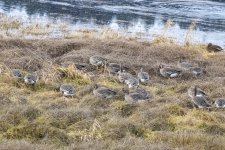
I had not seen this species previously at Nisqually. I suspect that the storms earlier in the week may have scrambled the locations of some of these winter migrants (or driven some laggard flocks farther south). Historically, white-fronted geese spend the winter in the Central Valley of California and along the costs of Louisiana, Texas, and Mexico. Pacific populations of the greater white-fronted goose have been increasing.
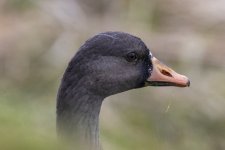
Adult white-fronted geese have dark belly-bars on a light dun background
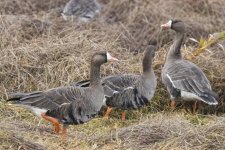
and a ring of white feathers between the bill and the eye, hence the species name of
albifrons (“white forehead”).
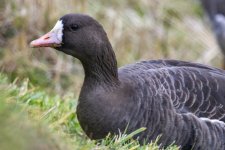
The belly of a juvenile greater white-fronted goose is a uniform dun color
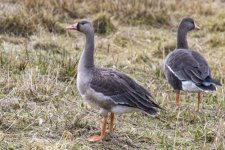
and a juvenile lacks the ring of white feathers around the base of the bill.
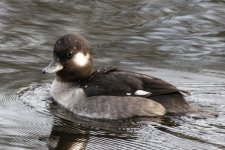
Many toylike buffleheads dive for food in McAllister Creek and the flooded saltwater mud flats. And there is usually a pair or two in the main pond by the Visitor Center, like this hen
or this drake.
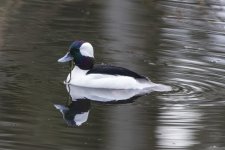
Typically, buffleheads feed on aquatic crustaceans, insects, and mollusks, but they will eat plant material in the fall, as this individual proves.
Hooded mergansers (and wood ducks) are a different story to these other ducks. Generally, there may be one or two pairs at a time in the refuge, like this drake
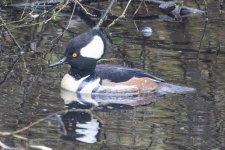
And this hen.
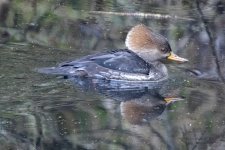
They prefer the canals around the Twin Barns loop and sometimes the main pond.
Steve