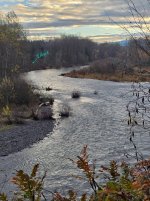
Nisqually Wildlife Refuge, 2024 November 18. My usual strategy when I am birding is more like active hunting. I try to walk quietly along the trail looking for any signs of motion in my peripheral vision and listening to any light bird call or rustle in the undergrowth – intense focus. Another option, a favorite of Australian bird guide Mike Jarvis, is to find a great location (such as a waterhole in the dry season in the Northern Territory) and just stake it out. The birds come to you. And with the falling temperatures, the birds’ first priority is keeping the furnaces stoked – eat, eat, eat.
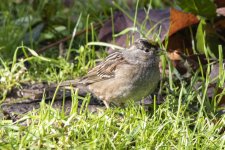
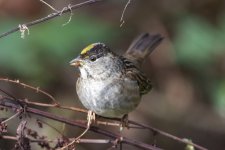
Along the Twin Barns Trail at Nisqually NWR, I stopped at gravel spur that crosses the main walking trail. I was anticipating that there would be a flock of golden-crowned sparrows here; there usually are. They graze on the fresh grass blades at the edge of the gravel. And they were there nibbling on grass.
But I also sighted a yellowish bird in the blackberry thicket adjacent to the sparrows. My first thought was that this would be a ruby-crowned kinglet, but when I put my binocs on it, it proved to be a warbler, specifically a female/immature orange-crowned warbler.
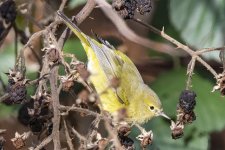
Outside of the occasional yellow-rumped warbler, very few warblers overwinter in Western Washington; most head south to warmer climes as the local temperatures drop. This orange-crowned warbler was carefully probing the old fruits of Himalayan blackberries.
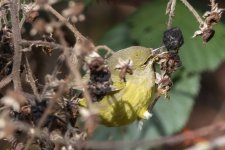
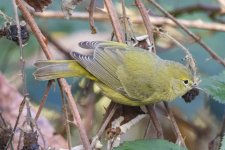
While these warblers are reported to consume fruit and nectar in winter, I suspect that this bird was looking for insects that were either hiding in the clumps of desiccated berries or that were feeding on the rotting fruit. Later in my walk, I encountered another female/immature orange-crowned warbler.
This was the start of a 45-minute stretch where I didn’t move more than 20 feet and snapped 315 pictures (out of 513 pictures for the visit). New species appeared every few minutes and I’ld move a step or two to get a better angle or clearer view. As most individuals were actively feeding, capturing a bird in focus and in good light was a challenge – quantity was the name of the game.
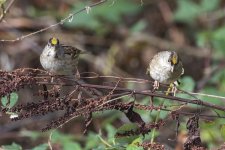
Something (me?) spooked the flock of golden-crowned sparrows into the blackberry thicket. When the sparrows felt safe, they flew onto the stems of the perennial plant dock and began harvesting dried seeds.
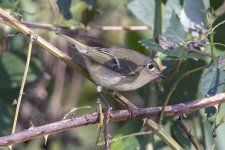
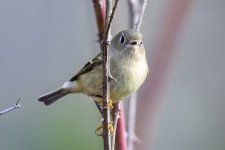
I had been hearing the contact calls of ruby-crowned kinglets from deeper in the alders and several moved to the edge of the clearing. They searched the leaves of the blackberry shrubs for a meal. Typically a difficult species to photograph because of their erratic activity, a few kinglets posed long enough for a few good images.
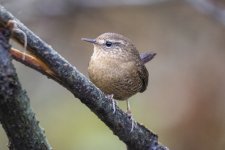
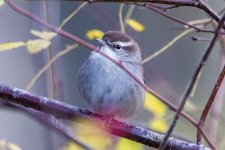
I had been hearing the distinctive raspy scolding of a Bewick’s wren. It popped into view and I managed to snap a few pictures before it disappeared deeper into the shrubs.
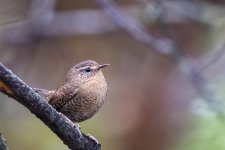
A Pacific wren popped into view so close that I had to take a step back to meet the minimum auto-focus distance of my camera. I managed just a single picture before it also disappeared.
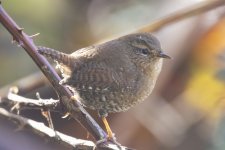
But the Pacific wren was replaced by a black-capped chickadee who was determined to demolish several galls on thimbleberry stems.
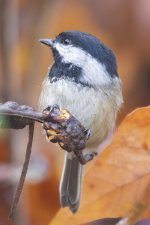
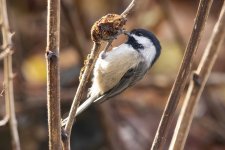
I investigated this and found that the gall wasps (likely
Diastrophus kincaidii) lay eggs on the thimbleberry stems in the spring. The thimbleberries build the galls in response to the presence of the wasp larvae. It is likely that the wasp larvae release growth hormones that stimulate the localized growth of the plant that results in the gall structure. The herbivorous wasp larvae consume the plant tissue. The wasp larvae pupate in the fall and emerge as adults in the spring to continue the process. This chickadee might have been searching for the pupae of the thimbleberry gall wasp or for other wasp species that parasitize these gall wasp pupae (parasitoids – think Alien movie).
Song sparrows are ubiquitous at Nisqually NWR. And they are not shy.
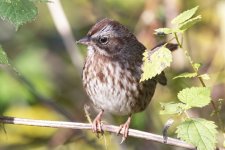
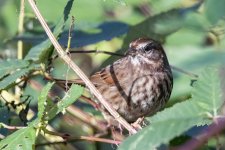
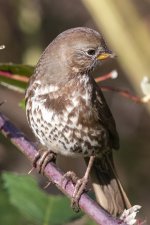
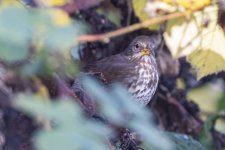
But I was surprised to see two fox sparrows emerge from the undergrowth and perch in view. These are sparrows that think that they are thrushes – scratching at leaves and other vegetation to reveal invertebrates hiding below. They tend to be more cryptic than the other sparrows at Nisqually. But two individuals came out and perched in good light.
A spotted towhee also popped up from the undergrowth, but I never had a clear camera shot at it. I heard pine siskins making their “psee” calls up in the canopy, but, per usual, they were too far off for worthwhile pictures at this site.
That changed later in my walk. I had just reached the gravel dike that separates the freshwater marsh from the mudflat. I heard and saw golden-crowned kinglets in the shrubs and trees. While I was waiting for a kinglet to give me a clean shot, a flock of 100+ pine siskins landed 20’ away from me in alders on the west edge of the dike. The noisy pine siskins were frantically feeding on the seeds (small-winged nutlets) inside the cone-like strobili (= female reproductive structure).
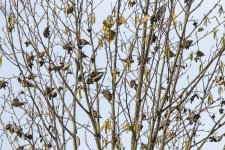
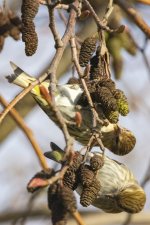
And just as quickly as they arrived, they headed off. And the golden-crowned kinglets were gone too.
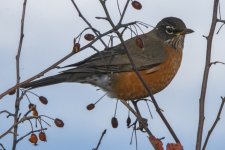
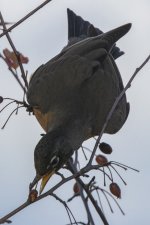
As I walked back to the parking lot, a male robin was perched in a Pacific crabapple tree in great light. It was harvesting the ripe fruit.
Steve


 Steve
Steve