Got any bird pics?

I am completely flummoxed and fascinated by our mallards, I was sure they would be gone by now, but no, this morning there were 6 on the pond when I first went out at daybreak, though typically over the last week or 2, we have 3, an adult drake, a juvenile male and a hen. I now suspect they may stick around all winter.

Mr. Drake is very photogenic, and yesterday did not seem the least bit bothered by my presence.

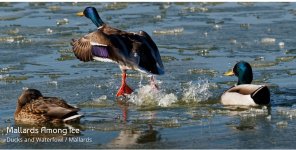
Struttin' his stuff on the ice:

View attachment 135688


View attachment 135690


View attachment 135691

The Misses

View attachment 135692

With Junior

View attachment 135693

Thank you for indulging me and our ducks (or maybe I'm theirs).
Ducks are cool
 
I am completely flummoxed and fascinated by our mallards, I was sure they would be gone by now, but no, this morning there were 6 on the pond when I first went out at daybreak, though typically over the last week or 2, we have 3, an adult drake, a juvenile male and a hen. I now suspect they may stick around all winter.

Mr. Drake is very photogenic, and yesterday did not seem the least bit bothered by my presence.

Struttin' his stuff on the ice:


View attachment 135693

Thank you for indulging me and our ducks (or maybe I'm theirs).
Awesome photos! That looks like a pair of black ducks!
 
Pennsylvania - correct? That’s within the range of the black duck. It’s definitely a bird of the eastern hardwood forests and coastal marshes.

Yup, Poconos. I think you may be correct, there is no white upper/lower streak on the speculum and the bills may be more olive, and no white tail that I have seen.
 
I agree with @RRSmith that the last picture (and probably the last two) are likely black ducks. Black ducks are superficially similar to hen mallards (see here). The two species will flock together in winter. Black ducks can be frustrating to identify, especially as mallards interbreed with black ducks, producing a range of hybrids. Unlike some geese, ducks will breed during the first spring after hatching = no "juvenile" coloration right now. Why black ducks? We know that neither bird is a male mallard as of the absence of a bright green head; we can cross out 1 of the 4 possibilities for both birds in the last image. So, these birds could be a hen mallard or a black duck. If a black duck, can we determine drake or hen?
A) left bird in last image.
1) In a mallard, the speculum (colored patch) on the secondary wing feathers is blue bordered by black and white. In black ducks, the speculum is more purple and bordered by black (no white). The bird on the left of your last picture (and in the third picture) has a purplish speculum with a black border = black duck. But is it a hen or a drake black duck?
2) Male black ducks have yellow bills, like the mallard drakes in your first three pictures (but not quite so bright - tending toward olive). Mallard hens have orange and black bills, much like this bird. Pure hen black ducks have dull olive bills. But it can't be a hen mallard because of the purple bordered by black speculum. So, I would call this as a hen black duck (speculum) with some mallard influence (bill).
B) right bird in the last image.
The bird on the left of your image has an olive bill. At the "All About Birds" web site, they have an image of drake black duck with a very similar bill (and body) color (see here). You can see that the bill of the hen is much duller. So, without a bright yellow bill, it isn't a male mallard. Without an orange and black bill, it isn't a hen mallard. The bill is brighter than what I would expect to see for a hen black duck. So, it is likely a drake black duck, based on bill coloration alone.
Great challenge!
Steve
 
Last edited:
The cool black duck images that @Canuck from Kansas posted stimulated some of my long dormant brain cells. Other than Wing Bee's, I never had any interaction with black ducks during my career as they very rarely occur in the Pacific Flyway. I did research and write a paper about the decline of black ducks in the Atlantic Flyway for a wildlife management class back in my college days.

In the 1960's and 70's, the East Coast black duck population was in serious decline. Beginning in the early 20th century, 1000's of acres of Boreal forest were converted to farmland in Canada which created ideal habitat for pioneering mallards (which preferred the open prairie provinces for nesting and brood rearing). Meanwhile, tens of thousands of game farm mallards were being raised and released by government agencies and private citizens in an attempt to establish a huntable population in the Eastern US. This strategy started to work as mallards became the most abundant duck in the Atlantic Flyway during the late 1960's. This increase in the East Coast mallard population coincided with a precipitous drop in black duck numbers through hybridization and competition. When I was a student in the late 1970's - this was a big deal if you were a waterfowl nerd (which I was and still am).

Fast forward to the present and the advent of modern genetic analysis. The decline of the Atlantic Flyway black duck population stabilized in the late 1980's however concern still exists about the genetic integrity of black ducks (and the mallards they are coexisting with). Genetic analysis has revealed that about 25% of the black duck population have mallard genes. The other 75% appear to be pure and from a single genetic stock. Fortunately, mallard/black duck hybrids appear to prefer breeding with mallards which has kept hybridization in check.

The one other side note that was interesting was about mallard genetics - which is far more diverse due to its hemispheric distribution and domestication over 1000's of generations. When attempts to propagate native mallards failed during the mid 20th century, game farms imported Eurasian mallard stock. Much like hatchery salmon and steelhead, these birds were far less genetically diverse due to selected breeding and ease of handling in captivity. Currently, over 90% of Atlantic Flyway mallards contain "game farm genetics". It illustrates that "domesticated" mallards can successfully breed in the wild and has raised a level of concern about genetic purity of wild North American stocks.
 
Last edited:
Tell us more about your pond!

Just a small pond, about 100 ft by 40 to 50 ft. It is fed by an artesian well (currently not flowing due to drought) and a spring (still flowing), so we have really nice, cold, clear water, till the muck gets stirred up. I have started a rehab, it suffered years of neglect under the previous owner:


Has some tadpoles and frogs, and of course the ducks. Hope to add some bait fish in the spring, and ultimately, stock some Brookies (apparently at one time it did have some).
 
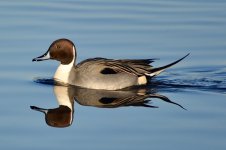
Drake pins are another beautiful bird.

Great pic, thanks
Agree! A fabulous image of my favorite puddle duck - thanks for posting! Back in the 1980's, I banded a juvenile pintail in California's Sacramento San Joaquin Delta area and it was recovered on Wrangel Island, Russia one year later. Northern pintail are also the most common wintering duck on the Hawaiian Islands. They are truly amazing birds!
 
@Cabezon @RRSmith

One surprising winter day, a surprising proportion of the mallards I saw had blue heads. Location, Mcnary nwr ponds . Discussion welcome.

View attachment 136085
First, great shot. The color in the feathers of a mallard head is not a pigment, like carotenoids which absorbs most wavelengths of light and reflects one (for example, see the orange leg color). Instead, the color of the head (and the purple speculum = secondary flight feathers) is structural. Inside the feathers are stacks of melanosomes. These melanosomes contain melanin and the stacks act like multilayer reflectors or prism (see here) creating iridescence that favors the blue/green end of the color spectrum. These layers scatter green light if the sun is in one position or blue light in another. So it is the angle of the light hitting these structures that determine the color (see here). There is a great article, "How birds make colorful feathers", which reviews bird coloration here.
Steve
 
Last edited:
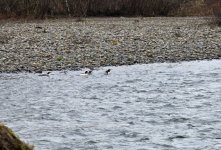
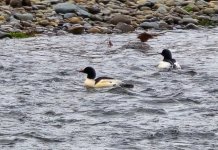
Saw these ducks today during a casting practice session. Hooded mergansers?

View attachment 136180View attachment 136181
No, those are common mergansers. Both common mergansers and red-breasted mergansers are large ducks (25" and 23" long respectively), even larger than a mallard (23"). Hooded mergansers are quite a bit smaller (18" long) (and look like wind-up toys...). Hooded merganser drakes have a crest that is white trimmed in black. Both common mergansers and red-breasted mergansers use group hunting tactics to increase foraging success; the flock will dive synchronously and head toward shore in a crescent. This drives their fish prey up against the shoreline where they are easier to catch.
Steve
 
Last edited:
Nisqually NWR, December. Puddle ducks and allies. At this time of year, ducks and geese have EVERY reason to be wary when they encounter humans. On a recent visit to Tokeland, a flock of mallards and American wigeons burst into flight from 100 yards away. At Ridgefield NWR, the geese and ducks typically stay several hundred feet from the Auto Route. But I am often able to be quite close to ducks and geese at Nisqually NWR. And yet outside the refuge, Nisqually Reach is open for hunting (never mind the sounds of the machine guns from Fort Lewis).
There may be several reasons for this lack of caution. First, in this cold weather the birds may be balancing safety vs. feeding. They will sacrifice safety in the absence of an acute threat; they are watchful while voraciously feeding. Second, the ducks and geese may simply become acclimated to the steady flow of non-threatening walkers and birders along the trails. Third, bald eagles may represent a more acute threat and the presence of humans may provide some protection against eagle attacks.
In any event, close proximity translates into great images.
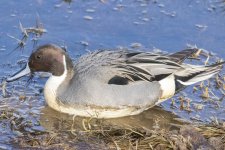
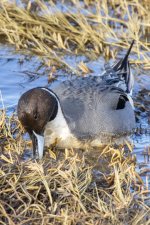
Drake pintails are one of my favorites, but they, especially the drakes, can be quite skittish. During a recent high-tide visit, several pintails had followed the incoming high tide out of the saltwater canal that parallels a section of the dike trail. They were vigorously feeding on the intertidal vegetation covering the bank shelf, perhaps 30’ away from the dike trail. Like this drake
A01aPintailDrake3669 copy.jpg
A01bPintailDrake3689 copy.jpg
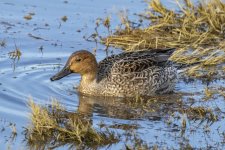
and this hen.
A02PintailHen3657 copy.jpg
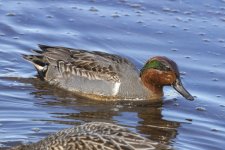
They were joined by several green-winged teals, including this drake.
A03GreenWingedTealDrake3701 copy.jpg
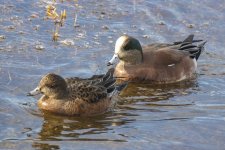
I would say that the most common duck species at Nisqually is either the green-winged teal or the American wigeons.
A04AmericanWigeonPair3750 copy.jpg
species are the least skittish ducks at the refuge.
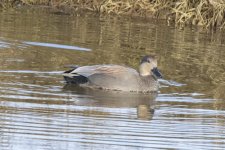
It has been a good year to see gadwalls at Nisqually. They intermingle with the pintails, mallards, and shovelers that dominate the flooded grasslands and seasonal freshwater marsh. This drake and a hen were even feeding in the saltwater canal.
A05GadwallDrake3575 copy.jpg
Shovelers tend to stay in the freshwater marsh.
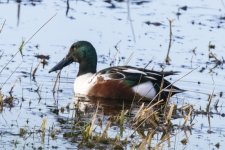
A06NorthernShovelerDrake3880 copy.jpg
The family of snow geese (adult and three juveniles) has been hanging around the dike trail for the last several weeks. They even went for a family excursion in the same saltwater canal.
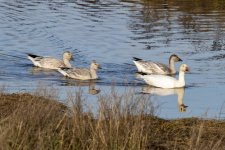
A06SnowGeeseFamilyOuting3585 copy.jpg
However, that outing (and the feeding of the puddle ducks) was interrupted when a bald eagle cruised by
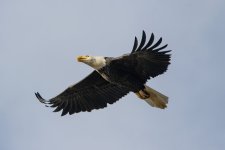
A07BaldEagleInFlight3612 copy.jpg
and all the ducks and geese blasted into the air. But once the threat passed, they settled back down and resumed feeding.
In my last visit on Thursday, the snow geese were joined by a flock of 20ish greater white-fronted geese.
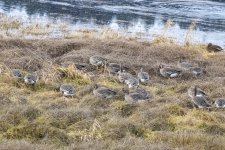
A08WhiteFrontedGeese4091 copy.jpg
I had not seen this species previously at Nisqually. I suspect that the storms earlier in the week may have scrambled the locations of some of these winter migrants (or driven some laggard flocks farther south). Historically, white-fronted geese spend the winter in the Central Valley of California and along the costs of Louisiana, Texas, and Mexico. Pacific populations of the greater white-fronted goose have been increasing.
Adult white-fronted geese have dark belly-bars on a light dun background
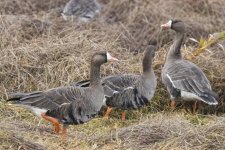
A09WhiteFrontedGeeseAdults4096 copy.jpg
and a ring of white feathers between the bill and the eye, hence the species name of albifrons (“white forehead”).
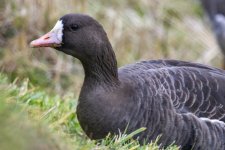
A10WhiteFrontedGooseAdult4147 copy.jpg
The belly of a juvenile greater white-fronted goose is a uniform dun color
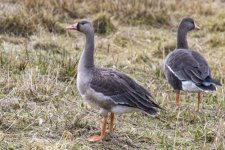
A11WhiteFrontedGooseJuvenile4108 copy.jpg
and a juvenile lacks the ring of white feathers around the base of the bill.
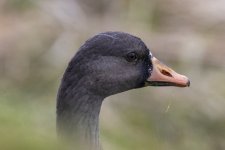
A12WhiteFrontedGooseJuvenile4143 copy.jpg
Many toylike buffleheads dive for food in McAllister Creek and the flooded saltwater mud flats. And there is usually a pair or two in the main pond by the Visitor Center, like this hen
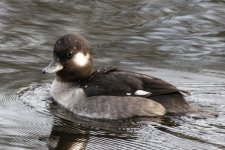
A13BuffleheadHen3189 copy.jpg
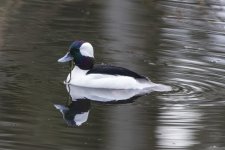
or this drake.
A14BuffleheadDrake4304 copy.jpg
Typically, buffleheads feed on aquatic crustaceans, insects, and mollusks, but they will eat plant material in the fall, as this individual proves.
Hooded mergansers (and wood ducks) are a different story to these other ducks. Generally, there may be one or two pairs at a time in the refuge, like this drake
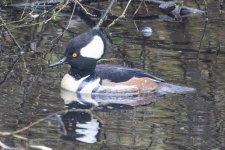
A15HoodedMerganserDrake3213 copy.jpg
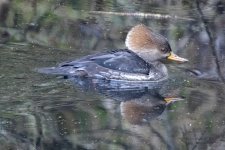
And this hen.
A16HoodedMerganserHen3210 copy.jpg
They prefer the canals around the Twin Barns loop and sometimes the main pond.
Steve

 
Last edited:
Back
Top