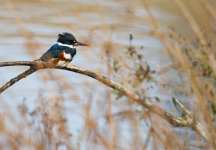
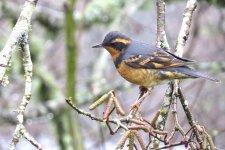
Got any bird pics?

Per usual, thanks for posting your amazing images Steve! If pintail are my favorite puddle duck, white fronted geese are my fav's among the goose tribe. I opportunistically chased a subspecies - the tule greater white-fronts around their wintering grounds of the Suisun Marsh which is in California's Sacramento/San Joaquin Delta. A handful of birds were neck collared on a molting lake in the interior of Alaska in the late 1980's. Back then, they were a mystery bird that showed up each fall but the whereabouts of their breeding grounds were still an unknown. Since that time, thanks to satellite tagging, we know a lot more about the tule subspecies. I posted about this awhile back in this thread: Tule Geese

The Pacific Flyway population of white fronts comes from two primary breeding areas in Alaska. The main population nests in the Yukon Kuskokwim Delta and to a lesser extent, along the west coast of Alaska and winters primarily in California. As Steve pointed out, the population has increased in the past few decades after being decimated by egg collecting and harvesting on the breeding grounds and landscape wide changes in their wintering habitat. The second population nests in the Bristol Bay area and winters in the central highlands of Mexico. The Bristol Bay population is always the first to migrate and we used to see flocks moving through NE California around Labor Day.
 
Last edited:
Per usual, thanks for posting your amazing images Steve! If pintail are my favorite puddle duck, white fronted geese are my fav's among the goose tribe. I opportunistically chased a subspecies - the tule greater white-fronts around their wintering grounds of the Suisun Marsh which is in California's Sacramento/San Joaquin Delta. A handful of birds where neck collared on a molting lake in the interior of Alaska in the late 1980's. Back then, they were a mystery bird that showed up each fall but the whereabouts of their breeding grounds were still an unknown. Since that time, thanks to satellite tagging, we know a lot more about the tule subspecies. I posted about this awhile back in this thread: Tule Geese

The Pacific Flyway population of white fronts comes from two primary breeding areas in Alaska. The main population nests in the Yukon Kuskokwim Delta and to a lesser extent, along the west coast of Alaska and winters primarily in California. As Steve pointed out, the population has increased in the past few decades after being decimated by egg collecting and harvesting on the breeding grounds and landscape wide changes in their wintering habitat. The second population nests in the Bristol Bay area and winters in the central highlands of Mexico. The Bristol Bay population is always the first to migrate and we used to see flocks moving through NE California around Labor Day.
Thank you for adding more additional detail. Very cool.
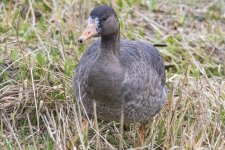
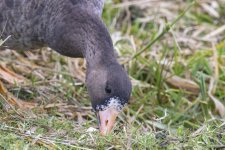
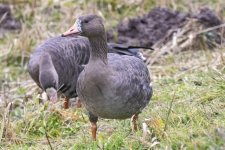
I have a question then to you about the age/status of these birds that have scraggly white feathers around the base of the bill. It reminds of "peach-fuzz" on a teenage boy... There were three different states of the white feathers in this flock: a) well-developed white ring = adult, b) no white ring, but tending toward black feathers around the base of the bill = first year juveniles as in the previous post, and c) these in-between individuals = ?.
WhiteFrontedGooseJuvenile4160.jpg
WhiteFrontedGooseJuvenile4171.jpg
WhiteFrontedGooseJuvenile4187.jpg
Are these birds from this year's breeding season or the previous breeding season? In doing some research on greater white-fronted geese, I learned that juveniles will often stay with their parents through the following breeding season and help defend the nest and chicks against predators (and therefore non-breeding themselves, presumably = cooperative breeding ). They wouldn't form pairs and breed on their own until the following year, two years after they themselves hatched.
Steve
 
Thank you for adding more additional detail. Very cool.
I have a question then to you about the age/status of these birds that have scraggly white feathers around the base of the bill. It reminds of "peach-fuzz" on a teenage boy... There were three different states of the white feathers in this flock: a) well-developed white ring = adult, b) no white ring, but tending toward black feathers around the base of the bill = first year juveniles as in the previous post, and c) these in-between individuals = ?.
Are these birds from this year's breeding season or the previous breeding season? In doing some research on greater white-fronted geese, I learned that juveniles will often stay with their parents through the following breeding season and help defend the nest and chicks against predators (and therefore non-breeding themselves, presumably = cooperative breeding ). They wouldn't form pairs and breed on their own until the following year, two years after they themselves hatched.
Steve
Oh man Steve - that's a tough one. Unfortunately, I left my favorite two references, Handbook of North American Birds Volume II by Ralph Palmer and Measurements of Geese by Dzubin and Cooch to my successor. As I recall, when we trapped and marked Arctic geese in migration or on the wintering grounds (which was rarely), we either identified them as hatch year (juvenile) or after hatch year (adult). When geese are rounded up on breeding grounds or molting lakes in the Arctic and sub Arctic, there's a third age class added. Flightless and newly flighted goslings (if there are any) are designated hatch year, after hatch year are birds from the previous year's production which have not yet molted and after second year which are birds in adult plumage. You may be correct that the scruffy teenage looking bird is indeed a two year old that hasn't completed its molt yet.

I knew that geese (and swan) family groups stuck together through migration (that is how migration routes and traditions are passed on) but I was not aware that the juvies stuck with the parents into the next breeding season. Nice job with the research!
 
Oh man Steve - that's a tough one. Unfortunately, I left my favorite two references, Handbook of North American Birds Volume II by Ralph Palmer and Measurements of Geese by Dzubin and Cooch to my successor. As I recall, when we trapped and marked Arctic geese in migration or on the wintering grounds (which was rarely), we either identified them as hatch year (juvenile) or after hatch year (adult). When geese are rounded up on breeding grounds or molting lakes in the Arctic and sub Arctic, there's a third age class added. Flightless and newly flighted goslings (if there are any) are designated hatch year, after hatch year are birds from the previous year's production which have not yet molted and after second year which are birds in adult plumage. You may be correct that the scruffy teenage looking bird is indeed a two year old that hasn't completed its molt yet.

I knew that geese (and swan) family groups stuck together through migration (that is how migration routes and traditions are passed on) but I was not aware that the juvies stuck with the parents into the next breeding season. Nice job with the research!
Thank you for your thoughts. Here is a link and this link are to abstracts of scientific papers that quantify / describe the benefits of having the juveniles around for the parents.
Steve
 
Nisqually NWR, December 2024. “Birds of a feather flock together”, part 1. This time of year, I will often walk at Nisqually or other areas for several minutes without hearing or seeing a bird. You begin to wonder where they have all gone. But it isn’t really that the bird populations have declined, but that individuals of several species are forming large foraging flocks. When you encounter a flock, there are birds everywhere. Membership in a mixed-species flock seem to be determined by foraging mode, for the most part. A big advantage of these larger groups is more eyeballs to identify threats like Cooper’s hawks or sharp-shinned hawks. But this is at the expense of potential exploitative competition for food with so many mouths going over the same area.
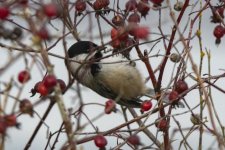
At the core of the insectivorous gleaning guild would be the noisy chickadees, like this black-capped chickadee foraging on a swamp rose pip.
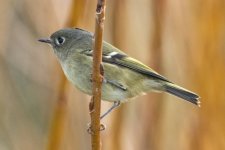
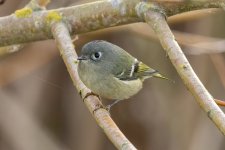
B01BlackCappedChickadeeOnSwampRose3259 copy.jpgYou can then add in one or two frenetic ruby-crowned kinglets with their frenetic energy and their chittering scolding calls (tsee, tsee).
B02aRubyCrownedKinglet3289 copy.jpg
B02bRubyCrownedKingletMale3282 copy.jpg
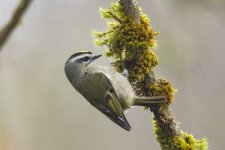
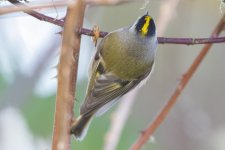
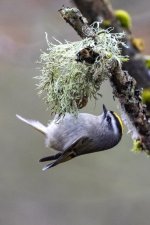
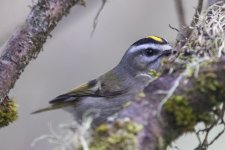
In some cases, flocks of chickadees will have joined forces with a flock of golden-crowned kinglets. The air will resound with their high-pitched tsee contact calls all around you.
B03GoldenCrownedKiinglet4028 copy.jpg
B03GoldenCrownedKinglet3899 copy.jpg
B03GoldenCrownedKinglet4009 copy.jpg
B03GoldenCrownedKinglet4286 copy.jpg
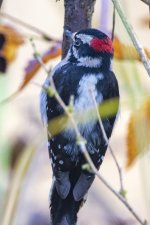
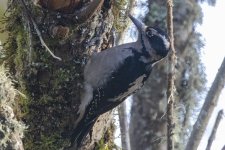
Less frequently, other species will join these active flocks, including downy woodpeckers,
B04DownyWoodpecker3566 copy.jpg
hairy woodpeckers,
B05HairyWoodpeckerFemale3874 copy.jpg
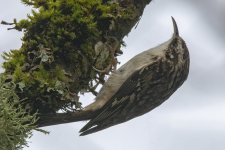
and brown creepers.
B06bBrownCreeper3954 copy.jpg
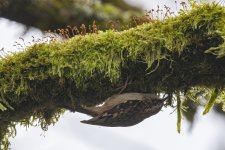
They have an amazing ability to walk on the underside of tree branches, as if the Laws of Gravity do not apply to them.
B06aBrownCreeper&MossSporophytes3999 copy.jpg
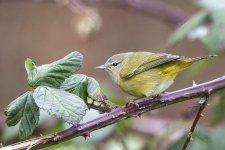
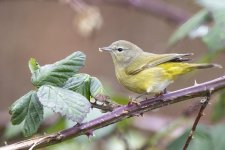
This year, there are at least two female orange-crowned warblers mixing in with the mixed species flocks.
B06caOrangeCrownedWarbler4247 copy.jpgThis one found a juicy morsel.
B06dOrangeCrownedWarbler4250 copy.jpg
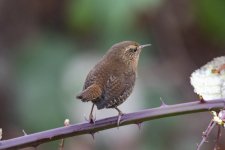
It seems that the resident birds that do maintain smaller home ranges through the winter become more active / visible when these foraging flocks are in the area. They may feel safer because of the presence of so many other birds. These include Bewick’s wrens,
B07aBewicksWren4268 copy.jpg
B07bBewicksWren4270 copy.jpg
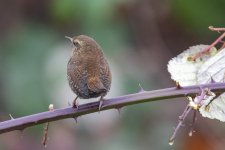
Pacific wrens,
B08aPacificWren3934 copy.jpg
B08bPacificWren3937 copy.jpg
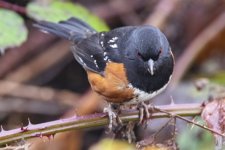
spotted towhees (love those eyes!), and
B09SpottedTowheeMale3940 copy.jpg
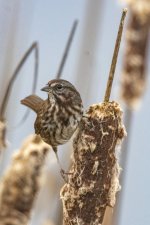
and song sparrows.
B10SongSparrow4124 copy.jpg

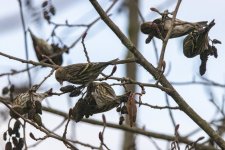
Finally, there is a flocking species that NO other species flocks with, pine siskins. They act like hyperactive 10-year-olds who have overdosed on sugar. They will noisily blast off if they sense any threat. And just as quickly come back and resume their frenzied search for seeds.
B11PineSiskins4213 copy.jpg
Steve
 
Last edited:
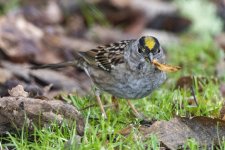
Nisqually NWR, December 2024. “Birds of a feather flock together”, part 2. There are several small flocks of golden-crowned sparrows at Nisqually NWR. When they first arrived, they scavenged the last of the edible blackberry fruits. But they have now switched to their winter staple, fresh grass blades.
Immature with rusty stripes on the head
C01GoldenCrownedSparrow4315 copy.jpg
Breeding adult with black head stripes bracketing a bright yellow stripe on the head
C02GoldenCrownedSparrow4318 copy.jpg
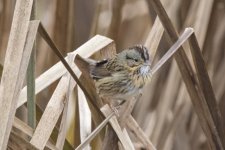
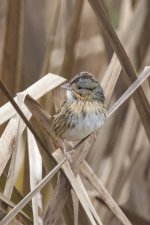
It is easy to see one or two distinctive golden-crowns and then dismiss the rest of the birds as more of the same, more golden-crowned sparrows. But, there can be one or two other species that are traveling with the golden-crowned flock. These additional species include a Fox sparrow or a Lincoln sparrow, like this individual.
C04LincolnSparrow4131 copy.jpg
C05LincolnSparrow4132 copy.jpg
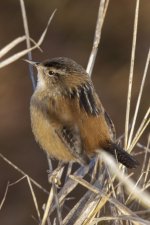
And finally, a species that doesn’t have much to do with other bird species is the marsh wren. Often heard, but rarely seen. I’ve been fortunate to find “posing” marsh wrens on two recent visits.
C06MarshWren3626 copy.jpg
C07MarshWren3889 copy.jpg
Steve
 
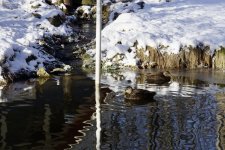
During this very cold snap, we got to 0 degrees, the ducks have been sitting near the outlet of the spring to keep warm.

1735135594542.jpeg

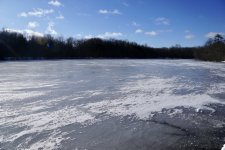
I am now of the belief these may be full time residents, our lake is completely frozen over with no sign of waterfowl.

1735135799386.jpeg


Cheers and a happy Holiday to all
 
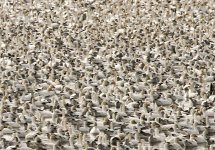
I had to make an unplanned trip to the Bay Area over Christmas. On my way back north, I stopped for a quick jaunt through Sacramento National Wildlife Refuge's tour route. There's a few Ross geese mixed in with this gaggle of snow geese. There are gazillions of white geese in the Sacramento Valley right now... it was impressive.

gaggleofsnowsandross.jpg
 
I had to make an unplanned trip to the Bay Area over Christmas. On my way back north, I stopped for a quick jaunt through Sacramento National Wildlife Refuge's tour route. There's a few Ross geese mixed in with this gaggle of snow geese. There are gazillions of white geese in the Sacramento Valley right now... it was impressive.

View attachment 137153
I was in Sacramento over the last week and could not get over the volume of birds we saw in the valley on our drive back north yesterday.
 
Screenshot 2024-12-28 at 3.43.43 PM.png
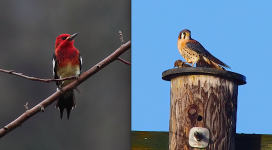
Above left : Sapsuckers buck the trend of the PNW lacking shockingly colorful birds.
Male kestrel right: Something I don't think I have ever seen. Kestrel with a bird. They will take everything else, yet the falcons from Merlins on up are pretty much bird eaters, but kestrels like small prey, generally, in my experience.

Below: Very dark red-tailed hawk. @Cabezon -could use your detailed expertise to explain the difference between harlan's and regular red-tails? I recall a harlan's has very light tail with little to no barring, and some white streaks on breast? I used to call all dark hawks harlan's but that was far from correct.
darkhawk33.jpg

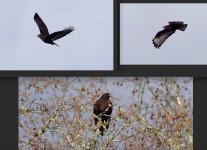
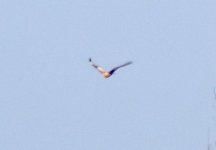
Below: One more @Cabezon or anyone wiling to try. Winged UFO. Might have found a local very uncommon short-eared owl flying away from about 300 yards, or more. Harriers are the common bird but this one has some interesting color patterns, yet it could also just be lighting.
shortearedowls2024ff 2.jpeg
 
Last edited:
Back
Top