
Navigation
Install the app
How to install the app on iOS
Follow along with the video below to see how to install our site as a web app on your home screen.
Note: This feature may not be available in some browsers.
More options
Style variation
You are using an out of date browser. It may not display this or other websites correctly.
You should upgrade or use an alternative browser.
You should upgrade or use an alternative browser.
Got any bird pics?
- Thread starter Wadin' Boot
- Start date


Gyrfalcon22
Legend
As a kid waaaaay back-and when bald eagles were quite rare, we had a single adult bald eagle show up on a very sunny day in our cottonwood on January 1st, 1976. How fitting for the start of the big bicentennial year! I still have the photo taken with my Christmas gift for that year. It was Kodak camera that had a 2 step lens lever to shift to telephoto. It was small speck to slightly bigger speck in the end.View attachment 137706
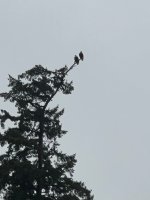
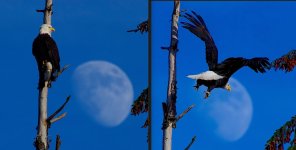
Not much compared to most of y’all’s postings here but notable for me was two mature bald eagles perched in a tree just two houses up the hill from me and visible from my front steps. I’m taking this as a good New Year’s omen.
Last edited:

Hi Gyrfalcon,View attachment 137700
Above left : Sapsuckers buck the trend of the PNW lacking shockingly colorful birds.
Male kestrel right: Something I don't think I have ever seen. Kestrel with a bird. They will take everything else, yet the falcons from Merlins on up are pretty much bird eaters, but kestrels like small prey, generally, in my experience.
Below: Very dark red-tailed hawk. @Cabezon -could use your detailed expertise to explain the difference between harlan's and regular red-tails? I recall a harlan's has very light tail with little to no barring, and some white streaks on breast? I used to call all dark hawks harlan's but that was far from correct.
View attachment 137701
Below: One more @Cabezon or anyone wiling to try. Winged UFO. Might have found a local very uncommon short-eared owl flying away from about 300 yards, or more. Harriers are the common bird, but this one has some interesting color patterns, yet it could also just be lighting.
View attachment 137702
Sorry, I am not an expert on subspecies of red-tailed hawks. There appears to be a lot of variation and even intergrades (see here). They do superficially look like the Harlan's subspecies, but there are also some dark red-tails that aren't Harlan's. And I am at a total loss on that last picture.
Steve
Gyrfalcon22
Legend
Thanks for the link Steve! Light/dark morphs throw more trouble in the mix. Can't think of any other bird where you can commonly see 5 individuals of a species in a day and might not get two that look exactly alike.Hi Gyrfalcon,
Sorry, I am not an expert on subspecies of red-tailed hawks. There appears to be a lot of variation and even intergrades (see here). They do superficially look like the Harlan's subspecies, but there are also some dark red-tails that aren't Harlan's. And I am at a total loss on that last picture.
Steve
Last edited:
While we are only a few days into winter, many birds are putting on their best plumage to attract mates. For herons and egrets that means developing long, slender plumes. These may grow from the head (occipital plumes), from the wings (scapular plumes), and/or from the breast (pectoral plumes).
Unfortunately for these bird species, these long, decorative plumes were highly desired by the millenary trade to adorn fancy hats in the late 19th and early 20th century. Whole rookeries of egrets, especially in the Everglades, were wiped out by hunters simply to supply plume feathers for this market. Concerns over the massive declines in the numbers of egrets and herons led to the implementation of regulations and establishment of protected areas. Fortunately, these efforts have led to a dramatic recovery of egrets and herons. On a recent visit to Ridgefield NWR, we saw at least a dozen great blue herons and four great egrets hunting in the meadows.
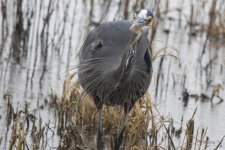
This great blue heron had flared its pectoral plumes and you can see the scapular plumes along its back.
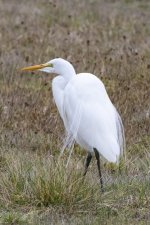
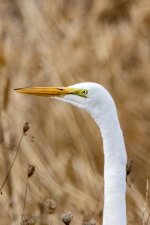
This great egret displays its long scapular plumes.
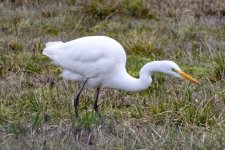
Other great egrets were on the hunt for voles.
Of course, fly-tying, especially for extra-fancy Atlantic salmon flies, has had its own impact on the populations of rare birds (see also “The Feather Thief”).
Steve
Unfortunately for these bird species, these long, decorative plumes were highly desired by the millenary trade to adorn fancy hats in the late 19th and early 20th century. Whole rookeries of egrets, especially in the Everglades, were wiped out by hunters simply to supply plume feathers for this market. Concerns over the massive declines in the numbers of egrets and herons led to the implementation of regulations and establishment of protected areas. Fortunately, these efforts have led to a dramatic recovery of egrets and herons. On a recent visit to Ridgefield NWR, we saw at least a dozen great blue herons and four great egrets hunting in the meadows.
This great blue heron had flared its pectoral plumes and you can see the scapular plumes along its back.
This great egret displays its long scapular plumes.
Other great egrets were on the hunt for voles.
Of course, fly-tying, especially for extra-fancy Atlantic salmon flies, has had its own impact on the populations of rare birds (see also “The Feather Thief”).
Steve

Gyrfalcon22
Legend
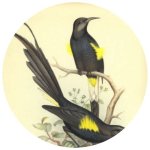
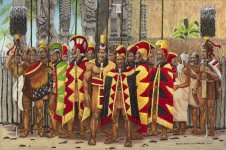
More great information Steve! Another tragic example of bird feathers being used for decoration is familiar to those who know the story of the Hawaiian cloaks made for royalty such as King Kamehameha by using the colorful feathers of small endemic birds of the islands. Some of these colorful feathers were just a pair of flank feathers that the small birds used for display.
The Bishop Museum in Honolulu in 1918 was in possession of some fifteen including the magnificent full-length cloak of King Kamehameha, made entirely of mamo feathers (450,000 feathers from 80,000 birds.), though some i'iwi red feathers were added to the trimming later when Kamehameha IV wore it ceremonially.
Many of the birds species used are now extinct.

 en.m.wikipedia.org
The Bishop Museum in Honolulu in 1918 was in possession of some fifteen including the magnificent full-length cloak of King Kamehameha, made entirely of mamo feathers (450,000 feathers from 80,000 birds.), though some i'iwi red feathers were added to the trimming later when Kamehameha IV wore it ceremonially.
Many of the birds species used are now extinct.
ʻAhu ʻula - Wikipedia
Last edited:
Gyrfalcon22
Legend
Hard to imagine that we live in a colorful world once the clouds give us a break (finally!)
Yellow-rumped (Audubon's) warbler
Yellow-rumped (Audubon's) warbler
Last edited:
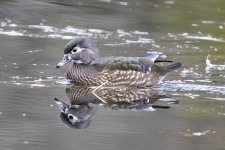
Wood ducks are so striking that I cannot resist taking numerous images if they are in camera range. These images were taken on a recent visit to the McLane Creek Nature Trail. While the hens of most duck species have purposely drab plumage to keep them camouflaged while on the nest and guarding/guiding ducklings, the plumage of hen wood ducks is a bit more elaborate.
Wood duck hens must be VERY picky when selecting mates. The plumage of a drake wood duck is about the most elaborate, even gaudy, among the ducks. Perhaps only the drake Mandarin duck is on par.
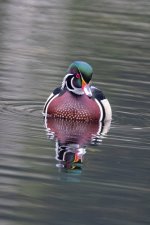
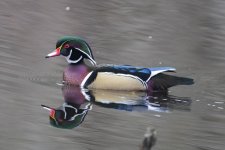
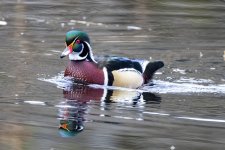
Explaining the seemingly extreme sexual dimorphism seen in many species (wood ducks, peacocks, the extinct Irish elk) was a conundrum for Darwin as these features would seem to be so over the top as to be maladaptive. The elaborate plumage of the males may demonstrate to females the underlying fitness of individual drakes. If a male can be that elaborate (and obvious to predators) and still survive, it must have good genes that would be passed to his offspring (the handicap principle developed by Amotz Zahavi in 1975). Another hypothesis for the elaborate male plumage in wood ducks might be runaway sexual selection, aka the sexy son hypothesis, proposed by Ronald Fisher. Under this hypothesis, females choose to mate with the most elaborate males because the sons that they produce will prove to be more desired by hens when it is time for them to mate. This creates a positive feedback loop driving elaborate male secondary sexual characteristic.
Steve
Wood duck hens must be VERY picky when selecting mates. The plumage of a drake wood duck is about the most elaborate, even gaudy, among the ducks. Perhaps only the drake Mandarin duck is on par.
Explaining the seemingly extreme sexual dimorphism seen in many species (wood ducks, peacocks, the extinct Irish elk) was a conundrum for Darwin as these features would seem to be so over the top as to be maladaptive. The elaborate plumage of the males may demonstrate to females the underlying fitness of individual drakes. If a male can be that elaborate (and obvious to predators) and still survive, it must have good genes that would be passed to his offspring (the handicap principle developed by Amotz Zahavi in 1975). Another hypothesis for the elaborate male plumage in wood ducks might be runaway sexual selection, aka the sexy son hypothesis, proposed by Ronald Fisher. Under this hypothesis, females choose to mate with the most elaborate males because the sons that they produce will prove to be more desired by hens when it is time for them to mate. This creates a positive feedback loop driving elaborate male secondary sexual characteristic.
Steve
Last edited:

Beautiful, I want some for our pond in the Poconos.Wood ducks are so striking that I cannot resist taking numerous images if they are in camera range. These images were taken on a recent visit to the McLane Creek Nature Trail. While the hens of most duck species have purposely drab plumage to keep them camouflaged while on the nest and guarding/guiding ducklings, the plumage of hen wood ducks is a bit more elaborate.
View attachment 138549
Wood duck hens must be VERY picky when selecting mates. The plumage of a drake wood duck is about the most elaborate, even gaudy, among the ducks. Perhaps only the drake Mandarin duck is on par.
View attachment 138550
View attachment 138551
View attachment 138552
Explaining the seemingly extreme sexual dimorphism seen in many species (wood ducks, peacocks, the extinct Irish elk) was a conundrum for Darwin as these features would seem to be so over the top as to be maladaptive. Several theories The elaborate plumage of the males may demonstrate to females the underlying fitness of individual drakes. If a male can be that elaborate (and obvious to predators) and still survive, it must have good genes that would be passed to his offspring (the handicap principle developed by Amotz Zahavi in 1975). Another hypothesis for the elaborate male plumage in wood ducks might be runaway sexual selection, aka the sexy son hypothesis, proposed by Ronald Fisher. Under this hypothesis, females choose to mate with the most elaborate males because the sons that they produce will prove to be more desired by hens when it is time for them to mate. This creates a positive feedback loop driving elaborate male secondary sexual characteristic.
Steve
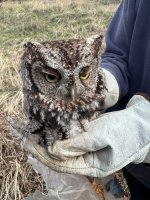
Maybe build a couple of Wood ducks boxes to attract them. Great for screech owls as wellBeautiful, I want some for our pond in the Poconos.


Wood ducks are so striking that I cannot resist taking numerous images if they are in camera range. These images were taken on a recent visit to the McLane Creek Nature Trail. While the hens of most duck species have purposely drab plumage to keep them camouflaged while on the nest and guarding/guiding ducklings, the plumage of hen wood ducks is a bit more elaborate.
View attachment 138549
Wood duck hens must be VERY picky when selecting mates. The plumage of a drake wood duck is about the most elaborate, even gaudy, among the ducks. Perhaps only the drake Mandarin duck is on par.
View attachment 138550
View attachment 138551
View attachment 138552
Explaining the seemingly extreme sexual dimorphism seen in many species (wood ducks, peacocks, the extinct Irish elk) was a conundrum for Darwin as these features would seem to be so over the top as to be maladaptive. Several theories The elaborate plumage of the males may demonstrate to females the underlying fitness of individual drakes. If a male can be that elaborate (and obvious to predators) and still survive, it must have good genes that would be passed to his offspring (the handicap principle developed by Amotz Zahavi in 1975). Another hypothesis for the elaborate male plumage in wood ducks might be runaway sexual selection, aka the sexy son hypothesis, proposed by Ronald Fisher. Under this hypothesis, females choose to mate with the most elaborate males because the sons that they produce will prove to be more desired by hens when it is time for them to mate. This creates a positive feedback loop driving elaborate male secondary sexual characteristic.
Steve
Steve, I assume the same hypotheses apply for the wild pattern/color variations in many fish species?
This comes to mind having watched a ton of fishing vids the last week or so, while recovering from a back injury. Many of the tropical reef species put any abstract art I've seen to shame.
It may be a more complex pattern in tropical fishes. Coloration may be a function of territoriality for feeding or school cohesion / predator confusion. Most coral reef fishes do not spawn in pairs. Often spawning is a group activity in the water column without much "mate selection". Exceptions include species like butterflyfishes or hamlets, but here the males and females are identical. In some wrasse species, like the blue-headed wrasse, multiple females mate with territorial males, but the female choices are more linked to the territory than any specific color patterns of the males, though males and females (future males because they change sex...) have different colorations.Steve, I assume the same hypotheses apply for the wild pattern/color variations in many fish species?
This comes to mind having watched a ton of fishing vids the last week or so, while recovering from a back injury. Many of the tropical reef species put any abstract art I've seen to shame.
Another aspect to consider when looking at the coloration of tropical reef fish is how the spectral qualities of light are modified by water. In clear tropical waters, red light is quickly absorbed and blue wavelengths travel the farthest. So, the vivid colors that you see in a photograph taken with a flash are much more vivid than the colors that you would see in ambient light at depth. And if you are closer to the fish (e.g., a mate or competitor), a fish's coloration will be more vivid in your vision than that of a predator that is viewing the fish from a distance.
Steve
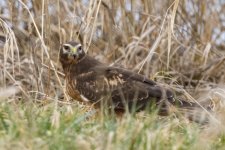
Northern harriers are far more at home on the ground than is typical for a raptors. Of course, some of that familiarity may come from the observation that Northern harriers nest on the ground. They will perch on low trees or sticks, but they will also commonly land on mounds in a field that provides them with a good perspective.
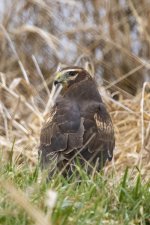
I caught this hen flying off. The outer feathers have the typical tan and black banding. But the central feathers are clearly darker than the others.
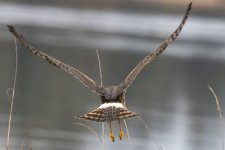
This pattern is not unusual in Northern harriers (see here) . There is no clear answer to why these central feathers are darker than the others. A darker feather would have more melanin and that appears to make the feathers harder and more resistant to abrasion (see here and here). It is possible that the differences between the central feathers and outer feathers may reflect differences in stiffness as well. The darker central feathers would be stronger but the lighter outer feathers would be more flexible, perhaps an advantage for the moth-like flight patterns of Northern harriers.
Steve
I caught this hen flying off. The outer feathers have the typical tan and black banding. But the central feathers are clearly darker than the others.
This pattern is not unusual in Northern harriers (see here) . There is no clear answer to why these central feathers are darker than the others. A darker feather would have more melanin and that appears to make the feathers harder and more resistant to abrasion (see here and here). It is possible that the differences between the central feathers and outer feathers may reflect differences in stiffness as well. The darker central feathers would be stronger but the lighter outer feathers would be more flexible, perhaps an advantage for the moth-like flight patterns of Northern harriers.
Steve
Last edited:

fkajwg
formerly known as ...
I have noticed they often perch on the ground on dykes in marshlands, sometimes w their prey.Northern harriers are far more at home on the ground than is typical for a raptors.
I did not know they nest on the ground
Jay
fkajwg
formerly known as ...
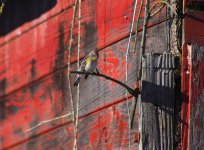
I enjoy when man made structures add compositional elements and color to a bird image.View attachment 138395
Yellow-rumped (Audubon's) warbler
Jay

Bonefish Jack
Steelhead
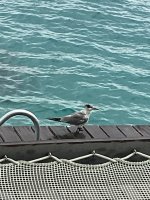
Bonefish Jack
Steelhead
More Terns from French Polynesia: These are White Terns, gracefully flitting about their roosting spot. There were three others outside of the frame. Pure white plumage.

Agree with FKAjwg, both shots are outstanding - @Gyrfalcon22 , really nice composition!I enjoy when man made structures add compositional elements and color to a bird image.
Jay

Surprised to see a half dozen Swallows flying around a nearby pond at this time of year, and in this cold weather. Not many flying bugs around for them to catch and eat. Apologies for the inferior phone pics.
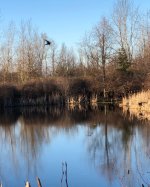
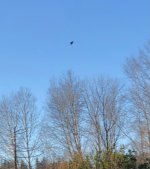
I also saw this single swallow in January while snowshoeing a few years ago at about the 3,000’ elevation. It was a warm day, and it must have been feeding on a midge hatch unseen by me because it kept swooping low over this small creek over and over. Nature’s full of surprises.
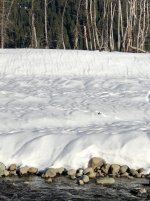
I also saw this single swallow in January while snowshoeing a few years ago at about the 3,000’ elevation. It was a warm day, and it must have been feeding on a midge hatch unseen by me because it kept swooping low over this small creek over and over. Nature’s full of surprises.