Got any bird pics?

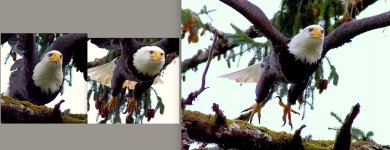
Heavy-cropped (as in belly buster) male Bald eagle sort of taking a not-so direct departure from a perch overhead. Some salmon carcasses at the river are carried in part to favorite lower perches to dine on.


baldeagledec6thooffd.jpg

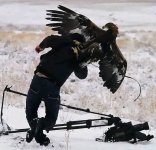
One day I might get a true closer encounter.. (obvious falconer's golden that likely just didn't stick the right landing spot)
img_1_1732544600315.jpg
 
Last edited:
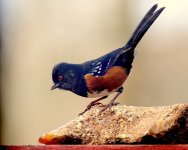
A favorite Winter bird, this Spotted Towhee is semi-clear through my dirty living room window. Raucous buggers, they have some jay in them as they are pesky instigators and generally bully other songbirds with a raspy, rattling call I rather enjoy.

tohehee2024DECa.jpg
 
Last edited:
Tokeland & Westport, 2024 November 27. It is a tricky time of year for birding, even if you are retired. I’m reluctant to take my nice cameras out in the rain and the light sucks anyway. And this time of year, even a “clear” morning can be foggy and the days are short. So, this dictates later departures and limiting the number of stops. With my wife on Thanksgiving break, we wanted to share an adventure and we decided to head to the coast. We headed to Tokeland first. In spite of there being no rain in the Westport forecast, we hit showers on the drive to Tokeland and a steady drizzle had settled in as we left Tokeland for Westport. Hitting a fortunate dry window, we arrived at the Tokeland Marina just after high tide; water was rushing out of Willapa Bay and into the open ocean. The marina was busy with boats going to / returning from crabbing and salmon fishing (I assume) before Thanksgiving.
A solitary white-winged scoter hen
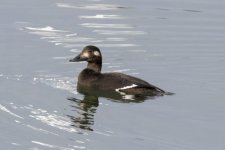
A01WhiteWingedScoterHen2842.jpg
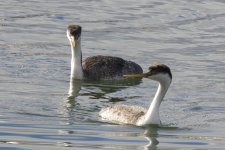
and two Western grebes
A02WesternGrebes2870.jpgwere diving for their own seafood meals (and dozing) within the marina.
From the elevated fixed platform and the outer floating dock, folks were busy tossing and retrieving snares and crab traps to enhance their own holiday meals. The recent storms had ripped up the eel grass beds in Willapa Bay; their dislodged blades were piled into thick green windrows along the shoreline and littered the docks.
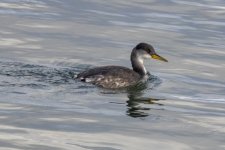
In the bay itself, several Western grebes dove for lunch, some close enough to the shore for nice pictures.
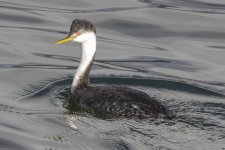
A03WesternGrebe2903.jpg
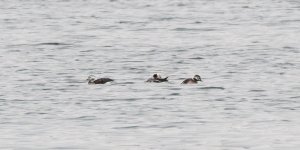
Off in the distance, loons and ducks (scoters?) were diving for lunch.
Before we headed to Westport, we stopped in at the empty campground. Several killdeers were searching the grass for food.
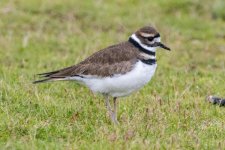
A04Killdeer2991.jpg
One pulled up a massive earthworm but was harassed by the others before it could gulp it down.
From the campground, we spied a flock of shorebirds chilling out at the edge of the marsh outside the breakwater. We decided to get out for a closer view. Even at a fair distance, we spooked some very nervous mallards and American wigeons into flight deeper into the bay. A flock of willets with a few intermingled black-bellied plovers snooze on the edge of the salt marsh perhaps 100’ away. A lone marbled godwit flew in to join them (often there are hundreds here), but it headed off when it noticed us.
On our drive out of Tokeland, we cruised by the grassy field to have another look at killdeer. A black-bellied plover had joined the killdeer; its non-breeding plumage is so bland, but it has the same saltatory search pattern for food as a killdeer.
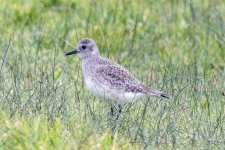
A05BlackBelliedPlover3017.jpg
We also encountered a flock of least sandpipers that were also searching through the short grass and mud for a snack.
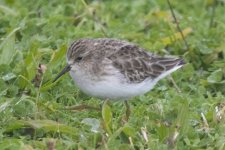
A06LeastSandpiper2977.jpg
As we headed out of the marina area, we passed a flock of cackling geese and a single juvenile snow goose in a large fenced grassy area There were at least two sizes of cackling geese in the flock, indicating the presence of two different cackling goose subspecies. This appears to be the minima subspecies.
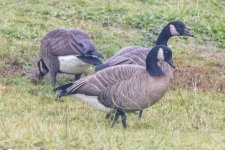
A07CacklingGeeseMinima3002.jpg
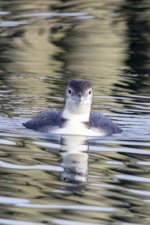
It was partially sunny when we arrived at Westport. Only a few folks were crabbing from the outer dock (float 20) and the wooden walkway atop of the outer breakwater. While the human fishing activity was light, the fishing action by the common loons was intense inside and outside the marina.
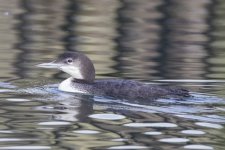
A08CommonLoon3046.jpg
A09CommonLoon3033.jpg
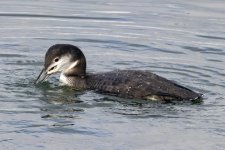
And because they “don’t need no stinking WDFW license”, loons were harvesting crabs and swallowing the evidence.
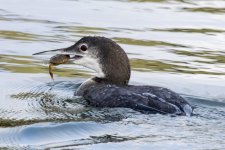
A10CommonLoonWCrab3034.jpg
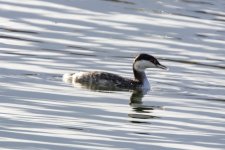
A11CommonLoonWCrab3085.jpgThe loons were joined by horned grebes
A12HornedGrebe2887.jpg
and red-necked grebes.
A13RedNeckedGrebe3138.jpgI have a 40+ year history of birding in Western Washington and in that time, the numbers of pelagic cormorants appear to have increased markedly in the Salish Sea. They have really exploited the Washington Ferry System’s new-style protective barriers as nesting sites. Westport has always been a reliable place to find pelagic cormorants.
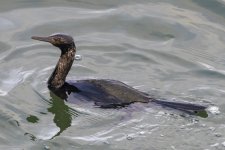
A14PelagicCormorant3107.jpg
In the right light, their feathers glow with a green sheen.
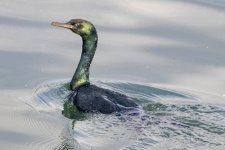
A15PelagicCormorant3129.jpg
They have a characteristic “hop” as they dive. While the loons may have had crabs on the menu, the pelagic cormorant had a fishier diet in mind, specifically a black prickleback (identified by the white line on the caudal peduncle).
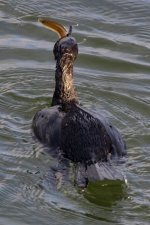
A16PelagicCormorantEatingBlackPrickleback3091.jpg
Steve
 
Great stuff, Steve. Those Pelagic cormorants almost give me the creeps with their reptilian eyes and a green color of a greasy oil slick that no self-respecting Creature from the Black Lagoon would dare wear. Had one pop up right next to me in the marina at Westport one time and instead of taking pics I was looking for a stick to poke it away. They have those alien blank eyes... I am thinking in another lifetime I may have been a prickleback and have good reason to be alarmed by them! I bet an alligator would pass on eating one.

All the cormorants are interesting birds for sure. Brandt's in breeding plumage are nuts.

A summer loon is a woodcarver's dream bird where as a cormorant is a mix and match of a few creations that I am not sure are related..
 
Last edited:
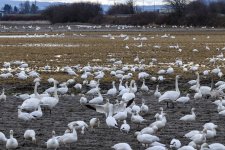
Nisqually National Wildlife Refuge, 6 December 2024. When I think of snow geese, the image that pops into mind are the massive flocks that overwinter in the Skagit farm fields and mud flats, often intermingled with tundra swans
A00aSnowGeeseTundraSwans8650.jpg
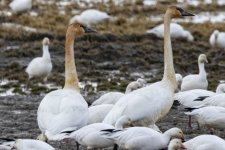
and trumpeter swans.
A00bTrumpeterSwansMixedWSnowGeese8615.jpg
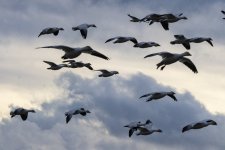
When a flock bursts into flight, they fill the sky like a blizzard.
A00cSnowGeeseInFlight8645.jpg
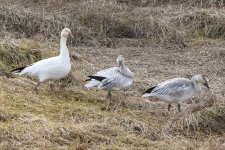
You do not find large flocks of snow geese at Nisqually; instead, large flocks of noisy cackling geese graze the meadows and explode into flight by a passing bald eagle. Some years, there may be a single snow goose mixed in with the cackling geese. This year, an adult snow goose and three juveniles have been hanging out with the cackling geese.
A01SnowGeeseFamily3243.jpg
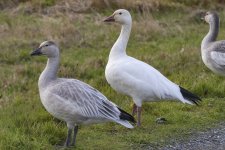
So, I was surprised to find the four snow geese on their own today, without a single cackling goose in sight (or ear) in the whole refuge. The snow geese were right up on the edge of gravel dike (Estuary Trail) that leads to the Nisqually Estuary Boardwalk. In addition to nibbling the fresh green grass at the edge of the trail, I suspect that they may also been consuming some gravel from the trail surface as grit for their crops. While the trail was busy with walkers and birds, the snow geese were wary but determined to hold their position. We walked around them on the trail without looking at them; that might have spooked them if we were that close and were staring at them. But once we were past, I snapped some nice close-ups.
All four birds at Nisqually were all white morphs, possibly a parent and its three offspring from this year. Most snow geese possess one of two color morphs, white or blue. These blue vs. white morphs were originally considered to be separate species. Both have black tips to their wing feathers and pink bills. White morph snow geese are otherwise all white with red legs. Their juveniles are grayer.
A02SnowGooseAdult&Juvenile3309.jpg
Blue morph snow geese have white heads but the rest of their plumage is slate gray. Their juveniles are dark brown.
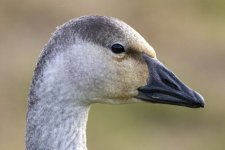
Totally herbivorous, snow geese use the lamellae (ridges) along their bills to tear vegetation, like grass blades, but also tubers, roots, and seeds. The lamellae show well in this head-shot of a juvenile.
A03SnowGooseJuvenileHeadShot3299.jpgThe otherwise white feathers can be stained by iron oxides in the sediment as you can see in this head-shot of the adult (see also the trumpeter swans above).
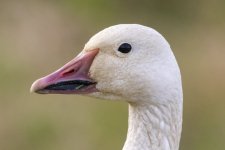
A04SnowGooseAdultHead3313.jpg
The white morph is by far the most abundant color morph in the west (80%+ of the population); blue morphs are more common among the snow geese that overwinter along the Gulf Coast and along the Mississippi River Flyway.
Plumage color is determined by a single gene (called the melanocortin-1 receptor = MC1R) which has two alleles (see interesting article here). This gene produces a protein that controls the synthesis of black / brown melanin pigment by melanocytes in the feathers. Birds with dark alleles produce far more melanin in their feathers.
The dark = blue allele is incompletely dominant over the white allele (back to HS / college Mendelian genetics). Two white morph parents (two white alleles = homozygous recessive) will always produce all white morph offspring. Two dark = blue morph parents that each have two dark alleles (homozygous dominant) will produce only goslings which are all-dark = blue morphs. In general, birds prefer to form long-term pair bonds with birds that have the same plumage as their parent (positive assortative mating), i.e., blue with blue and white with white. But occasionally a blue morph snow goose bird and a white morph bird will pair up. Their offspring will be heterozygous genetically (one dark allele and one white allele) and will be mostly dark = blue but with various degrees of white bellies (hence the “incomplete” dominance between the light and dark alleles). If two of these intermediate birds mate, ¼ of their offspring will be pure white, ¼ will be pure blue, and half will be intermediates.
Steve
 
Last edited:
Thanks for the posting the awesome snow goose photos Steve. A portion of the wintering Skagit Bay snow's migrate from their breeding grounds on Wrangel Island in Russia. There was a joint US/Russia effort to place neck collars on Wrangel snow geese back in the 1990's and early 2000's to track their migration. The bulk of that population winters in the Fraser River Delta.

The blue phase used to be super rare within the Pacific Flyway but has become more common in recent years. These birds primarily nest in the Western Arctic (Alaskan Arctic Plains, Mackenzie River Delta and Banks Island) and winter in California's Central Valley.
 
More great info @Cabezon and @RRSmith on a rather scarce goose species here in the SW corner of the state. We do get a single snow mixed in with canada goose flocks a year like Steve points out. Sometimes might be three or four, but seldom like Steve's family grouping. Yesterday, I had quite a rare sight for here with a full mini- flock of 15 or so snow geese bunched in a fast flyover.

Always exciting to see that. Happens about once every 5 years, or less.

Biggest snow goose flock on the ground I can ever recall this way was about 20 birds.

Missed a photo op last year of 4 trumpeter swans flying by with a single snow goose pulling up the rear in full formation. Could not tell if he was working twice as hard to keep up or trying to stay in the air envelope vacuum from the huge birds in front! It was quite a funny sight.

I see single tundra swans do the same pulling up the rear in a trumpeter flock a couple times a year. Can really see the trumpeter swans bulky mass difference easily when that close together.
 
Last edited:
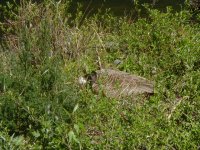
I was participating in a "clean-up" on the South Santiam River in April 2004. Checking an island in the middle of the river, I got that hair raised on the back of my neck feeling. I stood still and surveyed everything around me, when I spotted mama goose sitting on her nest giving me the evil eye.
I backed away and left her alone.
Mama Goose Giving TheCamel The Evil Eye 4-3-2004.JPG
 
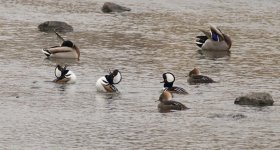
I am used to seeing the occasional/regular smattering of hooded mergansers in the colder months. But this was the first time I had seen them doing some clear mating/pairing behavior. These three males were trying very hard to impress the two females. Hoods fully fanned out, they would extend their necks up as far as possible, and them sometimes rock backwards/upwards for a brief moment.
193-BY-Birds-121224.jpg
 
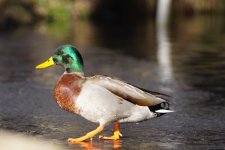
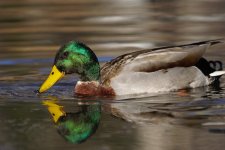
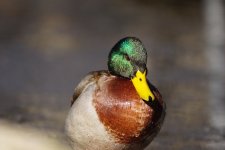
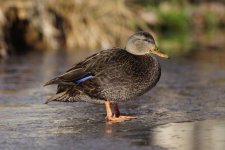
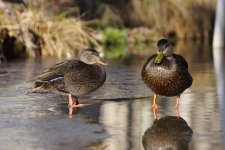
I am completely flummoxed and fascinated by our mallards, I was sure they would be gone by now, but no, this morning there were 6 on the pond when I first went out at daybreak, though typically over the last week or 2, we have 3, an adult drake, a juvenile male and a hen. I now suspect they may stick around all winter.

Mr. Drake is very photogenic, and yesterday did not seem the least bit bothered by my presence.

Struttin' his stuff on the ice:

1734285742642.jpeg


1734286005410.jpeg


1734286202256.jpeg

The Misses

1734286583490.jpeg

With Junior

1734286675274.jpeg

Thank you for indulging me and our ducks (or maybe I'm theirs).
 
Back
Top