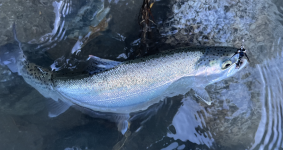
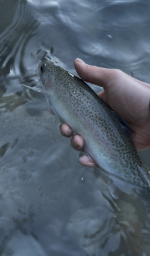
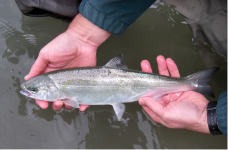
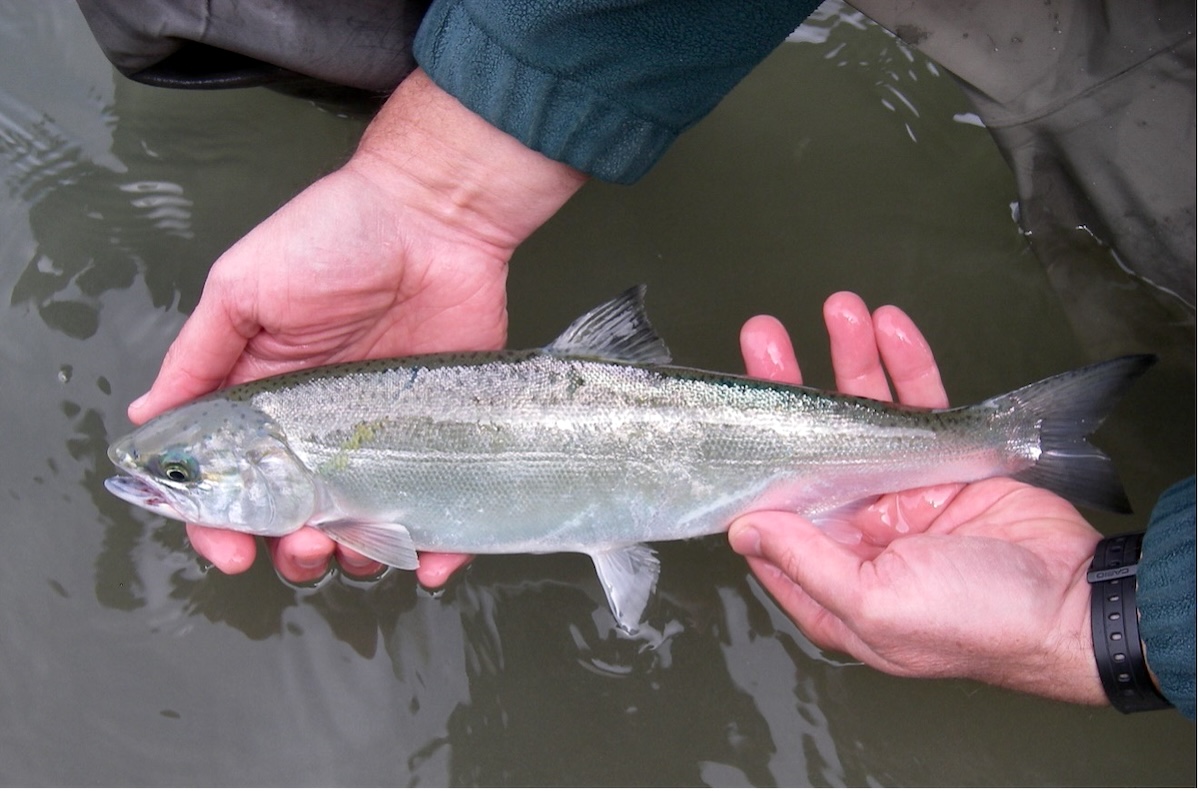
What fish is this?

I'd say jack steelhead - although it does look a lot like a small coho. There's the faintest blush of pink on the operculum. Unless you guys up North have some seriously late run coho.
 
The mouth looks all white so I would say a salty rainbow/steelhead. The tail is hard to see, but if it has spots on the lower half probably another indicator that it's a trout, not a salmon. Those scales seem to have the stuff from the salt that pumps them up and makes them chrome.
My buddy guides on Puget Sound and he's had 3 or 4 clients that have caught salty rainbows. No reason to think a few of them don't do the same thing a SRC does. So 1/2 salts? Who knows...
 
I’m gonna say it might also be a very bright searun cutt.

Edit, except that view of the mouth does say more “mykiss” than “clarkii” to me.
 
An interesting fish!

Based on just that photo and what we know about the various salmonids in the "s" rivers here is my best "guess".

Not a coho; while those rivers have some very late coho (spawning can last through March) by this time of year they would be exhibiting some coloration. Further coho pectoral fins in freshwater tend to be opaque and those in the photo are transparent.

Not a sea-run cutthroat; In the "S" rivers any adult sea-run would have been in freshwater for a couple months and would show some of typical cutthroat coloration. A subadult sea-run could be fairly bright this time of year, but the 15 inches says adult and any such fish would likely be holding/overwintering further downstream.

That leaves us with the fish being an O. mykiss.

While the fly obscures part of the head to my eye it looks to be a female, if so that rules out a Jack steelhead.

In the last 45 years I have seen 3 fish that appeared to have a "half pounder" life history. All 3 where caught on the Skagit (in tide water) in early October any were chrome bright about the size of the fish in question. All 3 fish had migrated that spring and returned 5 months later. I would expect any such fish to have some coloration by this time of year. While it is possible that fish has this life history it would be extremely rare.

That would leave a resident rainbow as the most likely. I agree that by this time of year such fish would have some color, especially if an adult. Generally, a 15-inch resident rainbow in these waters would be a mature fish. This fish has the look of an immature rainbow that took advantage of the very large pink escapement this year. The tendency is for resident fish to experience fall growth spurts for the abundant eggs/flesh. In such cases an immature fish could easily be as large as 15 inches. This is supported by how robust that fish appears to be.

All the above illustrates how dicey the "what is it" game be. As always making that call is helped by several photos and potentially a scale a sample.

Curt
 
The mouth looks all white so I would say a salty rainbow/steelhead.
Good point. Coho gums along the teeth are white, while the outer and inner parts of their mouths are black or dark grey.
The lower jaw is shorter than those of a cutthroat.
I'd agree with rainbow/young steelhead.

Beautiful fish!

Edit to add this pic of a young Puget Sound coho, showing mouth/gum colouration, from the U. of Washington:


1768873276682.png
 
Last edited:
While the fly obscures part of the head to my eye it looks to be a female, if so that rules out a Jack steelhead.


Curt
Curt, what's the tipoff that it might be a female?

Some more food for thought. I seem to remember reading a Pete Soverel article in The Osprey or somewhere years ago where he talked about catching small steelhead in the fall on a dry line below the snoqualmie/sky confluence.
 
Curt, what's the tipoff that it might be a female?

Some more food for thought. I seem to remember reading a Pete Soverel article in The Osprey or somewhere years ago where he talked about catching small steelhead in the fall on a dry line below the snoqualmie/sky confluence.
Dave-
Like the larger adult steelhead, I made the female call based on the head shape and shorter jaw.

I remember Pete making that comment. In the fall or in the salt folks sometimes confuse chrome bright sea-runs (usually immature and/or female sea-runs) as mini steelhead. In those cases, a good way to separate the two is look at the dorsal fin and/or pelvic fins. The dorsal fins of the cutthroat look narrower than rainbows/steelhead. That is due to fewer fin rays: 10 (9-11) for the cutts and 11/12 (10-13) for the bows. On the pelvic fins the cutthroat have 9 fin rays and the bows have 10.

Also, it is common to see chrome small adult summer steelhead (19 or 20 inches) on the various "S" rivers. The portion of the run of those smaller fish varies a lot from year to year. I can remember several years where those small 4-year-old where the dominate portion of the run.

curt
 
Dave-
Like the larger adult steelhead, I made the female call based on the head shape and shorter jaw.

I remember Pete making that comment. In the fall or in the salt folks sometimes confuse chrome bright sea-runs (usually immature and/or female sea-runs) as mini steelhead. In those cases, a good way to separate the two is look at the dorsal fin and/or pelvic fins. The dorsal fins of the cutthroat look narrower than rainbows/steelhead. That is due to fewer fin rays: 10 (9-11) for the cutts and 11/12 (10-13) for the bows. On the pelvic fins the cutthroat have 9 fin rays and the bows have 10.

Also, it is common to see chrome small adult summer steelhead (19 or 20 inches) on the various "S" rivers. The portion of the run of those smaller fish varies a lot from year to year. I can remember several years where those small 4-year-old where the dominate portion of the run.

curt
I was about to say I had caught one of those skagit half pounders last july plunking for sockeye on the skagit in Burlington, only it was more 19-20". Dime bright and clearly salty I'm now wondering if it wasn't a rare skagit summer that had returned as a small 3-4yo.

Fish are cool
 
Dave-
Like the larger adult steelhead, I made the female call based on the head shape and shorter jaw.

I remember Pete making that comment. In the fall or in the salt folks sometimes confuse chrome bright sea-runs (usually immature and/or female sea-runs) as mini steelhead. In those cases, a good way to separate the two is look at the dorsal fin and/or pelvic fins. The dorsal fins of the cutthroat look narrower than rainbows/steelhead. That is due to fewer fin rays: 10 (9-11) for the cutts and 11/12 (10-13) for the bows. On the pelvic fins the cutthroat have 9 fin rays and the bows have 10.

Also, it is common to see chrome small adult summer steelhead (19 or 20 inches) on the various "S" rivers. The portion of the run of those smaller fish varies a lot from year to year. I can remember several years where those small 4-year-old where the dominate portion of the run.

curt
I caught a winter fish like that. A fiesty 21-22 inch fish that took on the 5th strip. Dime bright solstice fish. One of the most memorable fish that I have ever caught.
 

Attachments

  • 395874_2889581166187_1858701980_n[1].jpg
    395874_2889581166187_1858701980_n[1].jpg
    206.7 KB · Views: 50
A 15 inch fish caught today on an S river. Adipose fin indicates it's wild. Trout or One salt steelhead or Jack coho
How many river miles from salt water was your encounter?
Just curious, as it DOES look as if there was some salt in the recent life history of that particular fish. IIRC, there is some good info floating around on amphidromy and partial/delayed migration observations of mykiss
 
Sure seems like the half pounders we get in the Trinity. I've been told that they're mostly unique to N. CA / S. OR systems. I wonder if that has anything to do with ocean temperature down here, and if so, will they become more prevalent further north as the ocean continues to warm?
 
How many river miles from salt water was your encounter?
Just curious, as it DOES look as if there was some salt in the recent life history of that particular fish. IIRC, there is some good info floating around on amphidromy and partial/delayed migration observations of mykiss
This fish was approximately 20 miles upstream from the salt water.
 
Sure seems like the half pounders we get in the Trinity. I've been told that they're mostly unique to N. CA / S. OR systems. I wonder if that has anything to do with ocean temperature down here, and if so, will they become more prevalent further north as the ocean continues to warm?
I agree every time I see this posted my first thought is “half-pounder”.
 
Back
Top