WDFW to end two early winter hatchery steelhead (chambers creek) programs

I am for opportunity. And this region (region 4) the worst of them all. We need every opportunity we can get. A big thanks to to all those involved in getting the chum salmon numbers back on the sky. If you don’t try you will always fail.
 
It seems like all the reports are great success down here in Oregon with the broodstock programs on the Sandy and Nehalem rivers, with plans to expand the programs
 
Just dropping in to say I recall a guy I (barely) know referring to Chambers Creek hatchery steelhead as "bananas." Always made me laugh, but I think he was right. Not all fish (even hatchery fish!) are created equal. I never had a ton of trouble making them bite, but their average size barely qualifies most of them as adult steelhead. I suppose that's a consequence of choosing a stock that returns fish perennially (as frequently as possible), albeit at a relatively diminutive size and quality compared to a typical wild steelhead.

All that said, opportunity is opportunity anymore. As @Salmo_g said, returns from the ocean generally suck for all steelhead, regardless of origin, so I have learned to think of whatever I can fish for as "good enough." Any hatchery program shut down at this point translates very nearly directly to the sport fisheries they support being shut down next. If it actually (meaningfully) benefitted wild steelhead, I would be all for it, but alas, all it seems to create is new petting zoos for endangered species that have no chance of recovery, while reducing our opportunity to fish for SOMETHING that much further.

All I ask is that we find a better solution before we eliminate one more of the last things we have that creates even the pathetic steelhead fishing opportunity we have left. Of course, I know that's too much to ask....
 
Question for the bios @Smalma or @Salmo_g
To your knowledge, has WDFW ever attempted to raised hatchery steelhead in saltwater net pens to larger sizes prior to release in hopes of better smolt survival? Raise them until they are ready to smolt then transfer them to saltwater net pens.
Would they imprint to the stream they came from or back to the site of the pens? Likely an expensive endeavor but I was just curious if something like this was even possible.
Thanks for your input.
SF
 
Question for the bios @Smalma or @Salmo_g
To your knowledge, has WDFW ever attempted to raised hatchery steelhead in saltwater net pens to larger sizes prior to release in hopes of better smolt survival? Raise them until they are ready to smolt then transfer them to saltwater net pens.
Would they imprint to the stream they came from or back to the site of the pens? Likely an expensive endeavor but I was just curious if something like this was even possible.
Thanks for your input.
SF
This doesn't exactly answer your question but-- Your idea would cut out the hatchery smolts' stream residence (usually pretty limited for most hatchery smolts) or stream migration, but I don't think that life stage is a limiting factor for Puget Sound steelhead, so it probably wouldn't accomplish much in any case.

When are they going to release the wandering lake smolts for Smoltzapalooza 2?
 
This doesn't exactly answer your question but-- Your idea would cut out the hatchery smolts' stream residence (usually pretty limited for most hatchery smolts) or stream migration, but I don't think that life stage is a limiting factor for Puget Sound steelhead, so it probably wouldn't accomplish much in any case.

When are they going to release the wandering lake smolts for Smoltzapalooza 2?

Matt,
I believe the marine stage is the most limiting. Would we have better survival rates with bigger and hopefully healthier smolts or just bigger smolts for seals to eat?
SF
 
Matt,
I believe the marine stage is the most limiting. Would we have better survival rates with bigger and hopefully healthier smolts or just bigger smolts for seals to eat?
SF
Oh I see, you take them from freshwater rearing pens to saltwater rearing pens and grow em up big before release? Huh, yeah that’s an interesting question. If you went too big you might get a bunch of “half salts” that “decide” they’re big enough and ready to spawn and head right back, maybe after a little estuary time. Those would be fun on a trout rod.
 
Question for the bios @Smalma or @Salmo_g
To your knowledge, has WDFW ever attempted to raised hatchery steelhead in saltwater net pens to larger sizes prior to release in hopes of better smolt survival? Raise them until they are ready to smolt then transfer them to saltwater net pens.
Would they imprint to the stream they came from or back to the site of the pens? Likely an expensive endeavor but I was just curious if something like this was even possible.
Thanks for your input.
SF
I'm not aware of WDFW doing that, but acquaculturists (sea farms) have taken steelhead smolts from freshwater hatcheries to saltwater pens. Then the Legislature passed a law a few years ago prohibiting it. Growing them larger and then releasing them from the saltwater pens would throw the fish off on their timing, as steelhead smolts migrate rapidly downriver and out of Puget Sound. Their travel time in the Sound is only a week or two, depending which river they come from, with Nisqually taking the longest. They would be larger prey for seals, but also faster swimmers, so I'm not sure how that math works. We know that seals do capture adult salmon and steelhead too.

The fish are imprinted to their hatchery and would seek it out, by way of the net pens, retracing their route out of the Sound as best we know. But their fidelity to the river of origin would be less due to not having out-migrated through it.

To answer your question, yes, it is possible. But it's not possible to know if it would produce better results overall without trying it.
 
I'm not aware of WDFW doing that, but acquaculturists (sea farms) have taken steelhead smolts from freshwater hatcheries to saltwater pens. Then the Legislature passed a law a few years ago prohibiting it. Growing them larger and then releasing them from the saltwater pens would throw the fish off on their timing, as steelhead smolts migrate rapidly downriver and out of Puget Sound. Their travel time in the Sound is only a week or two, depending which river they come from, with Nisqually taking the longest. They would be larger prey for seals, but also faster swimmers, so I'm not sure how that math works. We know that seals do capture adult salmon and steelhead too.

The fish are imprinted to their hatchery and would seek it out, by way of the net pens, retracing their route out of the Sound as best we know. But their fidelity to the river of origin would be less due to not having out-migrated through it.

To answer your question, yes, it is possible. But it's not possible to know if it would produce better results overall without trying it.

Sg
Thanks for the reply.
SF
 
Not all fish (even hatchery fish!) are created equal. I never had a ton of trouble making them bite, but their average size barely qualifies most of them as adult steelhead. I suppose that's a consequence of choosing a stock that returns fish perennially (as frequently as possible), albeit at a relatively diminutive size and quality compared to a typical wild steelhead.
Shad,

As a relative newcomer, you missed seeing what the Chambers Creek hatchery steelhead program provided over the course of its history. Before the Department started making each basin hatchery develop its own local broodstock, almost all juveniles came from Chambers and South Tacoma as fry. And then they were transferred to the various rearing ponds on the Stilly, Skagit, Sky, Snoqualmie, Green, etc., where they were reared until release. That was the original strategy because Chambers and S. Tacoma have significantly warmer water, which got egg incubation and initial fry rearing off to a faster start, so that the juveniles would reach smolt size by the next spring for release. From the 60s, 70s, and into the 80s, Chambers Creek adults averaged 6 pounds (or larger) for 2-salt fish and 12 pounds for 3-salts. While they weren't as pretty as wild fish, it was hard to tell a hatchery 3-salt from a wild fish except for its stubbed dorsal fin. They have become smaller, along with the reduced marine survival rates. The ocean has become less generous to salmon and steelhead over the past 30 years.

 
@Salmo_g
Were the 8 lb winter cookie cutters that returned to the Sky & Stilly in December of the 90s Chambers Creek stock?
They were always pretty fish, even though they were hatchery. Every now and then you might get a 4 or 5 pound skinny one, but the 8 lbers were always nice. The ocean was definitely better then!
 
Skyriver,

Yes, those were Chambers stock. But the program had shifted by then to each river's hatchery using returns to that facility as broodstock.
 
Salmo_g pretty much covered the potential of additional rearing of steelhead in sea-water net pens. In addition, a few more weeks (even months) of rearing prior to release still would not achieve the size needed to avoid in Sound predation (seals?).

And yes, those early winter hatchery fish (Chambers Creek) did support significant fisheries. During the winter of 1984/85 the recreational and tribal fisheries took nearly 22,000 hatchery fish (10,992 to the rec and 10,997 to the tribal) with an additional 4,392 returning to the hatcheries. As I recall the Snohomish/Skykomish/Snoqualmie supported 60,000 angler trips during the winter season. Yes the river was crowded.

Curt
 

Shad,

As a relative newcomer, you missed seeing what the Chambers Creek hatchery steelhead program provided over the course of its history. Before the Department started making each basin hatchery develop its own local broodstock, almost all juveniles came from Chambers and South Tacoma as fry. And then they were transferred to the various rearing ponds on the Stilly, Skagit, Sky, Snoqualmie, Green, etc., where they were reared until release. That was the original strategy because Chambers and S. Tacoma have significantly warmer water, which got egg incubation and initial fry rearing off to a faster start, so that the juveniles would reach smolt size by the next spring for release. From the 60s, 70s, and into the 80s, Chambers Creek adults averaged 6 pounds (or larger) for 2-salt fish and 12 pounds for 3-salts. While they weren't as pretty as wild fish, it was hard to tell a hatchery 3-salt from a wild fish except for its stubbed dorsal fin. They have become smaller, along with the reduced marine survival rates. The ocean has become less generous to salmon and steelhead over the past 30 years.
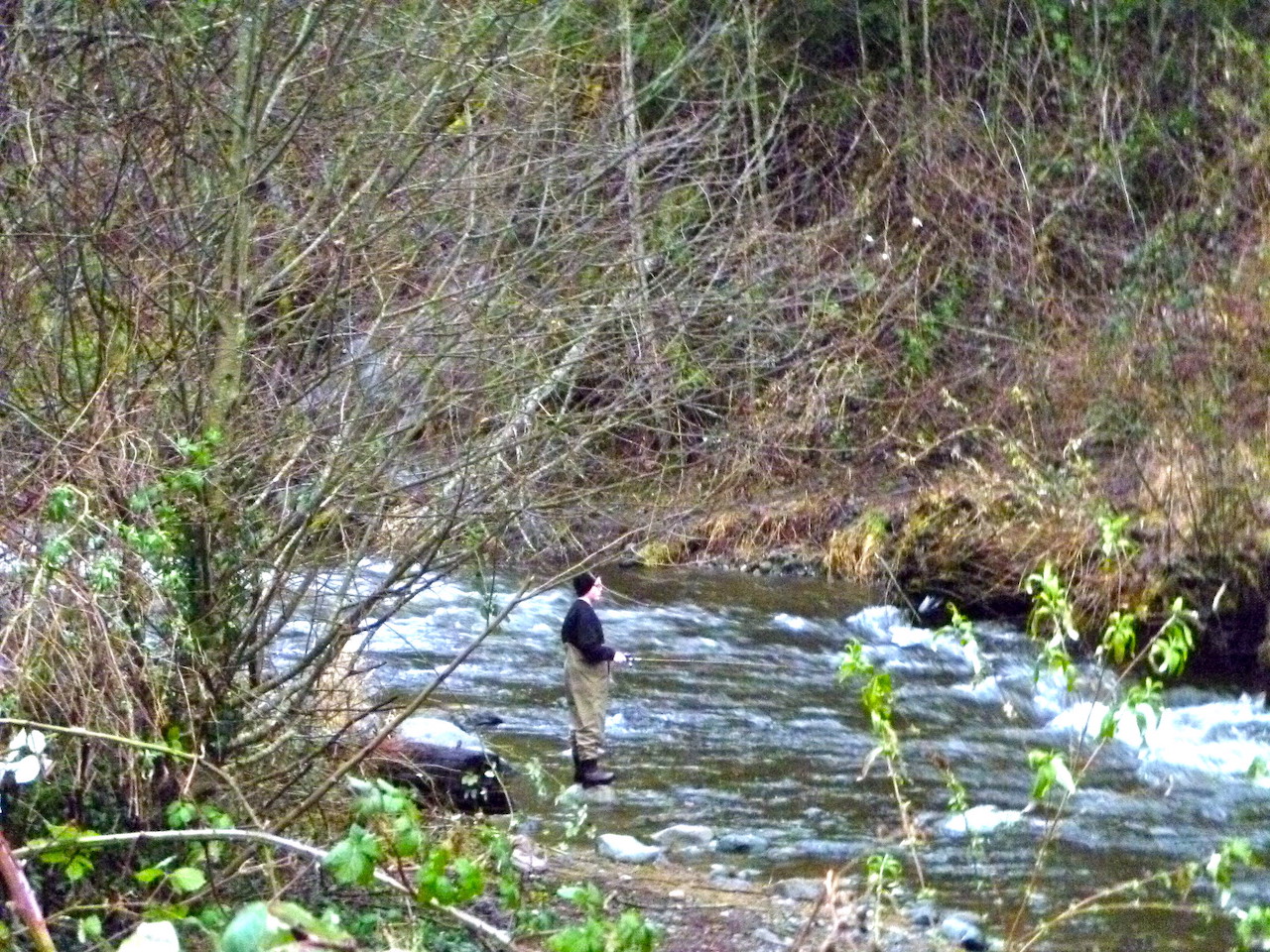
Indeed, relatively speaking, I am kind of a newcomer. I've also never fished the Sound rivers for them; just the early fish on the OP. A big one is 10 pounds there anymore, and most are less than half that. Looks like that Puget Sound stock produces (albeit few) better specimens in Puget Sound rivers. Go figure...

Thanks for the lesson on the origins of the program and the reasons for selecting Chambers stock. Very interesting.
 
The hatchery fish are smaller and the wild steelhead are smaller too. Maybe it is not as striking as chinook stocks, with how quickly they reduced their average size on return, but it is still substantial. Catching a teener wild steelhead these days is actually a pretty rare fish for a weekend warrior. It's been awhile since I have held a legit 20 lb winter steelhead, but it isn't that long ago when I'd catch one or two every year. I did it on consecutive casts about 20 yrs ago. I'm not even all that good of a steelheader, granted access on the big fish rivers has really tanked, but the fish seem to have smallened significantly,

fb
 
Slightly off topic but I see the whole snohomish system being closed until September in the near future. I'm not sure what we are supposed to fish for if they only plant 23k summers and we can't fish for hatchery kings because we might catch a wild one.
 
Slightly off topic but I see the whole snohomish system being closed until September in the near future. I'm not sure what we are supposed to fish for if they only plant 23k summers and we can't fish for hatchery kings because we might catch a wild one.
That's where the Nooksack was this year. Emergency closure til end of Aug (mainstem) and Sept (forks). I highly suspect it will continue to happen in years to come.
 
WDFW could screw up anything.
They are allergic to work and common sense.
Pathetic what they have become.
Normally I would have said “Bingo” or dead nuts on. But I got a chance to talk to a couple of hatchery guys at Reiter this year and they were hard working guys that wanted to make things better. And then there is the guys at wallace hatchery trying to bring back the chum run. So only a few maybe but some wdfw actually care. and BS on hatchery fish ruining the wild fish runs.
 
Back
Top