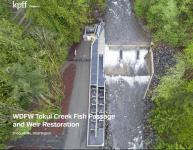
WDFW to end two early winter hatchery steelhead (chambers creek) programs

the_chemist

Life of the Party

I don't like this one bit. Unless the current seasons get extended into spring, there will be no opruntity to target tokul creek returning fish.
 
I dunno, I am not anti hatchery and support them for providing opportunities for us... but Chambers Creek fish are the one exception to that. They are just so expensive to put out there, and have extremely low return rates. They also tend to just shoot straight to the hatchery, providing minimal opportunity. Lastly, they seem to be much more tigh-lipped than other steelhead strains.
 
I would tend to agree. The problem is unless the winter steelhead season is extended into march/April on the snohomish/snoqualmie system, the wdfw has effectively turned that season into 1-2 weeks. Sure you can fish Thanksgiving, there's just a 0.0001% chance of encountering a steelhead.
 
I don't see us ever fishing the Snohomish systems (Skykomish or Snoqualmie) in March or April ever again - there is zero want too from the Department and they would have to invest so much money and time to get approvals from the Feds on that system, that the juice will not be worth the squeeze.
To the crowd that just says close it down and let them come back - I give you the Skykomish ................................. Closed in like 1997, and no one cares about that fishery or even knows much about it anymore. Its less work for Region 4 to just close it down and work on something else in the Spring

what a great river it was in February and early March
 
An integrated hatchery steelhead program using wild broodstock will not enhance the long term conservation of wild steelhead if it occurs in the presence of a non-selective gillnet fishery. With identical run timing, hatchery and wild fish will be harvested at the same exploitation rate, thereby leading to chronic under-escapement of wild fish. It is what happens in the real world. The notion that since both the hatchery and wild fish share the same genetics makes this OK is stupid. It's not the genetic origin of the fish, but rather the very process of hatchery incubation and juvenile rearing that makes the hatchery fish less well adapted to life in the natural environment.

I understand that Chambers Creek steelhead have exhibited low SAR (smolt to adult return) rates for the last decade or so, but that is only partly a factor of the stock. The rest is marine survival rates, which have been poor for hatchery and wild fish alike for the past 30 years now. I think WDFW should hang on to at least one group of the Chambers Creek stock as a "just in case" for unanticipated future conditions. My understanding is that Tokul Creek has generally shown the highest SAR of any of the Puget Sound population segments. If that is the case, then Tokul Creek is the last population segment that should be discontinued.

Unless I'm missing something, this proposal appears to be a plan that will further reduce the viability of Snohomish basin wild winter steelhead.
 
NEWS FLASH1 - Election results are in and by a large margin PS ESA listed salmonids (Chinook, steelhead, summer chum, and bull trout) have voted that the current recovery efforts have been a failure! The chum voting block was split with some support coming from the summer chum. Huge majorities of the Chinook, steelhead, and bull trout stocks voted that fed, state, com-manager recovery efforts have failed them.

Unfortunately, these votes are only advisory, and our decision makers are free to continue to ignore the fish's input.

This latest decision illustrates that co-managers have thrown the towel in on habitat recovery for another steelhead population and are falling back on the hatchery solution.

Curt
 
Broodstock... In the Snoqualmie? Haven't we been mixing in hatchery fish from Tokul Creek for a hundred years now. It does appear that quite a bit of work has gone into renovating the facility recently and that is a good sign that the state may give the broodstock program a real effort here.

1730306203058.png

I plucked my first fly caught Steelhead in the cable hole 38 years ago. My ashes will one day go over the falls and become one with this river as has my mother and sister before me. Hundreds of steely's have come to hand here over the years with only a few being what appeared to be real native fish. That said, I mostly just went to get a couple of brats for the bbq and enjoy the morning on the water. Years ago you could almost guaranty two fresh hatchery fish in December. Not so much these days. It has been clear to me over the last decade that what we were doing (lower and lower #'s of smolt plants) aren't working. While I personal lament the end of this program and oppertunity, we can only hope that selecting the most pure strains specimens for broodstock can improve things down the road and open up a better quality fishery. Maybe this is just a pipe dream...

The selfish hypocrite in me would increase the Chambers plants to 150K-250K and go on pretending that everything in just fine.
 
I dunno, I am not anti hatchery and support them for providing opportunities for us... but Chambers Creek fish are the one exception to that. They are just so expensive to put out there, and have extremely low return rates. They also tend to just shoot straight to the hatchery, providing minimal opportunity. Lastly, they seem to be much more tigh-lipped than other steelhead strains.

Pretty much my position. Chambers Creek stock are, I think, representative of many hatchery stocks that have been heavily fished for decades. And not just steelhead. I can think of a few coho programs that produce essentially uncatchable fish.

I'm sure there are alternate interpretations for early, shoot-to-the-hatchery returns, poor biting, and other negatives. So this may be overly simplistic, but what else should we expect when the hatchery spawns fish that (1) tend to not linger in the system {tend to not be caught}, and (2) fish that tend to not bite {tend to be not caught}. How can these NOT be selective factors?

If we are going to do hatchery fish, let's do them right. Barring adverse run timing effects with wild stocks, it would seem a lot smarter to select for hatchery fish that provide better in-river sporting opportunities. For example, sport collecting hatchery brood stock like is already being done with some wild stocks (but ONLY hatchery origin fish). Or even a program where sport caught fish are tagged with information on where/when/how the fish was caught. Any that make it back to the hatchery would give the staff at least some basis in run timing and sport quality to select spawning stock.
 
Last edited:
Sad that we may lose this fishery.

I can personally confirm that Tokul still has some years that produce fish in catchable numbers, even though of course it is a fraction of what it used to be due to the reduced plants. The survival rate there is definitely higher than at Reiter or Whitehorse for some reason.

I wish WDFW let sport anglers give their feedback before coming to decisions like this. I personally do not care about getting all worried about the genetics of hatchery fish. I’m happy with catching dumb brats as long as they comeback in numbers large enough for us to have a decent chance to catch fish.
 
Last edited:
@Smalma Are there any successful "integrated broodstock winter steelhead program" out there?

I'm doubtful, but would love to hear about any success stories.
 
There should be some information as to how these work.

The Vedder in BC does an intergrated hatchery program. It seems to produce fish. I don't know if it is "succesful". Oregon has a few, I believe. There was once one on the Chehalis. I think that the Cowlitz may be doing one as well?

@Salmo_g had a really smart comment. If these fish are to be used for a commercial harvest opportunity then it's an awful idea. There will be a whole lot fewer wild fish as a result.
 
I’m not sure how much of a success it was because I don’t think it was really monitored, but I caught some nice broodstock fish out of the Snider creek program on the Sol Duc.
That program ended I believe when they made the Sol Duc a gene bank stream. It may have been moved over to the Bogie, but I’m not sure as I’ve been out of the steelhead game for a while.
SF
 
@Smalma Are there any successful "integrated broodstock winter steelhead program" out there?

I'm doubtful, but would love to hear about any success stories.

As others have said the question of "success" depends on how we define success. One of the problems is many of the so-called brood stock programs lack the kinds of information to provide the data to answer that question.

The culture has progressed that in most cases hatcheries used wild brood stock can produce at least some fish that will migrate to and return from the ocean. One question that can vary quite bit is how representative the product of such programs actually represents the parent. Those changes occur because of the selective pressure of the hatchery environment is different than that the fish would experience in the wild. Remember for steelhead the period the juvenile fish are in the hatchery are for two years or at best one year with compressed rearing (most of our wild steelhead spend two years freshwater before becoming smolts.

One of the largest challenges that is rarely talked about how many wild fish must be removed from the wild population (mining of the wild fish) to assure a genetic representative of the wild population and how that would balance with the desire to limit the hatchery/wild interactions (usually done by limiting the number of smolts to be released. The answer to those questions often means that more eggs will be taken than needed. It is hard for users and managers to accept that not using a significant portion of the eggs taken.

If the success standard to successfully raise the fish, produce adequate adults to fish on, and not have excessive genetic interactions with the wild population than I don't know of any successful programs.

Such programs do not "fix" the underlying conditions limiting the wild population and if fact often produce a situation giving that those limiting factors do need addressed.

Curt
 
With returns and survival so low I wonder why WDFW keeps the Puget Sound hatcheries around. I would like to see more fish in them rather than less, but the economic and political will isn't there it seems like
 
Quinault, Queets/Salmon, Sol Duc Snider program(now gone) and the Wynoochy,(I think, Chehalis system now gone as well) are or where successful, and Oregon has several.
Then there is the Summer run program on the Skykomish thats taking a couple wild fish from the SF trap for a broodstock(72 this yr). Ya, thats working well, it will take a century to replace what the Skamaina program did with how few fish are being used!

But the real question is, of those fish taken would they have produced more fish naturally, and are we willing to lose those fish to harvest a few hatchery fish?
 
With the switch to a local wild brood stock will assure that there will be significant over-lap in both run and spawning timing between the returning hatchery fish and the ESA listed wild steelhead. The feds will need to approve a "take" permit to collect the brood stock and based on what was seen on the Skagit before any fishing occurs the co-managers will need to develop, submit, and get approved Snoqualmie/Snohomish steelhead management plan. Do not expect that to be quick process!

Further I would expect that such a plan will contain threshold levels and the associated allowed impacts. Looking at recent Snoqualmie wild steelhead escapements I expect that the majority of the time the forecasts will be such that directed fishery at those hatchery fish would be unlikely. That is of course unless the parties agree that the hatchery and wild fish are parts of the same population; then the managers can replace expected escapement shortfalls with hatchery fish. In either case any significant increases in natural origin recruits (NORs) will require the same improvements in habitat and climate conditions that were limiting the early time segregated program.

Remember just as on the Skagit the allowed impacts will be divided (after brood stock collection) will be divided equally between the recreational and tribal fisheries.

Curt
 
Reading between the lines of the news release it seems that these closures are being pushed by NMFS. I base this on the fact that the closure are happening end of 2024 regardless of other plans, and that WDFW is "developing" a plan for the Snoqualmie and still in talks about what to do on the Dungeness. It's not clear to me why these discussions are occurring now, maybe part of the 5 year review that best I can tell is a couple years over due?

Some of the responses here have surprised me. I am not sure if the negativity comes from the elimination of an early hatchery run, which I would find ironic given some of the conversations over the years on the old board, or plans to start a wild broodstock, or maybe a combination of both. I understand the concerns about a non-selective fishery on overlapping runs. It is valid. But have we heard anything from the Tulalips suggesting that is what they intend to do? It could be and probably is likely, but I will hold my concern on that until I see an actual plan.

I am neutral to slightly excited about the news. I like the idea of trying something new in Puget Sound. It seems somewhat consistent with the Quicksilver recommendations, though clearly on a different system. If the broodstock plan gets tribal buy in that helps make a spring fishery happen in the (far?) future all the better.
 
We have learned an incredible amount about the differences between hatchery and wild steelhead, and the effects of hatchery fish on wild fish, over the last 20 years or so. With that knowledge, the notion of creating integrated hatchery populations with wild broodstock strikes me as one of the very worst possible ideas. Remember, even Chambers Creek steelhead were originally all wild fish long before they became all hatchery fish. The only reasonable situation for an integrated program would be a situation analogous to the California condor, where the hatchery is used solely for the purpose of rebuilding the wild population to the point that it can sustain itself. Any use of the integrated program to support harvest - being subject to human instincts - pretty well dooms the likelihood of wild stock recovery.

Recovery of a wild population depends on two critical elements: habitat recovery and suppression of harvest on the recovering population. Over the last 30 years, Oregon and Washington have demonstrated the repeated inability to resist over-harvesting ESA listed threatened and endangered populations. As Smalma noted above, the listed populations have voted; they are not recovering. In most cases (summer chum excepted) they are continuing to decline because the critical habitat they depend on, including marine waters, is not recovering.

Many will tout the success of integrated hatchery-wild broodstock programs, often exemplifying the Quinault and Queets as run by the Quinault Tribe. However, those fish have voted also: the wild populations are NOT increasing. You can take broodstock from a wild population into a hatchery. That act alone will select the offspring that are best adapted to hatchery rearing while weeding out those that are only suited to rearing in the natural environment. This is not an avoidable condition no matter how much we want it to be. The process will return an adult that is almost, but not quite, as bad as a Chambers Creek fish reproducing in the natural environment. It won't be quite as bad as the Chambers fish because it will still retain wild stock run and spawn timing. However, its hatchery rearing heritage is likely to depress the spawning success of any wild fish that it mates with.

I'm kind of dazed and amazed that conversations promoting this kind of program is still being floated around. Perhaps the new motto of WDFW should be: "Striving for failure, and getting there sooner."

 
We have learned an incredible amount about the differences between hatchery and wild steelhead, and the effects of hatchery fish on wild fish, over the last 20 years or so. With that knowledge, the notion of creating integrated hatchery populations with wild broodstock strikes me as one of the very worst possible ideas. Remember, even Chambers Creek steelhead were originally all wild fish long before they became all hatchery fish. The only reasonable situation for an integrated program would be a situation analogous to the California condor, where the hatchery is used solely for the purpose of rebuilding the wild population to the point that it can sustain itself. Any use of the integrated program to support harvest - being subject to human instincts - pretty well dooms the likelihood of wild stock recovery.

Recovery of a wild population depends on two critical elements: habitat recovery and suppression of harvest on the recovering population. Over the last 30 years, Oregon and Washington have demonstrated the repeated inability to resist over-harvesting ESA listed threatened and endangered populations. As Smalma noted above, the listed populations have voted; they are not recovering. In most cases (summer chum excepted) they are continuing to decline because the critical habitat they depend on, including marine waters, is not recovering.

Many will tout the success of integrated hatchery-wild broodstock programs, often exemplifying the Quinault and Queets as run by the Quinault Tribe. However, those fish have voted also: the wild populations are NOT increasing. You can take broodstock from a wild population into a hatchery. That act alone will select the offspring that are best adapted to hatchery rearing while weeding out those that are only suited to rearing in the natural environment. This is not an avoidable condition no matter how much we want it to be. The process will return an adult that is almost, but not quite, as bad as a Chambers Creek fish reproducing in the natural environment. It won't be quite as bad as the Chambers fish because it will still retain wild stock run and spawn timing. However, its hatchery rearing heritage is likely to depress the spawning success of any wild fish that it mates with.

I'm kind of dazed and amazed that conversations promoting this kind of program is still being floated around. Perhaps the new motto of WDFW should be: "Striving for failure, and getting there sooner."
@Salmo_g
I remember reading about an Oregon program where the integrated hatchery fish spawning in the wild were far more ssuccesful than Chambers fish. If memory serves it was like 80% as succesful as wild fish and that the effects of the hatch environment on succesive generations tended to go away quickly.

Is there new or better science on the issue? I would love to read any actual science on this.

I also think that there may be an opportunity to use downstreamers and nurse them back to health and spawn them the second year like the Hamma Hamma "hatchery". There is a lot of money being spent opening up habitat behind barriers. This strikes me as a chance to enhance the seeding of some of those areas. Maybe this is just the dreamer in me. I'm sure you'll tell me if that is a bad idea.
 
@Salmo_g

Also, I'm completely back into Canada!
 
Back
Top