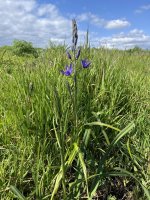
Common camas (
Camassia quamash), a member of the lily family, is common in the remnant prairies in the South Puget Sound area. In the spring, a great place to see the blooms up close and personal is the Mima Mounds Natural Area Preserve near Rochester.
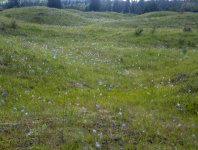


In spring, you also zoom past dense patches of common camas in the grassy medians along I-5 between Lacey and Centralia (e.g., the northbound Scatter Creek Rest Area and surrounding meadows). They are also common in the balds (grassy patches near rocky outcrops) in the San Juan Islands.
Most camas flowers are blue
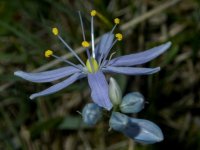
but you will encounter the occasional plant that produces white flowers.

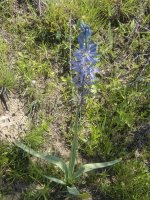
Giant camas (
C. leichtlinii) is less common. I think that I have encountered it among the Manastash Mounds above Ellensburg (not 100% convinced that I have the id correct).
Camas meadows were / are actively managed by family groups from PNW tribes. In spring, foragers used t-shaped digging sticks to harvest the bulbs when the blue blossoms were still visible. Camas bulbs were a staple food, an important trade item, and a key cultural symbol of spring (“First Foods” ceremonies). Management of the meadows included controlled burns, replanting of smaller bulbs, and selective harvesting to enhance sustainability.
Even though native harvesters would actively weed out death camas (
Toxicoscordion venenosum) from these prairies, you can find scattered plants at Mima Mounds, albeit at much lower density than common camas. In my experience, death camas blooms a few weeks later than common camas, more like late spring / early summer. The white flowers are very different in appearance from common or giant camas (even the white morphs).
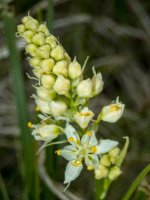


Consumption of as few as two death camas bulbs can lead to nausea, vomiting, irregular heart rhythm and low blood pressure, coma, and death in the extreme (and a very bad few days at a minimum). Treatments typically attempt to alleviate the symptoms. The highest zygacine concentrations are found in the seeds and in the bulbs. The zygacine toxin (a steroid-like molecule) is unaffected by time or cooking. When ingested, the toxin blocks voltage-gated sodium channels and sodium levels in a nerve or muscle cell increase. This results in repetitive nerve stimulation and increased muscle contraction. Grazing animals, especially sheep, are very susceptible to poisoning by death camas if the bulbs are ingested. Because even its pollen is toxic, it is primarily pollinated by a specialist bee, the death camas miner bee.
Steve