Wapato

Stonedfish

Known Pluviophile
Forum Supporter
Has anyone on the board ever harvested or eaten wapato?
If so, just curious on your thoughts on its flavor, texture etc.
SF

 
Has anyone on the board ever harvested or eaten wapato?
If so, just curious on your thoughts on its flavor, texture etc.
SF

Yes. I posted about it once. If you scroll down I describe my impression of it. https://pnwflyfishing.com/forum/index.php?threads/what-are-you-eating.2144/page-14#post-73544

@Pink Nighty was telling me about gathering camas and cooking it in a sous vide. Camas is still on my list. I have not had a chance to try it yet.
 
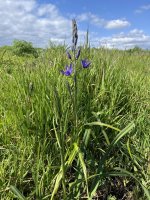
Camas is cool and pretty common! Learn to spot the flowers in may-june and they kinda show up everywhere that isnt mowed. If you harvest, select flowers with large, thick stems as they will be larger bulbs, bulbs are 4-6 inches below the surface.

Cooked at 180 in the sous vide til brown and syrupy, they are potato like, but gummies and denser. They are super filling and apparently really high in protein. The syrup is mildly sweet but could be condensed into something similar to other syrups I think.

I did once deep fry some thin slices of cooked camas for chips and I dont reccomend that.
 
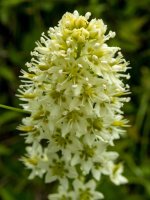
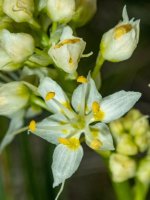
Be sure and stick to the blue flowering Cammasia quamash, as the white flowering one is deadly, in fact it's called Death Camas...(Toxicoscordion venenosum). Botanical name leaves little doubt, eh ?
Foliage is very similar in appearance when not in flower.
 
Camas is cool and pretty common! Learn to spot the flowers in may-june and they kinda show up everywhere that isnt mowed..

I find this really interesting because I know what it looks like and I actually don’t see it. But I live in the city. However I know a lot of plant nerds and it seems like it’s viewed as an increasingly rare plant. At least compared to historic conditions. I don’t know, maybe you happen to live in a low-pro camas stronghold. Or it’s just a lot more common still in N Sound.
I have a small bed in my front yard of common and great camas and it needs thinned so I know where I could get some bulbs. I don’t have a sous vide but Xmas is coming and ‘Merica (China)! Maybe.
 
I definitely live in a rural area with a significant amount of fields used for hay. I mostly dig mine on BP conservation grounds
Are you finding common camas?

Ok here’s a funny urban camas story. A few years back I was playing with the kids at a local park and ran down a hill that they don’t mow and hit some hole and fully rolled my ankle. I was in a bad way for a bit and had my little kids there, alone. It all worked out in the end.
But fast forward a couple years and I’m on the same hillside in spring and I’m seeing camas here, camas there…sparse great camas everywhere! Clearly a planting since the hillside is part of a buried reservoir. I think I rolled my ankle on an urban guerilla camas planting pit.

IMG_3843.jpeg
 
I find this really interesting because I know what it looks like and I actually don’t see it. But I live in the city. However I know a lot of plant nerds and it seems like it’s viewed as an increasingly rare plant. At least compared to historic conditions. I don’t know, maybe you happen to live in a low-pro camas stronghold. Or it’s just a lot more common still in N Sound.
I have a small bed in my front yard of common and great camas and it needs thinned so I know where I could get some bulbs. I don’t have a sous vide but Xmas is coming and ‘Merica (China)! Maybe.
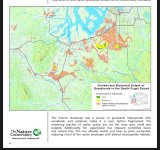
Canas prairies are ever more rare, what with subdivision developments and all.
 
Canas prairies are ever more rare, what with subdivision developments and all.
This is how you get developments using the naming convention of “resource impacted” + “aspirational term” e.g.
Wapato Way
Camas Circle Ranch
Elk Run Gardens
Orchard Grove Court
…etc…
 
Salmon Way
Steelhead Drive
Sculpin Circle
Flounder Flats. . .

Ok so maybe not Flounder Flats
 
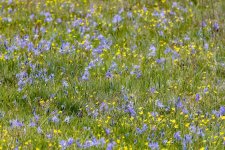
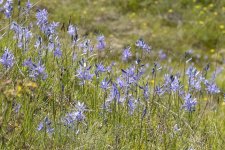
Common camas (Camassia quamash), a member of the lily family, is common in the remnant prairies in the South Puget Sound area. In the spring, a great place to see the blooms up close and personal is the Mima Mounds Natural Area Preserve near Rochester.
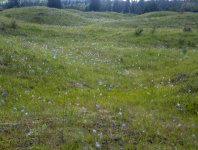
A01CamasMeadowP5140060.jpg
A02CamasButtercups0203.jpg
A03CamasBlossoms1978.jpg
In spring, you also zoom past dense patches of common camas in the grassy medians along I-5 between Lacey and Centralia (e.g., the northbound Scatter Creek Rest Area and surrounding meadows). They are also common in the balds (grassy patches near rocky outcrops) in the San Juan Islands.
Most camas flowers are blue
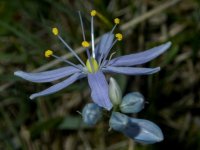
A04Camas_4180025Trim.jpg
but you will encounter the occasional plant that produces white flowers.
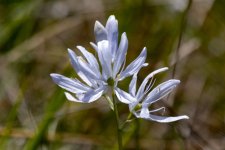
A05CommonCamasWhiteMorph0251.jpg
Giant camas (C. leichtlinii) is less common. I think that I have encountered it among the Manastash Mounds above Ellensburg (not 100% convinced that I have the id correct).
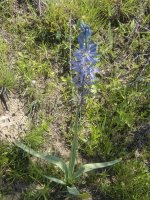
B06GiantCamasP5250318.jpg
Camas meadows were / are actively managed by family groups from PNW tribes. In spring, foragers used t-shaped digging sticks to harvest the bulbs when the blue blossoms were still visible. Camas bulbs were a staple food, an important trade item, and a key cultural symbol of spring (“First Foods” ceremonies). Management of the meadows included controlled burns, replanting of smaller bulbs, and selective harvesting to enhance sustainability.
Even though native harvesters would actively weed out death camas (Toxicoscordion venenosum) from these prairies, you can find scattered plants at Mima Mounds, albeit at much lower density than common camas. In my experience, death camas blooms a few weeks later than common camas, more like late spring / early summer. The white flowers are very different in appearance from common or giant camas (even the white morphs).
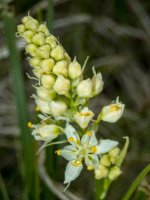
D07DeathCamas_5310035.jpg
D08DeathCamas_6080046.jpg
D09DeathCamas_5310037.jpg
Consumption of as few as two death camas bulbs can lead to nausea, vomiting, irregular heart rhythm and low blood pressure, coma, and death in the extreme (and a very bad few days at a minimum). Treatments typically attempt to alleviate the symptoms. The highest zygacine concentrations are found in the seeds and in the bulbs. The zygacine toxin (a steroid-like molecule) is unaffected by time or cooking. When ingested, the toxin blocks voltage-gated sodium channels and sodium levels in a nerve or muscle cell increase. This results in repetitive nerve stimulation and increased muscle contraction. Grazing animals, especially sheep, are very susceptible to poisoning by death camas if the bulbs are ingested. Because even its pollen is toxic, it is primarily pollinated by a specialist bee, the death camas miner bee.

Steve

 
Common camas (Camassia quamash), a member of the lily family, is common in the remnant prairies in the South Puget Sound area.
Definitely only small remnants of the once vast Puget prairies left, which I guess is my hesitance to call camas common anymore, especially around Puget Sound anyway. It’s all relative, I suppose!
IMG_5533.jpeg

Also I’m pretty sure the larger species is usually called “great camas” (not “giant” though it is understandable). And your photo does look like a great camas to me based on the wider, more robust looking foliage and tall sturdy flower spike. I have both common camas and great camas growing out front so I have had lots of time to examine them side by side.
 
I remember reading that Lewis and Clark were introduced to and consumed camas while traveling through the PNW. They made note of the excessive flatulence one gets from consuming excessive quantities. I believe the term “windy” was used.
 
Back
Top