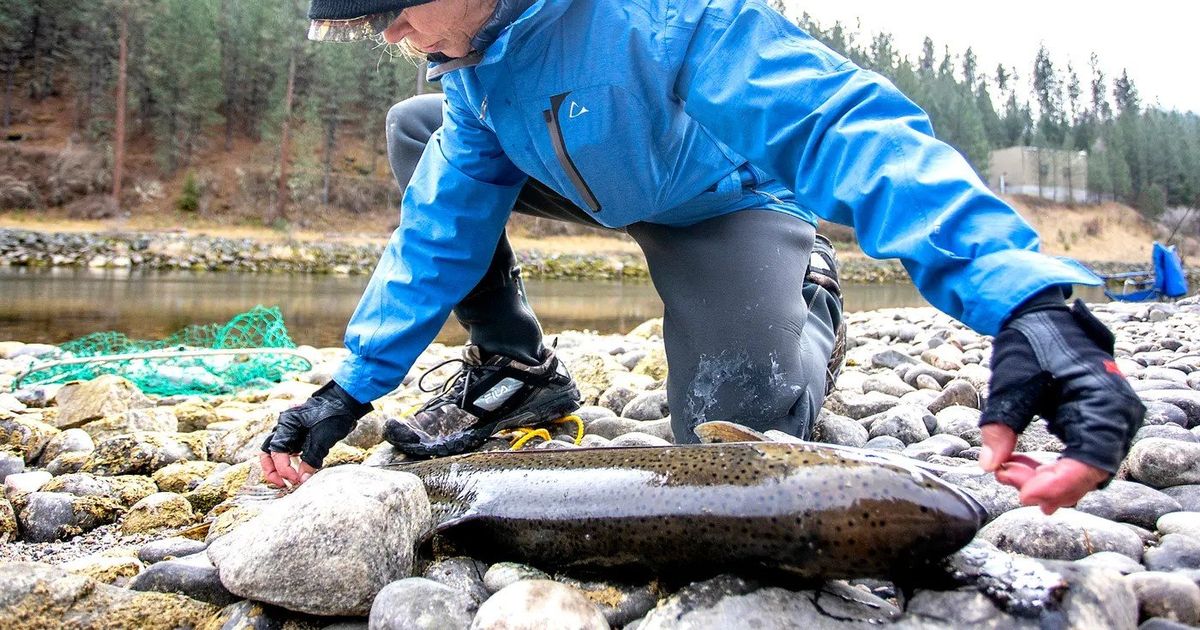
Hatchery Wild CoExist Brood Stock

Any idea of what "recovery" looks like? Where is the finish line? What's the number?

No idea about what recovery looks like. There is a lot of broodstock happening these days and it doesn’t appear to be an ecological disaster.

But I just heard a rumor at this point. It was from a reputable source. Maybe wishful thinking…
 
I keep hearing the OR wild steelhead broodstock programs are succeeding, but have yet to see what the definition of success is. Everyone who has been around fish culture knows that returning adults can be produced from wild broodstock programs. What seems to be missiing is data. Particularly the smolt to adult survival rate compared to other alternatives in the same basin and brood years. That is comparing wild broodstock survival to SAR for segregated hatchery programs and SAR for wild steelhead in that same basin. I've yet to see one single instance demonstrating that the wild broodstock program yields a better result than leaving those wild fish in their stream to spawn naturally. This basic information would be the deal maker, or deal breaker.

Looking at the table Stonedfish posted above, I see SAR as low as 1%. At return rates that low, a program's costs are not justified unless it's a last ditch effort to try to avoid the extirpation of a population. The only way those costs can be born for recreational or treaty net fishing is if you have a lot of "Other People's Money" to waste, waste meaning the same money could be more productively spent other ways.

Another remark about WA. WA hatchery steelhead programs are hamstrung by steelhead ESA listings in Puget Sound and the Columbia River.
Aren’t they also hamstrung by different wild fish advocacy groups suing the WDFW?
 
So if its not balls to the wall over the top success let’s just sit on our ass and do Nothing ! Sounds just like Head up your ass Washington State. Man I wish I could bring back my parents generation. They weren’t scared to work and Lazy or “I Cant “ got your ass wooped. Of course they went out and saved the world from evil.
Damm now if it even looks a little tough or God forbid you actually have to work or put effort into it everyone gives up. Cost too much , give me a break. As we waste who knows how much on stupid wolf crap or any a dozen other useless ideas. Did anyone complain back in the 60s, 70s, 80s etc when we had great to good steelhead fishing in just about every river ? No !
Good for you Oregon for making us up here look like Prime Idiots !
 
So if its not balls to the wall over the top success let’s just sit on our ass and do Nothing ! Sounds just like Head up your ass Washington State. Man I wish I could bring back my parents generation. They weren’t scared to work and Lazy or “I Cant “ got your ass wooped. Of course they went out and saved the world from evil.
Damm now if it even looks a little tough or God forbid you actually have to work or put effort into it everyone gives up. Cost too much , give me a break. As we waste who knows how much on stupid wolf crap or any a dozen other useless ideas. Did anyone complain back in the 60s, 70s, 80s etc when we had great to good steelhead fishing in just about every river ? No !
Good for you Oregon for making us up here look like Prime Idiots !
I can appreciate a good rant as well as the next guy. But do the math. Some of the hatchery steelhead efforts haven't been able to return enough adult fish to provide brood stock for the next generation of hatchery fish - even with zero fishing. No amount of bravery, or willingness to work hard, or unlimited deep pockets can reverse these smolt to adult survival statistics. At what point do you become intelligent enough to stop throwing good money after bad?
 
I can appreciate a good rant as well as the next guy. But do the math. Some of the hatchery steelhead efforts haven't been able to return enough adult fish to provide brood stock for the next generation of hatchery fish - even with zero fishing. No amount of bravery, or willingness to work hard, or unlimited deep pockets can reverse these smolt to adult survival statistics. At what point do you become intelligent enough to stop throwing good money after bad?
Hmmm...
 
I can appreciate a good rant as well as the next guy. But do the math. Some of the hatchery steelhead efforts haven't been able to return enough adult fish to provide brood stock for the next generation of hatchery fish - even with zero fishing. No amount of bravery, or willingness to work hard, or unlimited deep pockets can reverse these smolt to adult survival statistics. At what point do you become intelligent enough to stop throwing good money after bad?
Have you watched the film ? Are you calling all the folks involved Liars ?
Because i watched the film and the success these people testify to is real. Just like the part about the Snider creek program on the Sol Duc.
Or maybe you’re just another anti hatchery person.
And is this a banking/ money investment argument or is it a fishing, hunting and outdoor recreational argument ? Cause yes it costs money to have fishing, hunting etc. and what a sorry place to live it will be when its all shut down.
But then again I don’t hear a peep about what it costs for trout, bass , warm water fisheries or salmon fisheries. Cause the same people bitching about steelhead are out there fishing for these other fish . What is it with steelhead? They are just a fish crap sakes not some Holy and precious thing to be worshiped.
And some rivers might be in such a bad way that it’s not worth the time and money right now. But we must get to work on those systems that can have success.
You never know until you try !
Doing nothing has proved to be Failure. And way too many are just that happy with Failure !
 
So if its not balls to the wall over the top success let’s just sit on our ass and do Nothing ! Sounds just like Head up your ass Washington State. Man I wish I could bring back my parents generation. They weren’t scared to work and Lazy or “I Cant “ got your ass wooped. Of course they went out and saved the world from evil.
Damm now if it even looks a little tough or God forbid you actually have to work or put effort into it everyone gives up. Cost too much , give me a break. As we waste who knows how much on stupid wolf crap or any a dozen other useless ideas. Did anyone complain back in the 60s, 70s, 80s etc when we had great to good steelhead fishing in just about every river ? No !
Good for you Oregon for making us up here look like Prime Idiots !


We have worked, we've spend billions of dollars it didn't work because the problem is the ocean.

You're right, no one complained back in the 60's 70's and 80's. You know why? Because at that time the ocean supported all those fish, now it doesn't. Oregon has better fishing, slightly better. However they have lots of rivers that flow right into the ocean. Washington doesn’t.
Have you watched the film ? Are you calling all the folks involved Liars ?
Because i watched the film and the success these people testify to is real. Just like the part about the Snider creek program on the Sol Duc.
Or maybe you’re just another anti hatchery person.
And is this a banking/ money investment argument or is it a fishing, hunting and outdoor recreational argument ? Cause yes it costs money to have fishing, hunting etc. and what a sorry place to live it will be when its all shut down.
But then again I don’t hear a peep about what it costs for trout, bass , warm water fisheries or salmon fisheries. Cause the same people bitching about steelhead are out there fishing for these other fish . What is it with steelhead? They are just a fish crap sakes not some Holy and precious thing to be worshiped.
And some rivers might be in such a bad way that it’s not worth the time and money right now. But we must get to work on those systems that can have success.
You never know until you try !
Doing nothing has proved to be Failure. And way too many are just that happy with Failure !


We've done a lot.. none of it has worked.. the problem is ocean survival.

The north umpqua has had a wild broidstock for decades
Long before the Wilson river program was even thought of. That program failed.
Well then the hatchery burnt down.. hatchery programs of any type are not an answer until we can get fish back from the ocean.
I did not watch the video and will say nothing about it but this.....

Yes I believe people promoting an agenda are capable and willing to lie or distort facts to promote their agenda. In this day and age most people involved in such agendas will lie to get what they want, fishermen included. Like I said I haven't seen the video, I won't watch it and I have no clue who is involved. I am not saying they are lying only that there are people who would lie.
I am neither for or against broodstock programs but I will say. If we fix ocean survival we won't need many hatcheries. If we don't fix ocean survival it doesn't matter how many hatcheries we have.
 
I assume the video in question is the recent video on the Sandy River brood stock program. I had watched it prior to this discussion and again before responding to this tread.

Bottom line the video gives no information on the number of brood stock taken, the number of smolts released, the survival of those smolts or the relative contribution of those smolts to the catch versus the wild fish or other hatchery fish. In short as both Salmon_g and myself said is that fish have returned but the information to serious evaluate the success of the program.

Interesting that the Snider Creek program was mentioned. This program in the first decade or so was one of the few programs where there was enough information to evaluate the success of that effort. When I looked at that data the thing that jumped out to me was that based on the return to catch (sport plus tribal)/number of smolts planted those fish from the Snider Creek program returned at approximately 1/2 of the Chambers Creek fish released in the same basin in the same years. Such wild brood stock not only mine the wild population they produce fish with similar run timing as the wild population eliminating the opportunity to selective harvest the hatchery fish with run timing restrictions. In addition with a similar spawn timing as the wild fish there is increased opportunity to pass on altered genetics due to the selectivity of brood stock collection or the rearing process.

Curt
 
Let's further explore some potential issues with wild steelhead brood stock programs. For this hypnotical river program, I assumed that we have a wild population of 500 wild winter steelhead adults from which 50 brood stock will be collected using hook and line. For key smolt/spawner and eggs/spawner information I used the information that I could quickly find during a limited search (the Kalama was the only lower Columbia system I could find both values - there could other systems with that information). To the example -

450 wild spawners (500 minus the 50 for brood stock) using the Kalama 19.5 smolts per spawner we could expect 8,775 smolts. With a brood stock of 50 with Kalama eggs/spawner of 1,308 we would have an egg take of 65,400 of which we would expect the average Kalama egg to smolt production of 83% giving us 54282 smolts or roughly 6 times that produced by the wild population. The ultimate result in our model will depend on the relative survival of the hatchery produced fish and fishing rates. Regardless we are likely to see a significant portion of the natural spawning fish coming from those hatchery fish.

Those hatchery fish will have experienced several selective pressures pulling them away from the originate wild population. Collecting the fish with hook and line will likely select for both earlier returning fish and earlier spawning fish will the hatchery rearing process will likely select for earlier spawn timing and fish that during their early life to adapt to an artificial environment instead the more rigorous traits needed in a more hostile wild environment. The end result with any sort of marine survival the hatchery fish will represent an amplified impact (being less genetically fit) on the wild population. Yes, with some careful planning and thought some of those impacts could be lessen but to date have not seen much in the will to do so.

I would also like to remind folks that the original early time (Chambers Creek) began as a wild brood stock.

Curt
 
Have you watched the film ? Are you calling all the folks involved Liars ?
Because i watched the film and the success these people testify to is real. Just like the part about the Snider creek program on the Sol Duc.
Or maybe you’re just another anti hatchery person.
And is this a banking/ money investment argument or is it a fishing, hunting and outdoor recreational argument ? Cause yes it costs money to have fishing, hunting etc. and what a sorry place to live it will be when its all shut down.
But then again I don’t hear a peep about what it costs for trout, bass , warm water fisheries or salmon fisheries. Cause the same people bitching about steelhead are out there fishing for these other fish . What is it with steelhead? They are just a fish crap sakes not some Holy and precious thing to be worshiped.
And some rivers might be in such a bad way that it’s not worth the time and money right now. But we must get to work on those systems that can have success.
You never know until you try !
Doing nothing has proved to be Failure. And way too many are just that happy with Failure !
My my. Yes, I did watch the film. No, I am not calling anyone a liar. The success these people testify to is what we already know from wild steelhead broodstock programs. That is that we can take wild broodstock and produce subsequent returning adults. Unfortunately, none of the programs, as far as I can tell, have bothered to, or been able to collect the critical data for program evaluation that Smalma referenced in his post above. This was true with regard to the very well liked Snider Creek program on the Sol Duc as well. I am one of the least anti-hatchery fish biologists you will meet. If I am anti anything it is anti pissing money down a rat hole. I am pro fish and pro science. I want the best fish programs that deliver not only the greatest success, but also the most cost-effective success so that the people who are paying the freight feel good about the investment in fish programs that they are making.

You don't hear a peep about the costs for trout, bass, and warm water fish programs because they are extremely cost effective, meaning they produce a lot of fish per dollar expended. If you read some of my posts about hatchery salmon, you would encounter more criticism because I have plenty. WDFW invests WA tax dollars in many hatchery salmon programs that deliver a reasonable return of harvestable salmon to Canadian sport and commercial fisheries, some Alaskan sport and commercial fisheries, a modest harvest to WA commercial fisheries and treaty Indian fisheries, and a paltry contribution to WA recreational fisheries. I argued that for the amount of money spent, a far better return to WA taxpayers would result if, instead of raising hatchery salmon, those hatcheries instead raised trout and stocked them in lakes so that the people who paid for them would be most likely to realize a return on the investment. If fish managers invested in hatchery production the way they invested in their personal 401(k) plans, you would see very different hatchery practices in WA state.

Getting back to "what is it with steelhead?" As best as I can tell, since about 1990, factors favoring steelhead survival in marine waters have experienced a declining trend. Early marine survival is way down. The driving factor looks to be predation by marine mammals, mainly harbor seals, but including sea lions and occasionally some porpoise species. The Puget Sound harbor seal population looks to have increased from 6 or 7,000 in the 1970s and 80s to currently about 60,000. That's a lot of hungry mouths to feed, and while juvenile salmon and steelhead make up a small proportion of their diet, that small % really adds up when there are so many of them. Increased avian predation may also be a factor, at least as described for certain Puget Sound rivers as common cormorant populations have increased in parts of Puget Sound. This early marine predation appears to be much lower on coastal rivers. Then oceanographic factors come into play. Either there is less stability with the spring coastal upwelling - that is largely responsible for the density of the food supply - or we have just been in an unlucky cycle during the most recent 30 or so years. Open ocean productivity was once thought to be extremely stable; at least that was the assumption because we just flat out didn't know. Now we understand that productivity is also variable, and we have come to understand that the large scale hatchery production of pink and chum salmon in SE Alaska and chum salmon production from Japan is massive enough to influence the supply of forage in the north-western Pacific Ocean. And that happens to be the place where steelhead from north of Oregon's Umpqua River all the way up to SE Alaska go for their ocean feeding and growing. These are the factors I have learned about that the scientific community has come to understand are limiting the overall survival success of steelhead. It explains to me why hatchery steelhead programs that once returned smolt to adult surivval rates as high as 10% now struggle to return one or two percent, and some years even less than one percent. At that less than one percent return rate, hatchery programs not only cannot provide harvestable steelhead for recreational and treaty fishing, they begin to fail to support themselves even with zero fishing. This is why I posted that "No amount of bravery, or willingness to work hard, or unlimited deep pockets can reverse these smolt to adult survival statistics."

 
And to add insult to injury, overabundant hatchery pink salmon stocked by State of Alaska are now registering negative impacts in steelhead in Idaho and in a just published study on coastal steelhead.


The strongly negative pink salmon effect seen in the recent study of coastal steelhead is huge for both recruitment and kelt survival. This taken with the established steelhead response to fluctuations in ocean conditions helps explain the welcomed bump seen last year's returns on the Oregon coast, Columbia Basin, Skeena, etc, corresponding to the 2022 outmigration year - an uptick in ocean conditions luckily at an off-year for pink salmon that year. Clearly, a colder and low-competition ocean environment is favorable for steelhead survival at sea.
 
otter-world-history-v0-mmex7zf7e08b1.jpg
 
We have worked, we've spend billions of dollars it didn't work because the problem is the ocean.

You're right, no one complained back in the 60's 70's and 80's. You know why? Because at that time the ocean supported all those fish, now it doesn't. Oregon has better fishing, slightly better. However they have lots of rivers that flow right into the ocean. Washington doesn’t.


We've done a lot.. none of it has worked.. the problem is ocean survival.

The north umpqua has had a wild broidstock for decades
Long before the Wilson river program was even thought of. That program failed.
Well then the hatchery burnt down.. hatchery programs of any type are not an answer until we can get fish back from the ocean.
I did not watch the video and will say nothing about it but this.....

Yes I believe people promoting an agenda are capable and willing to lie or distort facts to promote their agenda. In this day and age most people involved in such agendas will lie to get what they want, fishermen included. Like I said I haven't seen the video, I won't watch it and I have no clue who is involved. I am not saying they are lying only that there are people who would lie.
I am neither for or against broodstock programs but I will say. If we fix ocean survival we won't need many hatcheries. If we don't fix ocean survival it doesn't matter how many hatcheries we have.
The NU hatchery/broodstock program didn’t fail…
The constant pressure of the “anti-hatchery want my private fishery” folks and the aforementioned ocean conditions failed the program.
 
Last edited:
I assume the video in question is the recent video on the Sandy River brood stock program. I had watched it prior to this discussion and again before responding to this tread.

Bottom line the video gives no information on the number of brood stock taken, the number of smolts released, the survival of those smolts or the relative contribution of those smolts to the catch versus the wild fish or other hatchery fish. In short as both Salmon_g and myself said is that fish have returned but the information to serious evaluate the success of the program.

Interesting that the Snider Creek program was mentioned. This program in the first decade or so was one of the few programs where there was enough information to evaluate the success of that effort. When I looked at that data the thing that jumped out to me was that based on the return to catch (sport plus tribal)/number of smolts planted those fish from the Snider Creek program returned at approximately 1/2 of the Chambers Creek fish released in the same basin in the same years. Such wild brood stock not only mine the wild population they produce fish with similar run timing as the wild population eliminating the opportunity to selective harvest the hatchery fish with run timing restrictions. In addition with a similar spawn timing as the wild fish there is increased opportunity to pass on altered genetics due to the selectivity of brood stock collection or the rearing process.

Curt
Alsea River has had a Broodstock program for years…they post the information.

Most will say… before the broodstock program, they had about a 1% return rate…currently achieving about a 5% return.

However, the number of plants been dwindling downward dramatically due to “eco-peoples’ “ constant pressuring, going against the real science and data.
 
Back
Top