Hatchery Wild CoExist Brood Stock

skyrise

Steelhead
Glad to say that Hatchery wild has a new film showing the great benefits from Brood stock programs. Can only hope that Washington state could start doing this on a regular basis. Why not ? It’s working at the Wallace hatchery with chum salmon. And of course Oregon with great success. Duh ! But of course common sense is rare gem in this state.
 
Perfection in WA state is when absolutely nobody is happy because you have compromised to everyone’s ideologies.

However, I know the Tribes are going to be getting some brood stock programs going soon because they are done waiting around for recovery.
 
I spent several years working for ODFW on their Sandy and Clackamas River spring chinook and winter steelhead integrated broodstock programs, it was a lot of fun. A great work perk was having the states (and OSP officers) permission to fish closed waters to remove hatchery fish to help keep PHAS below the mandated 10%. They'd send us out in September to help catch the quota of 50 wild males they would use for the broodstock program (could technically live spawn the males and release them stream side - collecting fish jizz on ice as you go).

Dealing with the public could be rough, as could the hours in the fall as the first rains came (on call 24/7 so the weir didn't blow out). Wrangling an angry beaver out of the weir could be a little sketchy too.
 
I spent several years working for ODFW on their Sandy and Clackamas River spring chinook and winter steelhead integrated broodstock programs, it was a lot of fun. A great work perk was having the states (and OSP officers) permission to fish closed waters to remove hatchery fish to help keep PHAS below the mandated 10%. They'd send us out in September to help catch the quota of 50 wild males they would use for the broodstock program (could technically live spawn the males and release them stream side - collecting fish jizz on ice as you go).

Dealing with the public could be rough, as could the hours in the fall as the first rains came (on call 24/7 so the weir didn't blow out). Wrangling an angry beaver out of the weir could be a little sketchy too.
I want angry beaver stories!
 
I wonder if some streams have enough Wild fish to actually start a broodstock program and if it is successful, would we be able to even fish it?
SF

IMG_0732.jpeg
 
I keep hearing the OR wild steelhead broodstock programs are succeeding, but have yet to see what the definition of success is. Everyone who has been around fish culture knows that returning adults can be produced from wild broodstock programs. What seems to be missiing is data. Particularly the smolt to adult survival rate compared to other alternatives in the same basin and brood years. That is comparing wild broodstock survival to SAR for segregated hatchery programs and SAR for wild steelhead in that same basin. I've yet to see one single instance demonstrating that the wild broodstock program yields a better result than leaving those wild fish in their stream to spawn naturally. This basic information would be the deal maker, or deal breaker.

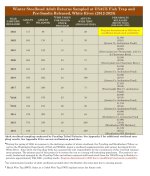
Looking at the table Stonedfish posted above, I see SAR as low as 1%. At return rates that low, a program's costs are not justified unless it's a last ditch effort to try to avoid the extirpation of a population. The only way those costs can be born for recreational or treaty net fishing is if you have a lot of "Other People's Money" to waste, waste meaning the same money could be more productively spent other ways.

Another remark about WA. WA hatchery steelhead programs are hamstrung by steelhead ESA listings in Puget Sound and the Columbia River.
 
I want angry beaver stories!
The beaver one is pretty mellow, came up to the weir in the morning and heard a lot of splashing (not unusual). Crack the lock on the door and open it up and there's a beaver in this thing swimming and diving and freaking out. Had to hop in with a hand net and try to scoop this pissed off beaver up and out the door opening so it could continue on his merry way. This was not that long after the story came out of the beaver attack in Belarus - https://en.wikipedia.org/wiki/Beaver_attack so I was a bit worried he'd gnaw off my twig.

The best one is we had otters get into the traps - and otters are a LOT smarter than beavers. So they'd sneak in at night, eat the eggs out of a few female salmon, and swim out the fyke by morning. The ODFW wildlife Bio had us take out a live trap to try to relocate the thing away from the buffet. He also gave us a rag and some shoulder length leather welding gloves. The plan was, we had to piss on the rag to bait the trap (we tried with fish carcasses but no go) and then if we did catch a pissed off otter we had to grab it with the welding gloves and check if it was lactating. So flip it over and squeeze a teat. If it was lactating we had to release it as it had kits nearby and couldn't be relocated. I went to school to work with fish, not get scalped by a pissed off momma otter as I searched for a teat. Luckily otters are smarter than most fish biologists and we never trapped it.

 
The beaver one is pretty mellow, came up to the weir in the morning and heard a lot of splashing (not unusual). Crack the lock on the door and open it up and there's a beaver in this thing swimming and diving and freaking out. Had to hop in with a hand net and try to scoop this pissed off beaver up and out the door opening so it could continue on his merry way. This was not that long after the story came out of the beaver attack in Belarus - https://en.wikipedia.org/wiki/Beaver_attack so I was a bit worried he'd gnaw off my twig.

The best one is we had otters get into the traps - and otters are a LOT smarter than beavers. So they'd sneak in at night, eat the eggs out of a few female salmon, and swim out the fyke by morning. The ODFW wildlife Bio had us take out a live trap to try to relocate the thing away from the buffet. He also gave us a rag and some shoulder length leather welding gloves. The plan was, we had to piss on the rag to bait the trap (we tried with fish carcasses but no go) and then if we did catch a pissed off otter we had to grab it with the welding gloves and check if it was lactating. So flip it over and squeeze a teat. If it was lactating we had to release it as it had kits nearby and couldn't be relocated. I went to school to work with fish, not get scalped by a pissed off momma otter as I searched for a teat. Luckily otters are smarter than most fish biologists and we never trapped it.
If there's one thing PNWFF appreciates, it's an even better otter story!
 
Perfection in WA state is when absolutely nobody is happy because you have compromised to everyone’s ideologies.

However, I know the Tribes are going to be getting some brood stock programs going soon because they are done waiting around for recovery.
I'd love to know what tribes are considering this. I know that WDFW teased a change to Kendall a couple years ago. It seems like a potential hatchery to reform into a broodstock hatchery. The WFC settlement on the Skagit also left the door open. Are we talking about these basins?
 
I keep hearing the OR wild steelhead broodstock programs are succeeding, but have yet to see what the definition of success is. Everyone who has been around fish culture knows that returning adults can be produced from wild broodstock programs. What seems to be missiing is data. Particularly the smolt to adult survival rate compared to other alternatives in the same basin and brood years. That is comparing wild broodstock survival to SAR for segregated hatchery programs and SAR for wild steelhead in that same basin. I've yet to see one single instance demonstrating that the wild broodstock program yields a better result than leaving those wild fish in their stream to spawn naturally. This basic information would be the deal maker, or deal breaker.

Looking at the table Stonedfish posted above, I see SAR as low as 1%. At return rates that low, a program's costs are not justified unless it's a last ditch effort to try to avoid the extirpation of a population. The only way those costs can be born for recreational or treaty net fishing is if you have a lot of "Other People's Money" to waste, waste meaning the same money could be more productively spent other ways.

Another remark about WA. WA hatchery steelhead programs are hamstrung by steelhead ESA listings in Puget Sound and the Columbia River.

Their rivers have fish in them that you can catch. That's more successful than most places up here. Up here success is rivers empty of fish and anglers. Easy to manage.
 
Like Salmo g I have not seen much evidence that with steelhead wild brood stocks have been essential except to produce fish to harvest.
In the Puyallup example it looks like the SAR for that program is around 0.12% - not much different what is being seen with the early timed (Chambers Creek) PS hatchery steelhead.

We should be clear the foundation of wild broodstocks whether Chinook or steelhead is that with such programs a fish is a fish (no differences between hatchery and wild fish. While such programs produce some fish to be harvested, I have not seen evidence such programs lead to recovery (in fact it is more likely that damage will be done to the donator stock).

A real danger with these wild broodstocks is that it gives false promise that some sort of river ecosystem recovery can be achieved without doing the hard habitat work and protection. Not unlike the push in previous decades that eliminating harvest and/or hatchery would lead to recovery.

A classic example of the failure of wild brood stock programs is the Stillaguamish Chinook program. We are further from recovery today than when that program was started nearly 40 years ago. In the decade before the listing of PS Chinook on the North Fork Stillaguamish the recruit/spawner (R?S) was 1.05; that is for every 20 fish put on the spawning grounds 21 recruits. In the first 15 years post listing the R/S fall to the point that pulling the same 20 fish on the spawning grounds only 13 recruits were being produced. Somehow, I think other habitat features are driving the decline of the Stillaguamish Chinook. Just one example, In the mid-1960s it was estimated that an astounding 18,000 metric tons of sediment was reaching Port Susan annually. In 2015/16 some 50 years later the estimate was the amount of sediment (excluding that produced by the Oso slide) had increased to 668,000 metric tons!!!

Curt
 
With ocean survival being our primary problem is don't see how pumping out more
Smolts is any kind of answer.. that said I am not opposed to hatchery programs where NOS is kept below 10% . I am not a fan of Chambers creek fish but i do like their run timing both as an angler and the theoretical temporal separation from wild fish they provide.

To be honest until we get better ocean conditions i am pretty appethetic towards steelhead management, not because I don't care, just because I don't think there is a lot we can actually do.
 
Back
Top