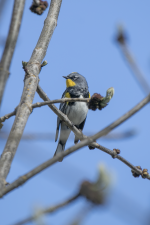
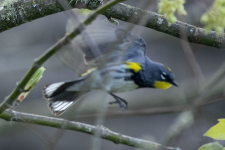
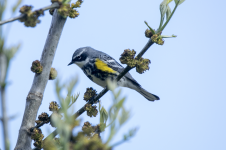
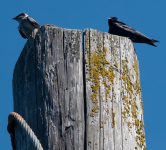
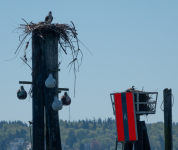
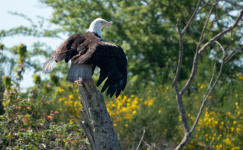
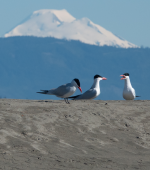
Got any bird pics?

As others have eluded too, woodland park zoo. Took the kids yesterday and snapped a few picks.
I was kinda living vicariously and envisioned you were traveling in an exotic locale where those birds are native.

what colorful birds whereever they’re seen 👍
 
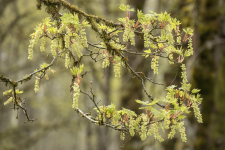
Billie Frank Jr. - Nisqually NWR, early-mid April. Part 3: Warblers. We are in a narrow window where the deciduous trees are just starting to produce their canopy of leaves. The big leaf maples are decorated with dangling clusters (racemes) of fragrant, nectar-rich flowers.
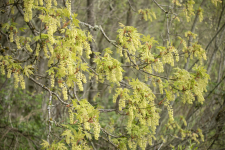
A01BigLeafMapleInBloom2C2A8834.png
I’ve been spoiled by the clear views of the insectivorous birds gleaning insects from the branches and trunks of the deciduous trees. But that window is rapidly closing.
A few warblers typically overwinter at Nisqually, a handful of yellow-rumped warblers and an orange-crowned warbler or two. In the spring Nisqually is a magnet for warblers as they refuel on their migration to their breeding grounds and the summer residents returned from points south.
In the last few weeks, the trees have been full of yellow-rumped warblers, especially males. They are often “hawking” flying insects either from the tree canopy or from the branches of shrubs. Certain groves of trees lying downwind from the freshwater pond and canals are magnets for yellow-rumps as they harvest flying midges.
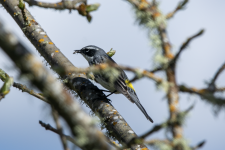
C05YellowRumpedWarblerMaleMyrtle2C2A9177.png
The individuals include two of the four subspecies of yellow-rumped warblers: the myrtle’s of Alaska, Canada and the east coast of the U.S. and Audubon’s of B.C., the PNW, Northern California, to the Rockies.
The males of these two subspecies are relatively easy to differentiate. The males of the Audubon’s subspecies have 1) rounded yellow throat patches that do not extend under the cheek (auricular), 2) white arcs above and below the eye, 3) gray cheeks (auriculars) that are the color same as the head and back feathers, and 4) solid (or mostly solid) black chests (look like the bird is wearing a black vest to me).
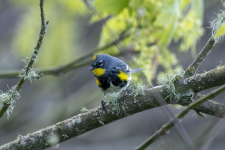
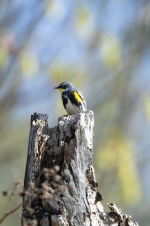
B02YellowRumpedWarblerMaleAudubons2C2A9142.png
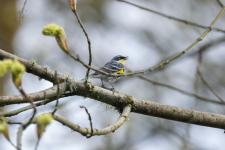
B03YellowRumpedWarblerMaleAudubons2C2A9201.png
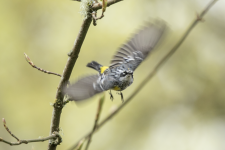
B04YellowRumpedWarblerMaleAudubonsInFlight2C2A9143.png
The males of the Myrtle’s subspecies have 1) white throat patches that extend under the cheek (auriculars), 2) white eye arcs and white streak “eyebrow” (supercilium) stripes, 3) black cheeks that contrast against gray heads and backs, and 4) black streaks along the breasts.
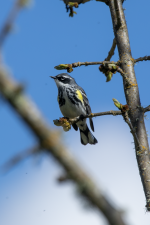
C06YellowRumpedWarblerMaleMyrtle2C2A9182.png
C07YellowRumpedWarblerMaleMyrtle2C2A9666-2.png
C08YellowRumpedWarblerMaleMyrtles2C2A9210.png
C09YellowRumpedWarblerMaleMyrtleInFlight2C2A8594.png
Females of either subspecies, like this Myrtle’s, are similar to their males but much more subdued.
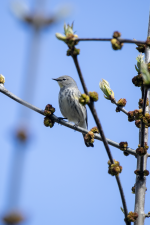
C10YellowRumpedWarblerFemaleMyrtle2C2A9187.png
The breeding ranges of these two subspecies overlap in the Canadian Rockies and Montana. Interbreeding occurs (hence subspecies, not full species) producing “intergrades” of the two subspecies. [A “hybrid” would be the offspring of mating between two separate species.]. Intergrades have various combinations of characters of each subspecies, some quite subtle, as you can see in these three individuals.
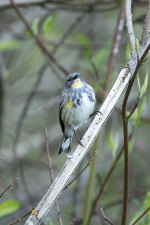
D11YellowRumpedWarblerFemaleIntergrade2C2A9216.png
D12YellowRumpedWarblerMaleIntergrade2C2A9022.png
D13YellowRumpedWarblerMaleIntergrade2C2A7808.png
The frequency of intergrades may be as high as 10% in some locations.
Because of the abundance of yellow-rumped warblers, after a while it is tempting to just start ignoring them and their “cheek” calls as they flit around the trees. But there is always the possibility of other warbler species mixed in. Anticipating this possibility, I did see one of my favorite warblers, a male black-throated gray.
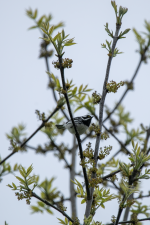
K14BlackThroatedGrayWarbler2C2A9732.png
Like the yellow-rumps, he was hawking insects from the top of a tall willow. I wouldn’t be surprised to find Townsend’s warblers doing the same thing on a future visit.
On another visit, I spied an orange-crowned warbler gleaning insects off the trunk and inner branches of an alder.
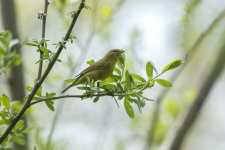
L15OrangeCrownedWarbler2C2A8790.png
Their plumage, even for a male warbler, is so much more subdued than you find in most warblers.
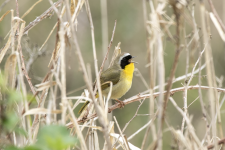
In the last three weeks, a number of common yellowthroat males have migrated back to the freshwater marsh. Most commonly, these bandits “squeak” at you from deep in the vegetation. But occasionally, a male will perch in the open and produce their piercing “witchety-witchety-witchety” song. If you are fortunate, you have a window through the vegetation to snap a few pictures.
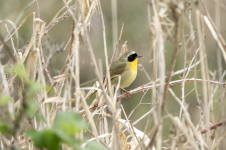
M16CommonYellowthroatMale2C2A9741.png
M17CommonYellowthroatMaleSinging2C2A9742.png
I haven’t seen any female common yellowthroats yet. These male trailblazers are establishing their territories in anticipation of the imminent arrival of females from Mexico and Central America.
And I expect that the forests will soon resound with the songs of yellow warblers when they arrive.
Steve

 
Last edited:
Billie Frank Jr. - Nisqually NWR, early-mid April. Part 4: Sparrows and finches. We had just begun a recent visit when we saw two birds fly into a big leaf maple. The tree was covered with clusters (racemes) of lime-green flowers.
A01BigLeafMapleFlowers2C2A8569.png
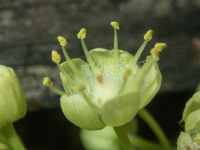
A02BigLeafMapleFlower4200011.png
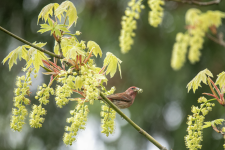
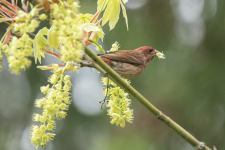
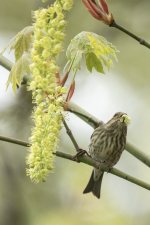
The birds were a male and female house finch.
A03HouseFinchMaleEatingBigleafMapleFlowers2C2A9571.png
A04HouseFinchMaleEatingBigleafMapleFlowers2C2A9594.png
A05HouseFinchFemaleEatingBigleafMapleFlowers2C2A9583.png
They were pulling flowers off the clusters by the flower base. It appeared that they squeezed the base and then dropped the flower. After conducting some online research, I suspect that the house finches were squeezing nectar out of the flowers. The flowers of big leaf maples do produce significant nectar and some beekeepers market the distinctive big leaf maple honey as a premium variety.
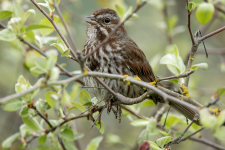
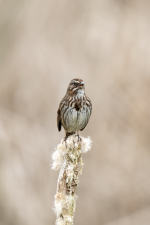
Song sparrows are perhaps the greatest habitat generalists among the birds inhabiting Nisqually NWR. They inhabit the forest edges,
B06SongSparrowSinging2C2A9768.png
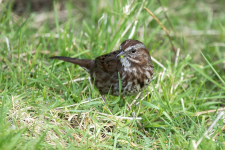
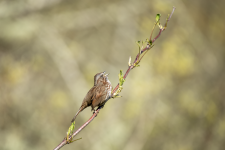
grassy meadows near cover,
B07SongSparrow2C2A7714.png
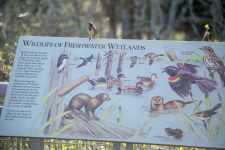
the riparian vegetation lining the canals and freshwater pond, [This song sparrow was wondering why they weren't included in this information graphic...]
B08SongSparrowExclusion2C2A7978.png
and the freshwater marsh.
B09SongSparrowOnCattail2C2A9747.png
They are not intimidated by human presence and go about their business regardless.
With the sap rising in the spring…, the males are staking out territories and singing their hearts out.
B10SongSparrowSinging2C2A8076.png
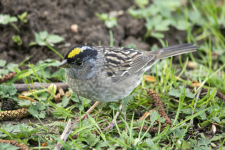
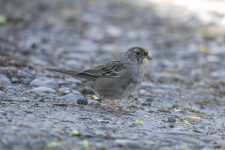
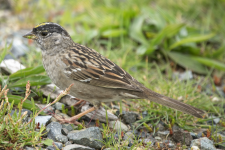
Over the year, I have learned the sites around the refuge where golden-crowned sparrows hang out.
C11GoldenCrownedSparrowAdult2C2A9076.png
In the fall, they foraged in the blackberries for the last fruits and seeds. For most of the winter and spring, they have grazed on grass blades.
C12GoldenCrownedSparrow2C2A9772.png
But they also have been exploiting the big leaf maple flowers that have fallen on the ground.
C13GoldenCrownedSparrow2C2A8038.png
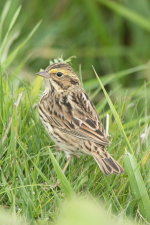
The only place where I have seen savannah sparrows at Nisqually NWR is on either side of the elevated dike that separates the permanent freshwater marsh and seasonally flooded meadow to the east from the salt marsh and mud flats to the west. [I commonly also see them at Mima Mounds as well.]. They are more often heard than seen, especially when they are among the cattails. But they will come out and search for snacks along the grassy banks of the dike.
D14SavannahSparrow2C2A9760.png
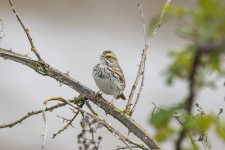
On a recent visit, a male savannah sparrow started singing from the canes of a Himalayan blackberry bush. He was quite exuberant.
D15SavannahSparrowMale2C2A9899.png
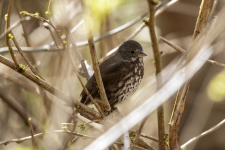
Clearly, the most elusive of the sparrows is the fox sparrow. There probably aren’t that many individuals, and the individuals who are there prefer to stay in deep cover. They act more like thrushes than sparrows. Most commonly, I see them scratching at leaf litter under shrubs as they search for insects taking cover under leaves. This individual I detected by the sounds of that scratching. Maneuvering stealthily, I managed to catch a few pictures of this individual before it noticed my presence and burst off into deep cover.
E16FoxSparrow2C2A7921.png

Steve
 
Last edited:
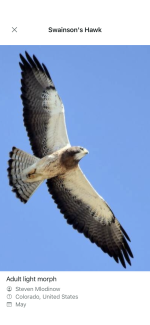
Yesterday afternoon I was working in the yard and heard a distinctive hawk call. I spotted a hawk and tried to mimic its call. To my surprise I heard it call back - only to figure out that it was calling to its mate. Activating the Merlin app (what a GREAT app!), I was able to identify a pair of Swainson's hawks, no cell pic so I'm borrowing Steven Mlowdinow's picture from the app:

Screenshot 2026-04-26 at 6.18.39 AM.PNG

The pair circled the neighborhood for several minutes - it seems the Eurasian collared doves had gone mute..........
 
To my surprise I heard it call back - only to figure out that it was calling to its mate.

This made me chuckle👆.

Once you realized it wasn’t answering you, did ya look around to see if anyone was watching? :D

Back in the day I saw a Great Horned Owl up in some scaffolding while visiting my parents back in Iowa. I was fresh outa some college wildlife course with new Mr. Natural knowledge so I sat in my car in the middle of downtown with the window rolled down and made baby rabbit calls…hoping to draw the owls attention.

Five or ten minutes into this, I start thinking, that’s kinda weird… it’s not moving at all….and finally I realize its friggin’ plastic! 🤦‍♂️.

So I tried not to see who was watching, hung my head in shame, and quickly drove away 🤪

and just to save a little face…this was when the use of plastic birds of prey to deter nuisance birds was just starting so they weren’t common as they are today. :cool:
 
This made me chuckle👆.

Once you realized it wasn’t answering you, did ya look around to see if anyone was watching? :D

Back in the day I saw a Great Horned Owl up in some scaffolding while visiting my parents back in Iowa. I was fresh outa some college wildlife course with new Mr. Natural knowledge so I sat in my car in the middle of downtown with the window rolled down and made baby rabbit calls…hoping to draw the owls attention.

Five or ten minutes into this, I start thinking, that’s kinda weird… it’s not moving at all….and finally I realize its friggin’ plastic! 🤦‍♂️.

So I tried not to see who was watching, hung my head in shame, and quickly drove away 🤪

and just to save a little face…this was when the use of plastic birds of prey to deter nuisance birds was just starting so they weren’t common as they are today. 🫤
I don't much care if someone heard me making the whistle like noise but I've pretty much stopped cawing loudly at ravens as I'm sure my neighbors think I'm a crazy old man (not far from reality). ;-)

I have one of those plastic owls that I put up near our table grapes. Wasted $ buying it.
 
Yesterday afternoon I was working in the yard and heard a distinctive hawk call. I spotted a hawk and tried to mimic its call. To my surprise I heard it call back - only to figure out that it was calling to its mate. Activating the Merlin app (what a GREAT app!), I was able to identify a pair of Swainson's hawks, no cell pic so I'm borrowing Steven Mlowdinow's picture from the app:

View attachment 182860

The pair circled the neighborhood for several minutes - it seems the Eurasian collared doves had gone mute..........

Hope to see a Swainson's one of these days. Very cool.

Merlin has turned out to be a very addictive app. My Dad was into birds so we always had field guide books and binoculars handy when I was growing up. Thought I had a pretty good handle on PNW birds, but between this thread and Merlin, I realize I didnt know shit.

One caveat about Merlin. I've caught it in 3 mis-ID's, and suspect a few others.

#1 Red tail hawk that was a very convincing Stellar's Jay mimic.

#2 False red wing blackbird as part of a Bewick's wren call.

#3 False Hammond's fly catcher that when listening to the replay was actually a faint bald eagle call (a.k.a "squeaky wheel" bird.)

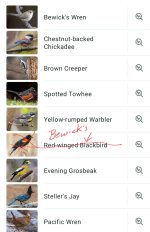
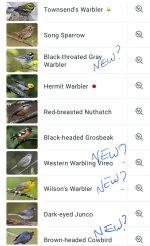
Overall though, Merlin is impressively accurate. It set a new single session record this morning of 19 birds. Actually 18 since one was another false red wing blackbird. Plus another 4 new birds that are TBD legit.

Screenshot_20260426_083101_Merlin Bird ID.jpgScreenshot_20260426_083135_Merlin Bird ID.jpg
 
Last edited:
I don't much care if someone heard me making the whistle like noise but I've pretty much stopped cawing loudly at ravens as I'm sure my neighbors think I'm a crazy old man (not far from reality). ;-)

I have one of those plastic owls that I put up near our table grapes. Wasted $ buying it.

I'd be more worried about what you say to the ravens than what your neighbors think. Those are some scary smart birds. I also wonder about the Stellar's with some of the bizarre sounds they make. I swear they are having conversations.
 
Hope to see a Swainson's one of these days. Very cool.

Merlin has turned out to be a very addictive app. My Dad was into birds so we always had field guide books and binoculars handy when I was growing up. Thought I had a pretty good handle on PNW birds, but between this thread and Merlin, I realize I didnt know shit.

One caveat about Merlin. I've caught it in 3 mis-ID's, and suspect a few others.

#1 Red tail hawk that was a very convincing Stellar's Jay mimic.

#2 False red wing blackbird as part of a Bewick's wren call.

#3 False Hammond's fly catcher that when listening to the replay was actually a faint bald eagle call (a.k.a "squeaky wheel" bird.)

Overall though, Merlin is impressively accurate. It set a new single session record this morning of 19 birds. Actually 18 since one was another false red wing blackbird. Plus another 4 new birds that are TBD legit.

View attachment 182867View attachment 182866
Those birds that you labelled as "new?" are very likely right now.
Steve
 
I notice details and am curious, what can I say? Also there’s no telling what all’s going on in a Norwegian back yard down yonder in Banjo Holler.
:LOL: I would've been disappointed in you had you not pointed that out (now that I see it). And yup, ya never know what kind of scandahoovian hijinx are happenin' down here.
 
Back
Top