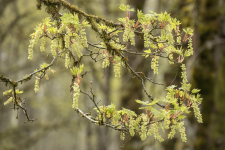
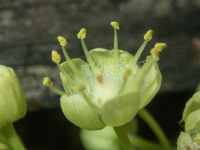
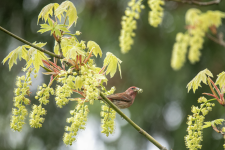
Billie Frank Jr. - Nisqually NWR, early-mid April. Part 3: Warblers. We are in a narrow window where the deciduous trees are just starting to produce their canopy of leaves. The big leaf maples are decorated with dangling clusters (racemes) of fragrant, nectar-rich flowers.
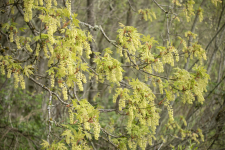
I’ve been spoiled by the clear views of the insectivorous birds gleaning insects from the branches and trunks of the deciduous trees. But that window is rapidly closing.
A few warblers typically overwinter at Nisqually, a handful of yellow-rumped warblers and an orange-crowned warbler or two. In the spring Nisqually is a magnet for warblers as they refuel on their migration to their breeding grounds and the summer residents returned from points south.
In the last few weeks, the trees have been full of yellow-rumped warblers, especially males. They are often “hawking” flying insects either from the tree canopy or from the branches of shrubs. Certain groves of trees lying downwind from the freshwater pond and canals are magnets for yellow-rumps as they harvest flying midges.
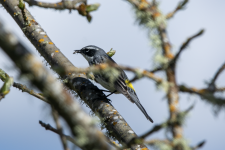
The individuals include two of the four subspecies of yellow-rumped warblers: the myrtle’s of Alaska, Canada and the east coast of the U.S. and Audubon’s of B.C., the PNW, Northern California, to the Rockies.
The males of these two subspecies are relatively easy to differentiate. The males of the Audubon’s subspecies have 1) rounded yellow throat patches that do not extend under the cheek (auricular), 2) white arcs above and below the eye, 3) gray cheeks (auriculars) that are the color same as the head and back feathers, and 4) solid (or mostly solid) black chests (look like the bird is wearing a black vest to me).
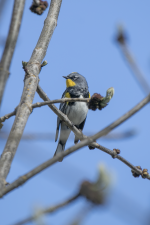
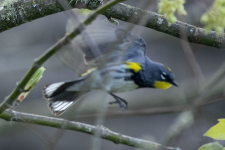
The males of the Myrtle’s subspecies have 1) white throat patches that extend under the cheek (auriculars), 2) white eye arcs and white streak “eyebrow” (supercilium) stripes, 3) black cheeks that contrast against gray heads and backs, and 4) black streaks along the breasts.
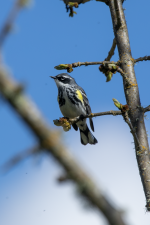
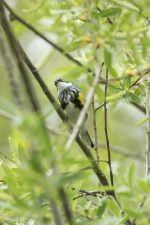
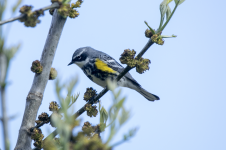
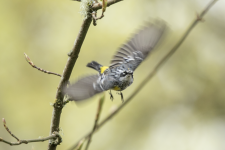
Females of either subspecies, like this Myrtle’s, are similar to their males but much more subdued.
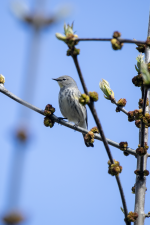
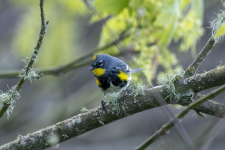
The breeding ranges of these two subspecies overlap in the Canadian Rockies and Montana. Interbreeding occurs (hence subspecies, not full species) producing “intergrades” of the two subspecies. [A “hybrid” would be the offspring of mating between two separate species.]. Intergrades have various combinations of characters of each subspecies, some quite subtle, as you can see in these three individuals.
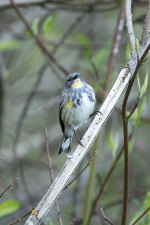
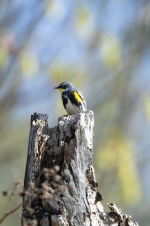
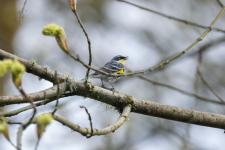
The frequency of intergrades may be as high as 10% in some locations.
Because of the abundance of yellow-rumped warblers, after a while it is tempting to just start ignoring them and their “cheek” calls as they flit around the trees. But there is always the possibility of other warbler species mixed in. Anticipating this possibility, I did see one of my favorite warblers, a male black-throated gray.
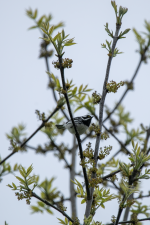
Like the yellow-rumps, he was hawking insects from the top of a tall willow. I wouldn’t be surprised to find Townsend’s warblers doing the same thing on a future visit.
On another visit, I spied an orange-crowned warbler gleaning insects off the trunk and inner branches of an alder.
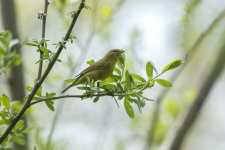
Their plumage, even for a male warbler, is so much more subdued than you find in most warblers.
In the last three weeks, a number of common yellowthroat males have migrated back to the freshwater marsh. Most commonly, these bandits “squeak” at you from deep in the vegetation. But occasionally, a male will perch in the open and produce their piercing “witchety-witchety-witchety” song. If you are fortunate, you have a window through the vegetation to snap a few pictures.
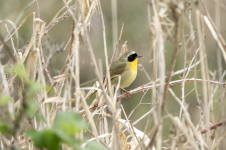
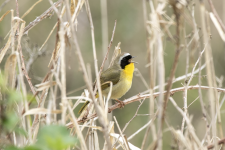
I haven’t seen any female common yellowthroats yet. These male trailblazers are establishing their territories in anticipation of the imminent arrival of females from Mexico and Central America.
And I expect that the forests will soon resound with the songs of yellow warblers when they arrive.
Steve






 .
.
 .
.




 I would've been disappointed in you had you not pointed that out (now that I see it). And yup, ya never know what kind of scandahoovian hijinx are happenin' down here.