As my brother and I were fishing for stripers around granite islands north of Boston, we had great views of the birdlife. And when we all agreed that we were done with fishing, our guide revisited some of the islands that we had fished so that I could take some bird pictures. We heard and saw American oystercatchers while fishing, but they proved to be elusive when the camera was out. One of the most interesting birds that we saw when fishing and on our photo-safari were hen common eiders and their chicks. I don’t remember eiders breeding in this area in the 70’s when I was diving this area, but they must be breeding on these islands. Typically, we saw two hens escorting a small gaggle of ducklings.


This behavior, creching, is common in eiders. It may include multiple hens shepherding a mingling of their ducklings or non-breeding females helping a breeding hen and her ducklings. The ducklings kept tight to shore and close to their moms. At this size, they would be a tempting morsel to a lurking striped bass or for a hungry black-backed gull.
We also encountered both solitary drake common eiders and small flocks of drakes on the water and resting in the intertidal. While a few of the birds were still in breeding plumage (or close to it),
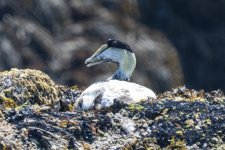
many drakes appeared to be in the less-striking eclipse plumage.
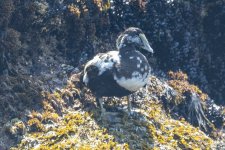
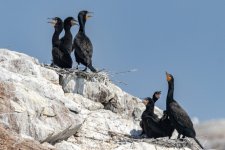
The heights of several uninhabited islands served as nesting sites for double-crested cormorants. The rudimental nests consist of clumps of sticks. The nestlings (cream-colored throat pouches vs. orange for the adults) were quite far along in size – fully feathered but still without flight feathers.
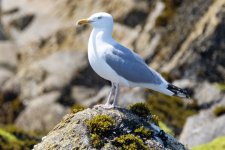
Of course, you can’t have a marine shoreline without gulls. These included herring gulls
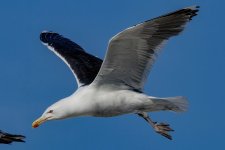
And the dominant gull in the Northeast, the greater black-backed gull.
Steve