SFR Fish Electrocuted in Lake Washington

Sorta fishing-related

"...invasive species... and a "small number" of salmon"
Unspecified species and number = Spin?

Salmon in Lake Washington during August are likely returning adult fish rather than smolts. Either is bad.

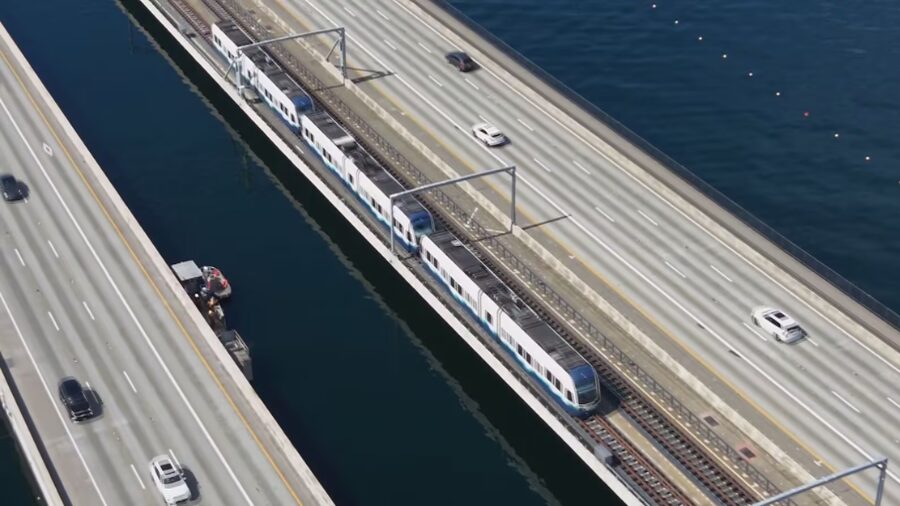
This is a 1500 VDC power distribution system for a $712M light rail project over a bridge, floating on a waterway used by migrating ESA listed fish.

The anodes for the (24VDC? - "Impressed Current) Cathodic Protection (ICCP)" system reportedly "rested on the lakebed." After the dead fish were discovered the anodes were raised up from the lakebed.

Several search results for variations of: "how would fish and swimmers be affected by anodes resting on the lakebed from a transit bridge floating on a lake for an impressed current cathodic protection system of a 1500vdc transit line" turns up some deadly serious issues if there is a system design (Low Vt anode proximity, High Vt isolation) fault or other failure. 🤯

And there is not much difference in the potential hazards between "resting on the lakebed" or "suspended".

I wonder how this was addressed and what testing was specified in the EIS?

 

"...invasive species... and a "small number" of salmon"
Unspecified species and number = Spin?

Salmon in Lake Washington during August are likely returning adult fish rather than smolts. Either is bad.

This is a 1500 VDC power distribution system for a $712M light rail project over a bridge, floating on a waterway used by migrating ESA listed fish.

The anodes for the (24VDC? - "Impressed Current) Cathodic Protection (ICCP)" system reportedly "rested on the lakebed." After the dead fish were discovered the anodes were raised up from the lakebed.

Several search results for variations of: "how would fish and swimmers be affected by anodes resting on the lakebed from a transit bridge floating on a lake for an impressed current cathodic protection system of a 1500vdc transit line" turns up some deadly serious issues if there is a system design (Low Vt anode proximity, High Vt isolation) fault or other failure. 🤯

And there is not much difference in the potential hazards between "resting on the lakebed" or "suspended".

I wonder how this was addressed and what testing was specified in the EIS?

Starting to have doubts .

The local political pressure involved in getting that project done alone had to be enormous. They just had to be "The First".

We all know the financial cost was staggering. Invariably, there had to be mistakes.

That out of the way, I often wondered how they were grounding all that current crossing those rails. I'd imagined they'd daisy chain from section to section and bury a large ground cable at each end. Dangling anodes to the lake bed doesn't seem like smart engineering, though.
 
The local political pressure involved in getting that project done alone had to be enormous....
A link to this article popped up in my search results. Apparently Sound Transit (& WADOT) had doubts back in December 2025
Any one want to go scuba diving there and check it out?
Nothing was said about the diver who discovered and reported the dead fish, and if there were any sort of physical barriers or posted warnings about a voltage hazard in the water encountered.

Search results said the anode strings are near the ends of the bridges where water depth is about 50 feet, and were possibly longer, extending to deeper water.

The fish were likely seen on the lakebed near the anodes. Sounds like the diver was very lucky.
 
Last edited:
Living in Portland, we see some really strange things, so I'm not shocked by any of this even if it is particularly jolting...
 
I was thinking about water skiers who venture close to the bridges at times to avoid wind chop. Yikes! Zing, what a feeling!
It probably increases their buzz.
 
“…Meanwhile, when a marquee Seattle infrastructure project is associated with roughly 2,000 dead fish, we discover that fish protection had been assigned “low importance” among the engineering requirements…”
 
I find this an interesting story and would like to know the details of their findings. I have my guess as to why it’s happening, but have no engineering proof to go by so,… I’ll wait till others who know more than I write about it.
 
  • Like
Reactions: RCF
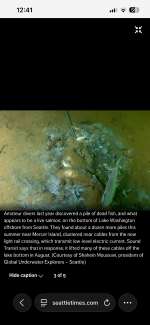
Yeah the Seattle Times article said it was discovered by hobbyist divers and had this sort of insane photo, is that a live adult Chinook possibly being attracted to the field and about to be zapped?

IMG_7528.png
 
I can only understand a fraction of this stuff.

I get this...
The I-90 transit bridge carrying Sound Transit's 2 Line light rail—utilizes Impressed Current Cathodic Protection (ICCP), which is an active form of Cathodic Protection (CP). ICCP systems use an external power source to force a continuous direct current (DC) through the water to protect metallic structures. The electrical current density and voltage gradient are highest in the immediate vicinity of the anode. Keeping the anode on the lake bottom isolates this high-risk zone to benthic (bottom-dwelling) environments. Raising it brings this electrical field directly into the open-water pathways where pelagic fish swim.

The following searches reveal a whole lot of information that is way over my head...

[ if a 24vdc iccp anode is not a hazard to fish, why the iccp in auto mode anode suspended in freshwater killing fish ]
An Impressed Current Cathodic Protection (ICCP) system in auto mode can kill fish in freshwater because freshwater has a high electrical resistance compared to saltwater. When the system enters freshwater, the automatic controller detects this drop in conductivity and drastically ramps up its rectified voltage to the maximum limit (e.g., 24VDC) in an attempt to maintain its target protective current. This creates severe localized [electrical and chemical] hazards surrounding the suspended anode.

[ is the i90 transit iccp system currently running in Auto or Manual mode ]
...Transitioning and "achieving auto-mode in the Cathodic Protection System for the floating bridge" was explicitly flagged by Sound Transit as a critical, near-critical path milestone required prior to the line entering full revenue service.

[ if a 24vdc iccp anode is not a hazard to fish, why is the i90 transit iccp anode suspended in freshwater still killing fish ]
The ICCP anode system on the I-90 floating bridge transit line is killing fish because it is handling massive amounts of stray DC traction current from the light rail trains, which operates in a highly resistive freshwater environment. While standard isolated 24VDC marine ICCP systems are generally safe in highly conductive seawater, the unique engineering constraints of the world's first floating railway have created an unintentionally lethal environment.
Chinook salmon and possibly sockeye, cuthroat reported among the fish killed:

"Dead fish were first found in piles by divers in 2025 and then again this year"! :mad:
 
Last edited:
Back
Top