Carp have moved to deeper water?

I wouldn't characterize it as a shame, not at all. It's just very uncommon. I'm very happy fishing for carp with a sunken fly, it's still sight casting and at times only sensing when to set.
@Buzzy your desire to get a clooper on the schmootz is well noted. You don't have to pretend. Of course the standard nymphing is great, but to get em on a clump of green foam up on top? Just the the thought of those lips gracefully slurping on the fly.....
 
I actually see them at the surface a LOT, and often in groups. Sometimes but not always, they are "clooping" - tube mouths working the surface for something, but nothing I can identify.
I've never gotten them to eat any dry fly.

A week or so ago, there were carp, both singular and in groups, just milling around under the surface on a Basin lake. Some had their backs poking out of the water, but only saw one (out of dozens) with lips up.
Casting just outside one of the groups, I did get one to chase and eat a slow-stripped, glass bead head, black marabou leech just under the surface:
1000019695.jpg
 
I wouldn't characterize it as a shame, not at all. It's just very uncommon. I'm very happy fishing for carp with a sunken fly, it's still sight casting and at times only sensing when to set.
Sorry, I should clarify. The "that's a shame" comment wasn't directed at you at all. It was actually something I was saying to myself, but I think the translation may have caused a misunderstanding. Please don't take it the wrong way.

Even here in Korea, there are fly anglers who fish for carp exclusively with sunken flies. I know very well that it's a challenging, exciting, and highly rewarding way to fish.


This is a video I uploaded to YouTube a long time ago. Back then, carp fly fishing was viewed quite negatively by many fly anglers in Korea because it wasn't considered the traditional style of fly fishing in clean mountain streams.

Anyway, sorry for the long explanation. I do have other reasons why I feel a bit disappointed about the lack of carp rises, but explaining them would probably take much longer than this post.
If my wording gave the wrong impression, I apologize.

No apology necessary! Keep posting carp pics and comments, you are very much welcome to this forum. I got a kick out of watching your friend finally set the hook on a rising carp! //Pat
 
I actually see them at the surface a LOT, and often in groups. Sometimes but not always, they are "clooping" - tube mouths working the surface for something, but nothing I can identify.
I've never gotten them to eat any dry fly.

A week or so ago, there were carp, both singular and in groups, just milling around under the surface on a Basin lake. Some had their backs poking out of the water, but only saw one (out of dozens) with lips up.
Casting just outside one of the groups, I did get one to chase and eat a slow-stripped, glass bead head, black marabou leech just under the surface:
View attachment 195528

Oh, that's exactly the kind of carp I target on lakes.

In my experience, if a carp is feeding on something at the surface, it's highly likely to eat a dry fly. The exact fly pattern is usually less important than the presentation.

The real key is to place the fly ahead of the fish's path, as naturally and unobtrusively as possible. You're not trying to get the carp to notice the fly from a distance and swim over to investigate it. Instead, you're putting it where the fish is already headed while feeding.

As long as the fly appears edible, the carp will make its own decision whether to suck it in or ignore it.

There are certainly situations where the pattern itself becomes important, but that's a separate discussion.

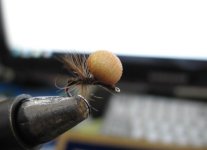
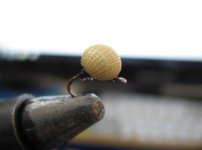
Let me show you a few of the flies I use. They're simple to tie, and I think they're worth trying when you run into fish behaving like that.

I've also found that carp cruising just beneath the surface, even when they're not obviously feeding, are often willing to take a well-presented dry fly placed in their line of travel.

The flies shown in the photos are tied on parachute or emerger hooks. I wrap a small piece of lightweight foam with women's nylon stocking material so that it resembles a single kernel of corn.

For lake carp, I believe smaller is usually better, so I try to make the corn imitation as small and subtle as possible.
 

Attachments

  • 화면 캡처 2026-11-01 003052.jpg
    화면 캡처 2026-11-01 003052.jpg
    142.2 KB · Views: 6
  • 화면 캡처 2026-11-01 003033.jpg
    화면 캡처 2026-11-01 003033.jpg
    127.6 KB · Views: 6
@Buzzy your desire to get a clooper on the schmootz is well noted. You don't have to pretend. Of course the standard nymphing is great, but to get em on a clump of green foam up on top? Just the the thought of those lips gracefully slurping on the fly.....
The funny thing is, we actually do catch carp that way. We tie green marabou flies and make them look just like the green schmootz floating on the surface. 😄
 

Attachments

  • 화면 캡처 2026-11-01 034652.jpg
    화면 캡처 2026-11-01 034652.jpg
    238.3 KB · Views: 11
  • 화면 캡처 2026-11-01 034101.jpg
    화면 캡처 2026-11-01 034101.jpg
    230.9 KB · Views: 11
That's interesting. I think it's similar in Korea. Because there is so much food available on the bottom in clear lakes, carp rising to dry flies actually seems to be more common in rivers near urban areas than in pristine waters.

To be honest, many years ago I uploaded some carp fly-fishing videos to YouTube, and they became fairly popular. The videos focused exclusively on carp dry fly fishing, from filming to editing. At the time, there were very few carp fly-fishing videos that featured dry flies at all.

Even now, there still aren't many videos of carp being caught on dry flies, which has always left me wondering: why don't anglers in other countries fish for carp with dry flies more often? Nymph fishing is great, of course, but carp on dry flies is incredibly fun as well.

That's actually what brought me to this forum. I was curious why so few people seem to pursue it.

By the way, I rely on online translation for English, so please excuse any awkward wording or expressions. 😊
Believe me, we have plenty of native English speakers who would do well to use the same tools as you 😂
 
Oh, that's exactly the kind of carp I target on lakes.

In my experience, if a carp is feeding on something at the surface, it's highly likely to eat a dry fly. The exact fly pattern is usually less important than the presentation.

The real key is to place the fly ahead of the fish's path, as naturally and unobtrusively as possible. You're not trying to get the carp to notice the fly from a distance and swim over to investigate it. Instead, you're putting it where the fish is already headed while feeding.

As long as the fly appears edible, the carp will make its own decision whether to suck it in or ignore it.

There are certainly situations where the pattern itself becomes important, but that's a separate discussion.

Let me show you a few of the flies I use. They're simple to tie, and I think they're worth trying when you run into fish behaving like that.

I've also found that carp cruising just beneath the surface, even when they're not obviously feeding, are often willing to take a well-presented dry fly placed in their line of travel.

The flies shown in the photos are tied on parachute or emerger hooks. I wrap a small piece of lightweight foam with women's nylon stocking material so that it resembles a single kernel of corn.

For lake carp, I believe smaller is usually better, so I try to make the corn imitation as small and subtle as possible.
I'm curious; are the lakes where you use these corn flies urban?
Meaning, are the carp fed corn on a regular basis?

I'm pretty sure the ones I see are not getting tossed corn or bread or anything else. Nor are they usually clooping schmoots. I can't see anything that they might be consuming. Midges, maybe?

I'll give it a shot, though!
Not really. Most lakes where people regularly throw bread or snacks to the carp are public park waters, and fishing is usually not allowed there.

For me, the main purpose of the corn fly is buoyancy. It also imitates the small round seeds, fruits, and other natural food items that carp commonly encounter. In urban waters, carp may have seen and eaten real corn kernels from time to time, but the fly is really just intended to look like a small, edible piece of organic matter drifting on the surface.

And yes, I think you're probably right. When carp appear to be feeding on something we can barely see, it's often midges or very tiny aquatic insects.

In those situations, we switch to a "midge corn" pattern, basically a midge hook with an extremely small foam corn attached, usually only 3-4 mm across.
The lake near me has "grass carp" and I haven't figured out a way to interest them in my flies. I have seen them "clooping" on the surface and you are giving me some ideas!

Sometimes they breach all the way out of the water and crash down on their sides, like a whale!
 
Last edited:
The lake near me has "grass carp" and I haven't figured out a way to interest them in my flies. I have seen them "clooping" on the surface and you are giving me some ideas!

Sometimes they beach all the way out of the water and crash down on their sides, like a whale!
We don't have many grass carp here, so my experience with them is pretty limited. But if their behavior is anything like common carp, I'd recommend being very patient when you see them clooping.

If the fly moves in the fish's view, there's a good chance it'll spook. I try to place the fly as close as possible and then simply wait for the fish to come to it.

The smaller the hook and fly, the quieter the presentation, which lets you cast much closer without alarming the fish.

And of course, never let the tippet land on or over the fish's head. That's a great way to send it running.
 
  • Like
Reactions: Zak
Back
Top