Carp have moved to deeper water?

I wouldn't characterize it as a shame, not at all. It's just very uncommon. I'm very happy fishing for carp with a sunken fly, it's still sight casting and at times only sensing when to set.
@Buzzy your desire to get a clooper on the schmootz is well noted. You don't have to pretend. Of course the standard nymphing is great, but to get em on a clump of green foam up on top? Just the the thought of those lips gracefully slurping on the fly.....
 
I actually see them at the surface a LOT, and often in groups. Sometimes but not always, they are "clooping" - tube mouths working the surface for something, but nothing I can identify.
I've never gotten them to eat any dry fly.

A week or so ago, there were carp, both singular and in groups, just milling around under the surface on a Basin lake. Some had their backs poking out of the water, but only saw one (out of dozens) with lips up.
Casting just outside one of the groups, I did get one to chase and eat a slow-stripped, glass bead head, black marabou leech just under the surface:
1000019695.jpg
 
I wouldn't characterize it as a shame, not at all. It's just very uncommon. I'm very happy fishing for carp with a sunken fly, it's still sight casting and at times only sensing when to set.
Sorry, I should clarify. The "that's a shame" comment wasn't directed at you at all. It was actually something I was saying to myself, but I think the translation may have caused a misunderstanding. Please don't take it the wrong way.

Even here in Korea, there are fly anglers who fish for carp exclusively with sunken flies. I know very well that it's a challenging, exciting, and highly rewarding way to fish.


This is a video I uploaded to YouTube a long time ago. Back then, carp fly fishing was viewed quite negatively by many fly anglers in Korea because it wasn't considered the traditional style of fly fishing in clean mountain streams.

Anyway, sorry for the long explanation. I do have other reasons why I feel a bit disappointed about the lack of carp rises, but explaining them would probably take much longer than this post.
If my wording gave the wrong impression, I apologize.

No apology necessary! Keep posting carp pics and comments, you are very much welcome to this forum. I got a kick out of watching your friend finally set the hook on a rising carp! //Pat
 
I actually see them at the surface a LOT, and often in groups. Sometimes but not always, they are "clooping" - tube mouths working the surface for something, but nothing I can identify.
I've never gotten them to eat any dry fly.

A week or so ago, there were carp, both singular and in groups, just milling around under the surface on a Basin lake. Some had their backs poking out of the water, but only saw one (out of dozens) with lips up.
Casting just outside one of the groups, I did get one to chase and eat a slow-stripped, glass bead head, black marabou leech just under the surface:
View attachment 195528
Oh, that's exactly the kind of carp I target on lakes.

In my experience, if a carp is feeding on something at the surface, it's highly likely to eat a dry fly. The exact fly pattern is usually less important than the presentation.

The real key is to place the fly ahead of the fish's path, as naturally and unobtrusively as possible. You're not trying to get the carp to notice the fly from a distance and swim over to investigate it. Instead, you're putting it where the fish is already headed while feeding.

As long as the fly appears edible, the carp will make its own decision whether to suck it in or ignore it.

There are certainly situations where the pattern itself becomes important, but that's a separate discussion.

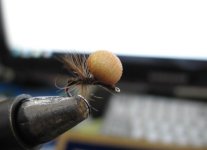
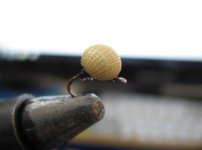
Let me show you a few of the flies I use. They're simple to tie, and I think they're worth trying when you run into fish behaving like that.

I've also found that carp cruising just beneath the surface, even when they're not obviously feeding, are often willing to take a well-presented dry fly placed in their line of travel.

The flies shown in the photos are tied on parachute or emerger hooks. I wrap a small piece of lightweight foam with women's nylon stocking material so that it resembles a single kernel of corn.

For lake carp, I believe smaller is usually better, so I try to make the corn imitation as small and subtle as possible.
 

Attachments

  • 화면 캡처 2026-11-01 003052.jpg
    화면 캡처 2026-11-01 003052.jpg
    142.2 KB · Views: 3
  • 화면 캡처 2026-11-01 003033.jpg
    화면 캡처 2026-11-01 003033.jpg
    127.6 KB · Views: 3
@Buzzy your desire to get a clooper on the schmootz is well noted. You don't have to pretend. Of course the standard nymphing is great, but to get em on a clump of green foam up on top? Just the the thought of those lips gracefully slurping on the fly.....
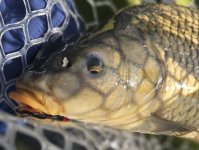
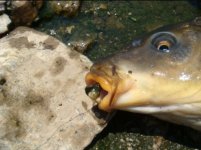
The funny thing is, we actually do catch carp that way. We tie green marabou flies and make them look just like the green schmootz floating on the surface. 😄
 

Attachments

  • 화면 캡처 2026-11-01 034652.jpg
    화면 캡처 2026-11-01 034652.jpg
    238.3 KB · Views: 0
  • 화면 캡처 2026-11-01 034101.jpg
    화면 캡처 2026-11-01 034101.jpg
    230.9 KB · Views: 0
Back
Top