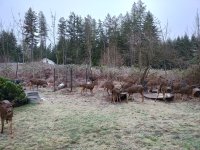
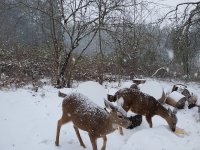
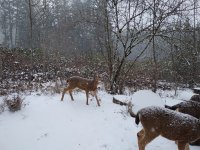
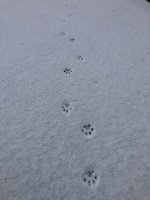
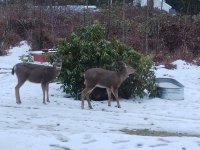
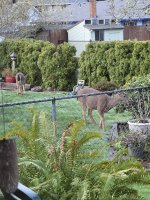
It is early February and the deer rut must be over. One forked subordinate buck still has his rack, hope springs eternal...
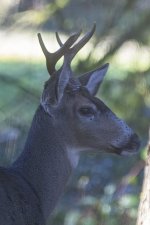
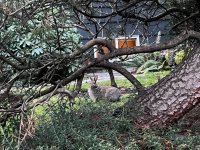
But the larger, more dominant bucks have dropped their antlers over the last week or two. One walked by my office window last week with only one antler; the next time I saw him, he had shed the other too. I managed to capture a few nice pictures of a buck with the scars on his head from where the antlers had been.
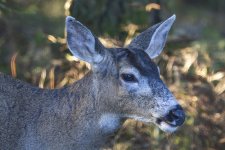
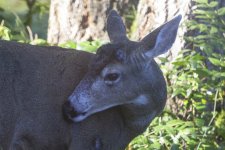
The bucks will have a few months to restore their nutritional states before they begin the antler-growing process again in the spring. Deer antlers are entirely composed of bone, albeit with less inorganic material, such as calcium, and more collagen proteins, than the skeleton. This makes the antlers less stiff and weaker than skeletal bones, but antlers are less likely to fracture.
Deer antlers grow at an amazing rate (0.25”/day in white-tailed deer, 1”/day in elk, a pound/day for a moose). Rising testosterone levels in the spring trigger the formation of new antler buds from attachment points on the skull (the pellicle) on the frontal bone. The growing antler is covered by a highly vascular skin, the velvet, which provides nutrients and oxygen to the chondroclasts and osteoblasts building the antler.


Like the bones of the appendicular skeleton (the femur, for example), the tip of an antler grows initially as a core of cartilage. This cartilage is then replaced by bone, a process known as endochondral ossification. A second process, intramembranous ossification (the process that builds skull bones, for example. This is the process that closes the “soft-spots” (fontanelles in the skull of a newborn), adds to the thickness of the antler.
These growth processes require a tremendous investment of nutrients, especially calcium. These demands cannot be met by a buck’s diet alone; calcium is robbed from other bones such as the ribs and scapula. Essentially, the tremendous nutritional (and energetic) cost of antler growth leads a buck to develop seasonal osteoporosis in other parts of his skeleton.
Once the antlers have completed their growth, blood flow to the velvet is stopped. The velvet dries and is scraped off by the buck (velvet shedding) in just a few days. The dead antlers are then used in battles between bucks (male competition) and in displaying to does (female mate choice). There is also evidence that antlers protect males from predators, such as wolves. Falling testerone levels due to shorter day lengths trigger osteoclast (bone resorbing cells) at the base of the antler to increase activity. The antlers are then shed and the pellicle scabs over.
Steve