Backyard Wildlife

The wire mesh I'm looking at has 2×4" openings. That said, I have yet to see a rabbit. Not sure if that's due to being surrounded by thick woods, or the eagles. Squirrels might be the real problem though.
2x4 is too large in my experience, looks nice but ineffective.
 
I used 1" grid plastic deer netting 7' high for my deer exclosure. Turns out that deer can break right through the plastic deer netting when they have a reason. I use 2" poultry netting for the replacement sections, but when I need to do it all over I will switch to some large mesh galvanized steel web for the deer fencing. I use 1" poultry netting 2' high around my raised bed garden area, and that has kept the rabbits out. But the bottom has to be buried slightly or the little buggers will dig under it.
 
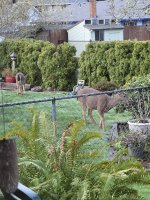
Lush lawn, plush bunny . . .
 
Nice lawn, no bunnies, lots of squirrels . . .
 
Was just reading some stuff last night and started hearing this bizarre wailing/screeching sound. I figured it was my neighbor, who likes to tool around and work with metal. Particularly spinning metal that shrieks as he cuts or grinds or turns it. Anyway, this sound didn't have that kind of predictable machine-like pitch or rhythms. So grabbed a flashlight and went outside to look. Two huge raccoons were in the tree by my kitchen window. For whatever reason Racoons love this sorta small Hinoki cypress we have, often we will see an adult + multiple babies in it. Although we have lots of trees in the yard, this 20 foot tree is their go-to.

Anyways these were two adults getting frisky. Trying to bite each other, hissing, crying out. But not exactly fighting. It looked super awkward and uncomfortable, and did I mention how loud they were? I called my wife over to have a look and she said to leave them alone, let them get it on. So fortunately/unfortunately there's no explicit photos of raccoon stuff sullying the austere pages of PNWFF's Backyard Wildlife thread for you....
 
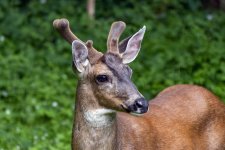
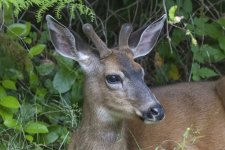
It is early February and the deer rut must be over. One forked subordinate buck still has his rack, hope springs eternal...
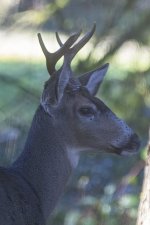
A01BuckWithForkedAntlers0821.jpg
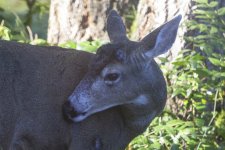
But the larger, more dominant bucks have dropped their antlers over the last week or two. One walked by my office window last week with only one antler; the next time I saw him, he had shed the other too. I managed to capture a few nice pictures of a buck with the scars on his head from where the antlers had been.
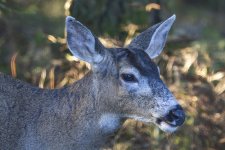
A02BuckWithAntlerScar0791.jpg
A03BuckWithAntlerScar0813.jpg
The bucks will have a few months to restore their nutritional states before they begin the antler-growing process again in the spring. Deer antlers are entirely composed of bone, albeit with less inorganic material, such as calcium, and more collagen proteins, than the skeleton. This makes the antlers less stiff and weaker than skeletal bones, but antlers are less likely to fracture.
Deer antlers grow at an amazing rate (0.25”/day in white-tailed deer, 1”/day in elk, a pound/day for a moose). Rising testosterone levels in the spring trigger the formation of new antler buds from attachment points on the skull (the pellicle) on the frontal bone. The growing antler is covered by a highly vascular skin, the velvet, which provides nutrients and oxygen to the chondroclasts and osteoblasts building the antler.
A04BuckGrowingAntlersProfile2738Trim.jpg
A05Buck2InVelvet2584Trim.jpg
Like the bones of the appendicular skeleton (the femur, for example), the tip of an antler grows initially as a core of cartilage. This cartilage is then replaced by bone, a process known as endochondral ossification. A second process, intramembranous ossification (the process that builds skull bones, for example. This is the process that closes the “soft-spots” (fontanelles in the skull of a newborn), adds to the thickness of the antler.
These growth processes require a tremendous investment of nutrients, especially calcium. These demands cannot be met by a buck’s diet alone; calcium is robbed from other bones such as the ribs and scapula. Essentially, the tremendous nutritional (and energetic) cost of antler growth leads a buck to develop seasonal osteoporosis in other parts of his skeleton.
Once the antlers have completed their growth, blood flow to the velvet is stopped. The velvet dries and is scraped off by the buck (velvet shedding) in just a few days. The dead antlers are then used in battles between bucks (male competition) and in displaying to does (female mate choice). There is also evidence that antlers protect males from predators, such as wolves. Falling testerone levels due to shorter day lengths trigger osteoclast (bone resorbing cells) at the base of the antler to increase activity. The antlers are then shed and the pellicle scabs over.
Steve

 
Just a couple of Robins hanging out in our locust tree. They seem chunkier than typical this year
View attachment 141933
That "rounded" look reflects a bird fluffing out its feathers to provide a thicker layer of insulation (dead air space) between the cold external environment and its warm body. That helps trap more warm air by increasing the distance that heat must travel to reach the outside environment. In summer, the feathers can be kept closer to the body to allow more body heat to dissipate. On contrast, mammals may grow a shorter summer coat and longer winter coat.
Steve
 
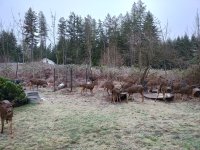
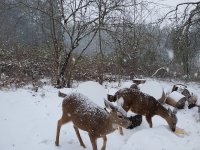
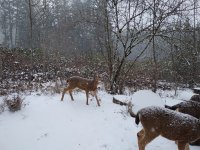
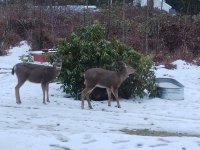
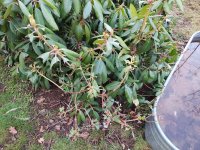
Just about every day, the deer come eat a few leaves off the rhododendron. Some branches are almost bare. From what I hear they are poisonous. I'm not a biologist but I suspect there may be something medicinal in small doses. Anybody else see this behavior?

I also hear cherry tree leaves are poisonous, but if I prune some branches, boy do they love the leaves.

1000003907.jpg

1000003912.jpg


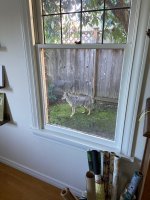
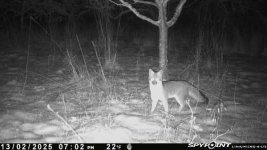
Also, would you agree this is a fox? Looks too short to be coyote.

1000003908.jpg
 
Last edited:
Sure looks like a Gray Fox to me.
 
Back
Top