Ridgefield NWR, late November. Part 4, Miscellaneous birds. When birding, I’m typically using my ears as much as my eyes to locate birds. The ability of the Merlin app to identify birds by song/calls is very helpful (but it can be wildly wrong…). Hearing birds vocalizing is more restricted while driving on the Auto Route at Ridgefield. Because you are constrained to your vehicle (except at the entrance kiosk and at one midway site where a trail leads to a blind), options to see / hear smaller birds and forest birds are somewhat limited to whatever appears while you drive by. This time of year, the avifauna is mix of straggling migrating birds that are refueling on their way south and resident birds that live at Ridgefield year-round.
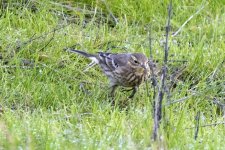
An example of former are American pipits.
View attachment 174114
American pipits breed in the grassy meadows and shrub patches in the Arctic and in mountain meadows. Most individuals migrate to the southern U.S. and Central America. As I drove past a flooded plowed field, I heard melodic “pi-pit” calls coming from the transition between the mud and the grass. Glassing where I heard the calls, I soon picked out a flock of 20+ cryptic American pipits that were frenetically searching the ground for insects and other food items. After days or weeks of refueling, they will head off soon to continue their migration.
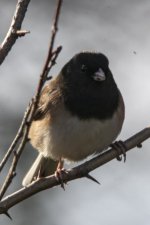
As I passed through a forested section on one loop, I could hear the high "chipping" calls of a flock black-eyed juncos and then a cheeky dark-eyed junco popped into a perfect photographic pose.
View attachment 174115
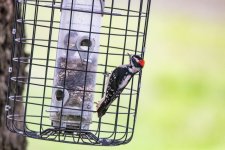
At the end of my second (of three) circuits, I got out of the truck to stretch my legs and to scan the bird feeder at the entrance kiosk. Often blackbirds, black-capped chickadees, and golden-crowned sparrows drop by the feeder. I could hear the sharp squeak of a downy woodpecker hidden in the foliage of nearby cottonwoods but it was well-hidden. While I was scanning for it, t finally flew across from the cottonwood to the feeder and grabbed a few seeds.
View attachment 174116If I hadn't heard its distinctive call, I wouldn't have spent the time to seek it out.
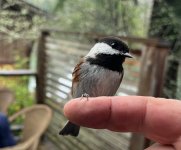
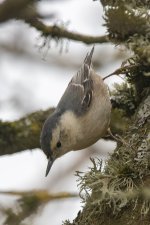
Ridgefield is just 100 miles south of Nisqually NWR, but there are some birds that are common at Ridgefield that are rare or absent at Nisqually and the South Sound region in general. The next species are quite rare further north (though their range has been moving north in the 20+ years that I have lived here). First, when we set up a bird feeder filled with Black sunflower seeds in our backyard, the feeder was often visited by red-breasted nuthatches. You will also encounter white-breasted nuthatches east of the mountains and south of Olympia,
View attachment 174117
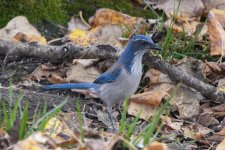
When I lived in Santa Barbara, scrub jays were common on campus and the neighborhoods, with Steller’s jays exclusively in the mountains. But in Olympia, we have Steller’s jays in my yard, but no scrub jays. Scrub jays have been expanding north and now appear in the Olympia area (and further north), especially in urban areas. At Ridgefield, handsome scrub jays are quite common.
View attachment 174118
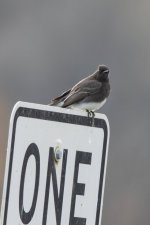
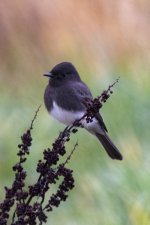
Finally, another bird that was common in Santa Barbara, the black phoebe, is quite rare in the Olympia area. But this species is a common sight at Ridgefield; I encountered at least five individuals on a single circuit of the Auto Route.
View attachment 174119
View attachment 174120
The black phoebe is a small flycatcher. It finds a perch from which it can burst into flight to intercept flying insects. In summer several other local flycatcher species breed at Nisqually, but they all migrate south in fall. A few black phoebes have appeared in the Chehalis flood plain. But the black phoebes at Ridgefield are present year-round.
Steve