Got any bird pics?

Nisqually NWR, early / mid-December. On the rare day when the sun is shining, the light even at midday is so rich. At this time of year the sun is so low on the horizon that the wavelengths of light that reach the surface are rich and warm like the golden hour after dawn or before dusk in mid-summer. A gap in our series of atmospheric rivers, Saturday dawned with clear skies and sunshine. After being cooped up for most of the previous week, I decided to head out to Nisqually NWR, especially to become more familiar with an early Xmas present to me, a Canon 5D mark IV camera. (early reviews – VERY nice). I typically do not visit Nisqually on a weekend, as it can be very crowded (and I have the option to visit midweek), but nice weather windows in December are rare. I managed to find into a spot in the full parking lot and skipped around a birding tour led by refuge volunteers.
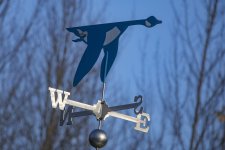
As I have mentioned before, Nisqually NWR is a great place to see ducks and geese up close. It is as if the birds are trying to serve as living representations of the “Blue Goose” symbol of the National Wildlife Refuge System. This symbol was created by J.N. Darling, a Pulitzer-Prize-winning political cartoonish and conservationist. A “Blue Goose” weather vane tops the Education Center at Nisqually NWR.
A00GooseWeathervane2C2A0099.jpg
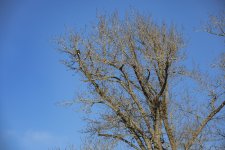
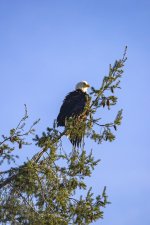
It is a bit incongruous to have ducks and geese blithely gorging or dozing in the refuge while you can hear shotgun blasts ringing around the periphery of the refuge. It may well be that the ducks and geese learn that the people walking along the trails at Nisqually are not threats (and their presence may even provide some protection from eagles and other potential predators). Of course, bald eagles represent a major threat (outside of hunters). After being absent for several months, the resident pair of eagles has returned to the nest tree by the Twin Barns.
A01aBaldEagleAdultInNestTree2C2A0164.jpg
A01bBaldEagle2C2A0425.jpg
Like other raptors, eagles begin the breeding season early so that their nestlings and fledglings are present when their food sources are peaking.
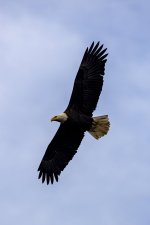
This time of year, the late chum run in the Nisqually River attracts other bald eagles to join the residents in the refuge. While I’m sure that chum carcasses are the main item on the menu, the eagles are not above adding the occasional duck or goose to their diet. If you see an explosion of cackling geese or ducks from across the refuge, you will typically find a bald eagle cruising the neighborhood.
A01cBaldEagleInFlight2C2A0075.jpg
On my recent visit, I encountered a very chill duck that allowed me to approach quite closely along the boardwalk. However, I have had some trouble coming up a precise identification, perhaps some type of teal.
A02UnidentifiedDuck2C2A0301.jpg
While less common (and quieter) than cackling geese, Canada geese are found in small flocks in the freshwater marshes and flooded grasslands.
A03CanadaGeeseK4A6119.jpg
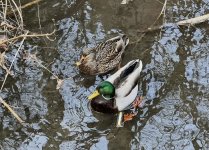
Mallards are also a consistent component of the avifauna. Less commonly seen in the salt marsh or mudflats, they are abundant in the freshwater marshes, the flooded fields,
A05MallardMob6846.jpg
the drainage canals (especially slurping duckweed),
A04MallardDrakeSlurpingDuckweed7022.jpg
and the main pond.
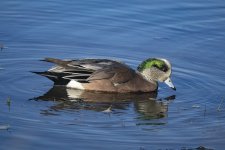
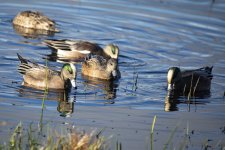
American wigeons are everywhere, especially in the saltwater mudflats and shoreline vegetation. It is quite common to find birds dozing at the junction of the gravel dike and the elevated boardwalk that leads out into the saltwater mudflats.
A06AmericanWigeons2C2A0139.jpg
A07AmericanWigeonDrake2C2A0236.jpg
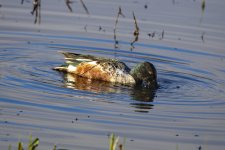
A good part of the diet of a northern shoveler comes from single-celled algae and other microorganisms in the water column. They are quite common in the seasonally-flooded fields / marsh to the south of the trail from the Visitor Center to Twin Barns. Commonly, you will find shovelers often a pair, quickly circling around a center point. These feeding movements, called vortexing, draws water and planktonic food into the middle where they can then filter the concentrated food.
A08NorthernShovelerDrake2C2A0144.jpg
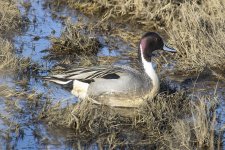
In contrast, northern pintails spend most of their feeding time with their beaks buried in the roots of waterlogged vegetation, either in the flooded grasslands or in the saltmarsh.
A09PintailDrake2C2A0324.jpg
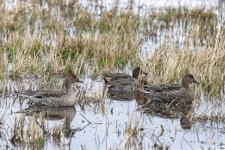
A10PintailHens&GreenWingedTealDrake7051.jpg
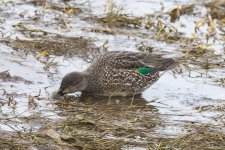
Green-winded teals (drakes above and hens below), like the northern pintails, will also dig among roots.
A11GreenWingedTealHenK4A6111.jpg
But they will also spend considerable effort slurping the biofilm from the surface of the mudflats.
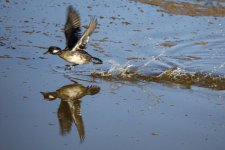
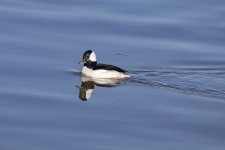
While the puddle ducks can be relatively nonchalant toward walkers at Nisqually, the diving ducks: the scoters, the goldeneyes, the ring-necked ducks, tend to be far more wary. Buffleheads in particular, are quite skittish when I try to capture a closer image. If they feel that I am too close, they will quickly swim away until they feel that they have a large enough buffer. But if I try to minimize my movements when they are at the surface and move to a closer vantage point when they are underwater, I can take the more intimate images that I am seeking.
A12BuffleheadHen2C2A0278.jpg
A12BuffleheadHenInFlight2C2A0214.jpg
A14BuffleheadDrake2C2A0290.jpg
Always fun to catch a sunny winter’s day.

Steve
 
Nisqually NWR, early / mid-December. On the rare day when the sun is shining, the light even at midday is so rich. At this time of year the sun is so low on the horizon that the wavelengths of light that reach the surface are rich and warm like the golden hour after dawn or before dusk in mid-summer. A gap in our series of atmospheric rivers, Saturday dawned with clear skies and sunshine. After being cooped up for most of the previous week, I decided to head out to Nisqually NWR, especially to become more familiar with an early Xmas present to me, a Canon 5D mark IV camera. (early reviews – VERY nice). I typically do not visit Nisqually on a weekend, as it can be very crowded (and I have the option to visit midweek), but nice weather windows in December are rare. I managed to find into a spot in the full parking lot and skipped around a birding tour led by refuge volunteers.
As I have mentioned before, Nisqually NWR is a great place to see ducks and geese up close. It is as if the birds are trying to serve as living representations of the “Blue Goose” symbol of the National Wildlife Refuge System. This symbol was created by J.N. Darling, a Pulitzer-Prize-winning political cartoonish and conservationist. A “Blue Goose” weather vane tops the Education Center at Nisqually NWR.
View attachment 174822
It is a bit incongruous to have ducks and geese blithely gorging or dozing in the refuge while you can hear shotgun blasts ringing around the periphery of the refuge. It may well be that the ducks and geese learn that the people walking along the trails at Nisqually are not threats (and their presence may even provide some protection from eagles and other potential predators). Of course, bald eagles represent a major threat (outside of hunters). After being absent for several months, the resident pair of eagles has returned to the nest tree by the Twin Barns.
View attachment 174823
View attachment 174824
Like other raptors, eagles begin the breeding season early so that their nestlings and fledglings are present when their food sources are peaking.
This time of year, the late chum run in the Nisqually River attracts other bald eagles to join the residents in the refuge. While I’m sure that chum carcasses are the main item on the menu, the eagles are not above adding the occasional duck or goose to their diet. If you see an explosion of cackling geese or ducks from across the refuge, you will typically find a bald eagle cruising the neighborhood.
View attachment 174825
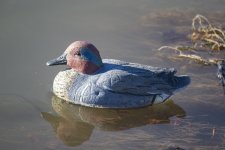
On my recent visit, I encountered a very chill duck that allowed me to approach quite closely along the boardwalk. However, I have had some trouble coming up a precise identification, perhaps some type of teal.
View attachment 174826
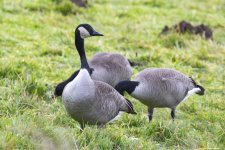
While less common (and quieter) than cackling geese, Canada geese are found in small flocks in the freshwater marshes and flooded grasslands.
View attachment 174827
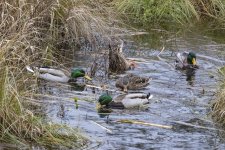
Mallards are also a consistent component of the avifauna. Less commonly seen in the salt marsh or mudflats, they are abundant in the freshwater marshes, the flooded fields,
View attachment 174829
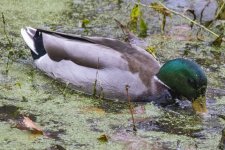
the drainage canals (especially slurping duckweed),
View attachment 174828
and the main pond.
American wigeons are everywhere, especially in the saltwater mudflats and shoreline vegetation. It is quite common to find birds dozing at the junction of the gravel dike and the elevated boardwalk that leads out into the saltwater mudflats.
View attachment 174830
View attachment 174831
A good part of the diet of a northern shoveler comes from single-celled algae and other microorganisms in the water column. They are quite common in the seasonally-flooded fields / marsh to the south of the trail from the Visitor Center to Twin Barns. Commonly, you will find shovelers often a pair, quickly circling around a center point. These feeding movements, called vortexing, draws water and planktonic food into the middle where they can then filter the concentrated food.
View attachment 174832
In contrast, northern pintails spend most of their feeding time with their beaks buried in the roots of waterlogged vegetation, either in the flooded grasslands or in the saltmarsh.
View attachment 174833
View attachment 174834
Green-winded teals (drakes above and hens below), like the northern pintails, will also dig among roots.
View attachment 174835
But they will also spend considerable effort slurping the biofilm from the surface of the mudflats.
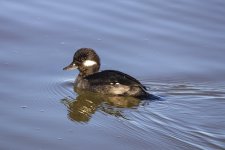
While the puddle ducks can be relatively nonchalant toward walkers at Nisqually, the diving ducks: the scoters, the goldeneyes, the ring-necked ducks, tend to be far more wary. Buffleheads in particular, are quite skittish when I try to capture a closer image. If they feel that I am too close, they will quickly swim away until they feel that they have a large enough buffer. But if I try to minimize my movements when they are at the surface and move to a closer vantage point when they are underwater, I can take the more intimate images that I am seeking.
View attachment 174836
View attachment 174837
View attachment 174838
Always fun to catch a sunny winter’s day.

Steve
I swear, that putative "teal" looks like a wood-carved decoy - is it just me?

Great post as usual!!

cheers
 
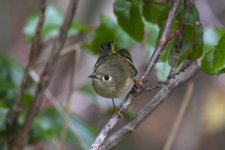
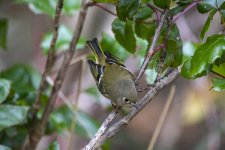
Nisqually NWR, early / mid-December. Insectivorous birds. As the temperatures turns cooler, the insectivores coalesce to form mixed-species feeding flocks. They also become more focused on gathering as many calories as possible in the shorter days (and are therefore a little less wary). Even on a busy Saturday, I could hear chickadees and kinglets in the alders and other trees just off the Twin Barns boardwalk. Of course, their frenetic movements don’t make them easy subjects for photographs. But with digital cameras, quantity can lead to quality (“even a blind squirrel finds the occasional nut”).
At this time, this male ruby-crowned kinglet is keeping his light under a bushel.
A01RubyCrownedKingletMaleK4A6058.jpg
A02RubyCrownedKingletMale_K4A6057.jpg
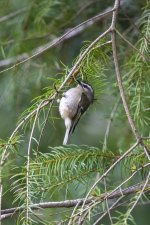
In summer, I hear golden-crowned kinglets foraging high in the canopy. However, in winter, they move much closer to the ground.
A03GoldenCrownedKingletK4A6065.jpg

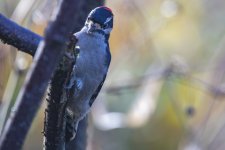
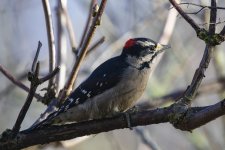
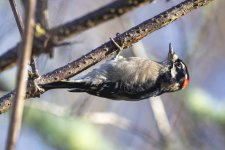
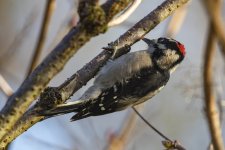
I heard the “squeaking” first. A male downy woodpecker came into view. It was methodically searching the stems of a common elderberry for burrowing insects.
A05DownyWoodpecker2C2A0367.jpg
A06DownyWoodpecker2C2A0418.jpg
It knew that I was there, but I kept still and relied on my telephoto lens. The downy continued to search for a snack.
A07DownyWoodpecker2C2A0401.jpg
It found something that was picked up with its cute red tongue.
A08DownyWoodpecker2C2A0397.jpg
Steve
 
Great photos, Steve!
 
If you find yourself on the wet side they are at Finley NWR year round. I can even point you to a spot they hang around more often than not.
My mother in law lives in Corvallis. I will have to check that place out.

In fact I read Northern Harrier and was thinking Goshawk - not quite the same thing. I have seen plenty of Marsh Hawks. When did they become Northern Harriers?
 
My mother in law lives in Corvallis. I will have to check that place out.

In fact I read Northern Harrier and was thinking Goshawk - not quite the same thing. I have seen plenty of Marsh Hawks. When did they become Northern Harriers?
Goshawk is on my list too, I’m of no help there.
Finley is always worth driving though in the winter for the birds, plus you have the possibility of spotting the local elk herd.
 
My mother in law lives in Corvallis. I will have to check that place out.

In fact I read Northern Harrier and was thinking Goshawk - not quite the same thing. I have seen plenty of Marsh Hawks. When did they become Northern Harriers?
Hi CG,
In the early 1980's as molecular analyses began to become more comprehensive, the American Ornithological Union decided to restrict the work "hawk" to accipiters, especially in the genus Buteo (aka "buzzards" in Europe). Part of the drive was to have the common names reflect more specifically the taxonomic / evolutionary relationships, versus simple resemblance to some Old-world bird. Therefore, marsh hawk became Northern harrier. Harrier is the term used to refer to related species, also in the genus Circus, elsewhere in the world. The "marsh hawk" was the only species in this genus that wasn't called a "harrier".
This reasoning was also the impetus for renaming the American sparrowhawk as the American kestrel about the same time. This is especially appropriate as a kestrel is a falcon, not an accipiter such as a sharp-shinned hawk. That also led to the suppression of of "pigeon hawk" now merlin and "duck hawk" versus peregrine falcon, all in the order Falconiformes, not order Accipiteriformes.
The common names of birds have been tighter under national and international regulation for a long time. Because of this consistency, most birders, even ornithologists, use common names more often than scientific names.
While there have been some attempts at standardization of common names in the fish literature, generally the common names are far looser (hence why scientific names must be used). For example, the lingcod (Ophiodon elongatus) is neither a "ling" (family Lotidae) nor a "cod" (genus Gadus) (both in the order Gadiformes) but a greenling in the suborder Cottoidei, family Hexagramidae.
Steve
 
Goshawk is on my list too, I’m of no help there.
Finley is always worth driving though in the winter for the birds, plus you have the possibility of spotting the local elk herd.

I've been fortunate to have had several goshawk sightings over the years but almost never when I am looking for them. When I worked for NPS in Tuolumne Meadows/Yosemite, we had a neighborhood goshawk that regularly nabbed stellar jays out of our employee residential compound (elevation 8000'). In recent years, most of my observations were in California's South Cascades and Klamath Mountains - generally above 5,000' elevation. My only Oregon sighting was in the Klamath Mountains of Cascade Siskiyou National Monument near the California/Oregon border. I really haven't spent much time in good goshawk habitat since relocating to Oregon. I am always on the lookout for them when I am in the higher elevation spots of the Coast Range in Lincoln and Tillamook Counties.
 
Last edited:
I had the pleasure to work in the woods outside of Enterprise, OR one summer. In my work area there was a goshawk nest. I had numerous sightings of both the male and female. Sometimes they would announce their presence flying through and breaking small pine branches. Of course, the ground squirrels also announced their presence. Very special sightings for me.
 
Scott's post reminded me that for part of one summer while I was there, the Park Service had to close the Four Mile Trail between Yosemite Valley and Glacier Point due to its proximity to a goshawk nest. A hiker sustained minor injuries when a dive bombing goshawk impaled her scalp with its talons. While the pair were in the egg laying/incubating phase, the Service briefly considered cutting down the lodgepole pine where the nest was located. I was to be teamed up with a forestry tech (the sawyer) and we were supposed to do the dastardly deed. They hemmed and hawed long enough that the eggs hatched so the decision was made to just close the very popular trail. Keep in mind that this was in the late 1970's. ;)
 
Last edited:
RR - can’t believe they would actually consider cutting down a nesting tree.
Barred owls are very aggressive, even now. An open season them?
 
RR - can’t believe they would actually consider cutting down a nesting tree.
Barred owls are very aggressive, even now. An open season them?

Scott - I agree that the idea of cutting down a nest tree sounds horrific. The no brainer was to close the trail but at the time, that was something the park was hoping to avoid given the time from incubation to fledging would be during the peak of the visitor season. The Chief of Resources Management (Dick Riegelhuth) was this old school WW II vet - I remember being scared of him :LOL: . I was just a seasonal scientific technician but my supervisor who was the wildlife biologist said that the thought process was to try to get the pair to move to another tree further away from the trail.
 
Ridgefield NWR, late November. Part 4, Miscellaneous birds. When birding, I’m typically using my ears as much as my eyes to locate birds. The ability of the Merlin app to identify birds by song/calls is very helpful (but it can be wildly wrong…). Hearing birds vocalizing is more restricted while driving on the Auto Route at Ridgefield. Because you are constrained to your vehicle (except at the entrance kiosk and at one midway site where a trail leads to a blind), options to see / hear smaller birds and forest birds are somewhat limited to whatever appears while you drive by. This time of year, the avifauna is mix of straggling migrating birds that are refueling on their way south and resident birds that live at Ridgefield year-round.
An example of former are American pipits.
View attachment 174114
American pipits breed in the grassy meadows and shrub patches in the Arctic and in mountain meadows. Most individuals migrate to the southern U.S. and Central America. As I drove past a flooded plowed field, I heard melodic “pi-pit” calls coming from the transition between the mud and the grass. Glassing where I heard the calls, I soon picked out a flock of 20+ cryptic American pipits that were frenetically searching the ground for insects and other food items. After days or weeks of refueling, they will head off soon to continue their migration.
As I passed through a forested section on one loop, I could hear the high "chipping" calls of a flock black-eyed juncos and then a cheeky dark-eyed junco popped into a perfect photographic pose.
View attachment 174115
At the end of my second (of three) circuits, I got out of the truck to stretch my legs and to scan the bird feeder at the entrance kiosk. Often blackbirds, black-capped chickadees, and golden-crowned sparrows drop by the feeder. I could hear the sharp squeak of a downy woodpecker hidden in the foliage of nearby cottonwoods but it was well-hidden. While I was scanning for it, t finally flew across from the cottonwood to the feeder and grabbed a few seeds.
View attachment 174116If I hadn't heard its distinctive call, I wouldn't have spent the time to seek it out.
Ridgefield is just 100 miles south of Nisqually NWR, but there are some birds that are common at Ridgefield that are rare or absent at Nisqually and the South Sound region in general. The next species are quite rare further north (though their range has been moving north in the 20+ years that I have lived here). First, when we set up a bird feeder filled with Black sunflower seeds in our backyard, the feeder was often visited by red-breasted nuthatches. You will also encounter white-breasted nuthatches east of the mountains and south of Olympia,
View attachment 174117
When I lived in Santa Barbara, scrub jays were common on campus and the neighborhoods, with Steller’s jays exclusively in the mountains. But in Olympia, we have Steller’s jays in my yard, but no scrub jays. Scrub jays have been expanding north and now appear in the Olympia area (and further north), especially in urban areas. At Ridgefield, handsome scrub jays are quite common.
View attachment 174118
Finally, another bird that was common in Santa Barbara, the black phoebe, is quite rare in the Olympia area. But this species is a common sight at Ridgefield; I encountered at least five individuals on a single circuit of the Auto Route.
View attachment 174119
View attachment 174120
The black phoebe is a small flycatcher. It finds a perch from which it can burst into flight to intercept flying insects. In summer several other local flycatcher species breed at Nisqually, but they all migrate south in fall. A few black phoebes have appeared in the Chehalis flood plain. But the black phoebes at Ridgefield are present year-round.

Steve
Steve that is super interesting about resident black phoebe at Ridgedield in WA state.

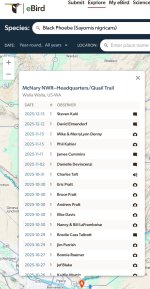
There has been one locally around McNary NWR this fall.

Perhaps, like the scrub jays they have been expanding their range northward and then eastward through the gorge.

I became familiar with them on San Diego trips, from beach bluffs to neighborhood no parking signs, and in the Ash meadows NWR in southern NV

Jay

IMG_1454.jpeg
 
Last edited:
@Cabezon

Oh I see now you already mentioned about range extensions for several birds

Jay

I’ll add, scrub jays are common in specific places from umatilla OR and Finley Wa to walla walla

I happen to have also seen a scrub Jay in a yard in Burns OR a couple of weeks ago!
 
Last edited:
Back
Top