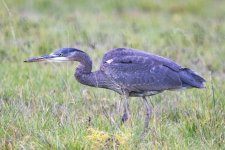
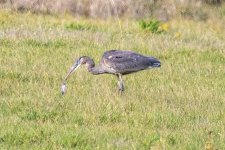
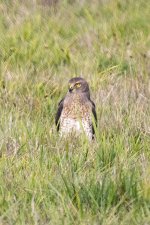
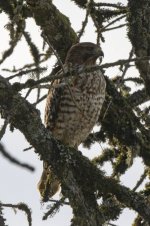
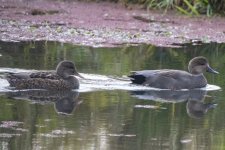
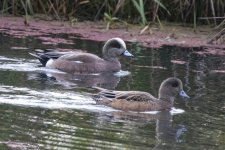
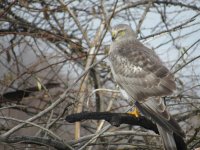
Got any bird pics?

Nice shots, Brian. Must have been after tree frogs . . . ;)

It has always amazed me that these long-legged feathered critters nest in the top of tree canopies.

Jim,
There were some frogs croaking so I’d imagine they are on the menu.

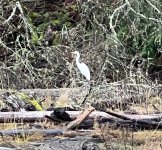
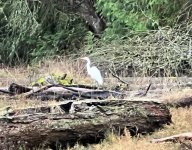
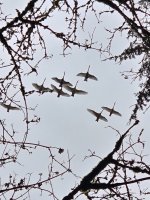
Less then stellar pictures on this one, but since it is white I assume it’s an egret?
I’ve seen them before but can’t remember seeing one on the sound before. It flew by me just as it was getting light and I was thinking, damn that is a big seagull! 😂
SF

IMG_4890.jpegIMG_4889.jpeg
 
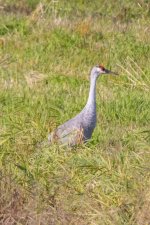
Ridgefield NWR, late November. Part 2, Cranes, Herons, and shorebirds. The Auto Route at Ridgefield is a reliable site to see Sandhill Cranes in Western Washington in winter. In spring 2020 (during COVID restrictions) , one pair even nested at the refuge, but the colt does not appear to survived. In the fall, most sandhill cranes migrate to the Central Valley of California, to the Texas / Mexico border, or to Florida, / Cuba, but the marshes and meadows at Ridgefield and other nearby areas along the Columbia River attract many birds through the winter. Their bugling calls ring across the refuge (“Jurassic Park” vibes…). They do not overwinter at Nisqually NWR, but I have heard and seen them flying overhead during spring migration. If you fish Dry Falls in the spring, you will often hear them flying overhead as they move from Othello and other nearby sleeping areas in the southcentral Columbia Basin to feeding areas during their “refueling” stop.
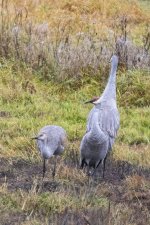
Many sandhill cranes at Ridgefield are organized as family groups, two life-long mates (with red masks)
C02SandhillCraneAdult7431.jpg
and this year’s colt (no mask, a rusty cap and neck, more rusty feathers along sides and wings).
C01SandhillCraneFamily7546.jpg
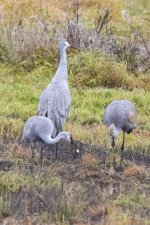
In this image, both the colt and a parent have dug up tubers from the mud for lunch.
C03SandhillCranesWBulbs7541.jpg
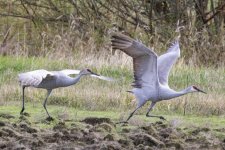
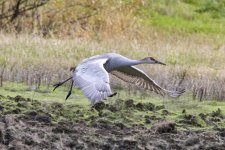
With a 6.5’ wingspan and broad wings, a sandhill are capable of soaring like a hawk or eagle
C04SandhillCranesTakingOff7382.jpg
C05SandhillCraneInFlight7385.jpg
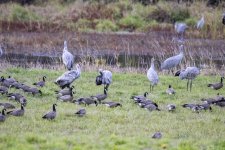
In addition to several family groups scattered across the refuge, we also encountered a larger aggregation of a dozen sandhills (quite size difference between the cranes and the cackling geese).
C06SandhillCranes&CacklingGeese7486.jpg
Some birds were feeding. Others were preening feathers. Others were noisily squabbling with their neighbors.

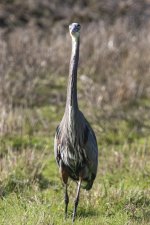
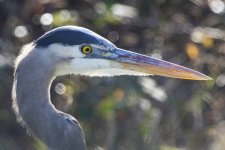
Unlike sandhill cranes, great blue herons are widespread in Western Washington.
D07GreatBlueHeron7137.jpg
D08GreatBlueHeronHeadShot7156.jpg
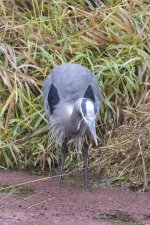
Often, you will see a heron hunting at the edge of a canal.
D09GreatBlueHeronHuntingInCanal7575.jpg
But most great blue herons at Ridgefield are stealthily stalking rodents in the grasslands.
D10GreatBlueHeronStalking7493.jpgIf you watch for just a few minutes, you are very likely to see a lightning stab by a heron. After a successful stab, the heron will pull up a vole
D11aGreatBlueHeronWVole7407.jpg
which is quickly swallowed whole. While Nisqually NWR has grassy meadows (major feeding grounds for cackling geese and American wigeons), I do not often see great blue herons hunting here.

The rodent populations in the Ridgefield grasslands also support a great egret or two (very rare at Nisqually), several northern harriers
D11bNorthernHarrierHen7394.jpg
(many fewer at Nisqually), red tailed hawks,
D11cRedTailedHawkJuvenile7233.jpg
and several American kestrels (rarer at Nisqually NWR).

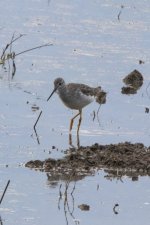
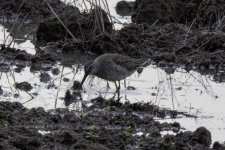
I see shorebirds more consistently at Nisqually NWR, especially in the salt-water mud flats and the estuarine shores of McAllister Creek. While less abundant, there are often a few shorebirds foraging along the shorelines of muddy ponds at Ridgefield. These include a solitary noisy greater yellowlegs
D12GreaterYellowlegs7298.jpg

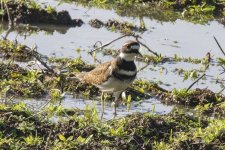
prim-and-proper killdeer,
D13Killdeer7126.jpg
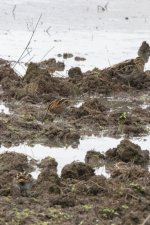
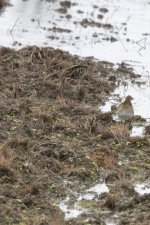
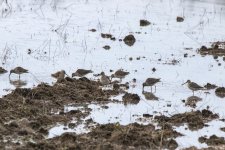
a cluster of cryptic Wilson’s snipes (actually more commonly seen at Ridgefield vs Nisqually),
D14WilsonsSnipes7604.jpg
D15WIlsonsSnipe7619.jpg
and a flock of industrious long-billed dowitchers.
D16LongBilledDowitcher7314.jpg
D17LongBilledDowitchers7319.jpg
Steve
 
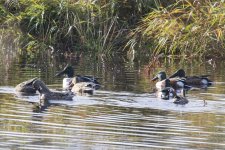
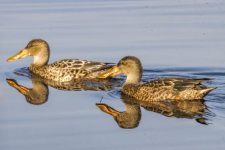
Ridgefield NWR, late November. Part 3, Ducks and grebes. Even with hunting pressure just outside the refuge, Nisqually is a great place to view ducks up close. Yes, they are wary but the distance between you and them is often quite close. In contrast. Ridgefield can be hit or miss for observing ducks up close. Most of the ducks at Ridgefield are feeding / preening / resting in the ponds, but typically 100’ or more from the road. If there has been a lull in the birding traffic, a few ducks might wander closer to the road to feed, like these Northern shovelers.
E01NorthernShovelers7074.jpg
E02NorthernShovelerHens7218.jpg
However, they quickly beat a retreat beyond that safe buffer distance as your vehicle (your mobile “blind”) approaches.
Ducks, such as gadwalls
E03GadwallPair7350.jpg
E04GadwallDrake7357.jpg
and American wigeons,
E05AmericanWigeon7360.jpg
in the canals allow the closest approach, but they also will quickly swim toward cover or areas that are out of sight of the road as your vehicle approaches.
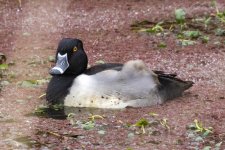
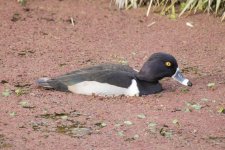
I encountered a sole ring-necked duck drake chowing down on azolla (Azolla pinnata) in a canal just covered with this aquatic fern.
E06RingNeckedDrakeInAzolla7587.jpg
E07RingNeckedDuck7452.jpg
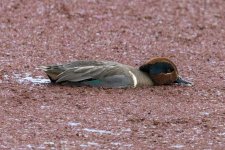
Like the unrelated duckweed, these small azolla fern plants float at the surface in calm waters; this is facilitated by small water-repellent hairs on the surface of its leaves. Azolla grows rapidly, capable of doubling in mass in two days. The population can expand asexually by fragmentation and also through the germination of spores. It partners with a symbiotic cyanobacterium that converts (“fixes”) atmospheric nitrogen (N2) into forms that the fern can use. Not only does this symbiosis allow azolla to thrive in low-nitrogen environments, but it also makes azolla a rich food source for herbivores like this ring-necked duck. In another canal, several green-winged teals, like this drake, weren’t even making a dent in the azolla abundance even with their voracious appetites.
E08GreenWingedTealDrake7375.jpg
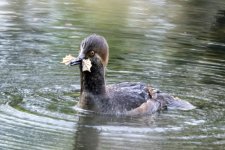
Hooded mergansers
E09HoodedMerganserHen7649.jpg
are certainly not herbivores. I missed the start of the hunt, I arrived as this hen was manipulating a frog that it caught.
E10HoodedMerganserHenWFrog7345.jpg
And in the last stage, I did capture the moment when just the frog’s hind feet waved goodbye...
E11HoodedMerganserHenSwallowFrog7348.jpg
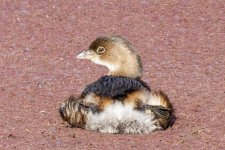
Finally, I consistently find pied-billed grebes in these canals. Sometimes, they are shy and turn away or dive when our mobile blind approaches.
E12PiedBIlledGrebeInAzolla7103.jpg
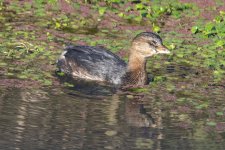
Other times, they are more cooperative (or you can catch them just as they surface).
E13PiedBilledGrebe7223.jpg
Steve
 
Ridgefield NWR, late November. Part 4, Miscellaneous birds. When birding, I’m typically using my ears as much as my eyes to locate birds. The ability of the Merlin app to identify birds by song/calls is very helpful (but it can be wildly wrong…). Hearing birds vocalizing is more restricted while driving on the Auto Route at Ridgefield. Because you are constrained to your vehicle (except at the entrance kiosk and at one midway site where a trail leads to a blind), options to see / hear smaller birds and forest birds are somewhat limited to whatever appears while you drive by. This time of year, the avifauna is mix of straggling migrating birds that are refueling on their way south and resident birds that live at Ridgefield year-round.
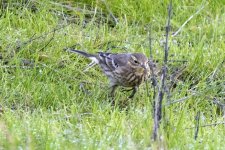
An example of former are American pipits.
F01AmericanPipit7277.jpg
American pipits breed in the grassy meadows and shrub patches in the Arctic and in mountain meadows. Most individuals migrate to the southern U.S. and Central America. As I drove past a flooded plowed field, I heard melodic “pi-pit” calls coming from the transition between the mud and the grass. Glassing where I heard the calls, I soon picked out a flock of 20+ cryptic American pipits that were frenetically searching the ground for insects and other food items. After days or weeks of refueling, they will head off soon to continue their migration.
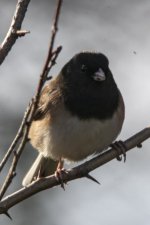
As I passed through a forested section on one loop, I could hear the high "chipping" calls of a flock black-eyed juncos and then a cheeky dark-eyed junco popped into a perfect photographic pose.
F02DarkEyedJunco7108.jpg
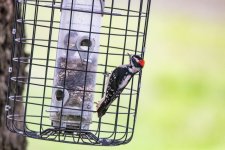
At the end of my second (of three) circuits, I got out of the truck to stretch my legs and to scan the bird feeder at the entrance kiosk. Often blackbirds, black-capped chickadees, and golden-crowned sparrows drop by the feeder. I could hear the sharp squeak of a downy woodpecker hidden in the foliage of nearby cottonwoods but it was well-hidden. While I was scanning for it, t finally flew across from the cottonwood to the feeder and grabbed a few seeds.
F03DownyWoodpeckerAtFeeder7504.jpgIf I hadn't heard its distinctive call, I wouldn't have spent the time to seek it out.
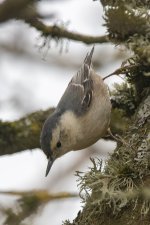
Ridgefield is just 100 miles south of Nisqually NWR, but there are some birds that are common at Ridgefield that are rare or absent at Nisqually and the South Sound region in general. The next species are quite rare further north (though their range has been moving north in the 20+ years that I have lived here). First, when we set up a bird feeder filled with Black sunflower seeds in our backyard, the feeder was often visited by red-breasted nuthatches. You will also encounter white-breasted nuthatches east of the mountains and south of Olympia,
F04WhiteBreastedNuthatch7518.jpg
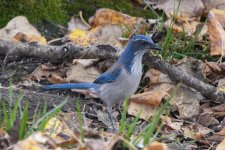
When I lived in Santa Barbara, scrub jays were common on campus and the neighborhoods, with Steller’s jays exclusively in the mountains. But in Olympia, we have Steller’s jays in my yard, but no scrub jays. Scrub jays have been expanding north and now appear in the Olympia area (and further north), especially in urban areas. At Ridgefield, handsome scrub jays are quite common.
F05CaliforniaScrubJay7503.jpg
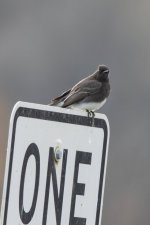
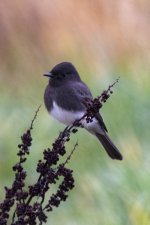
Finally, another bird that was common in Santa Barbara, the black phoebe, is quite rare in the Olympia area. But this species is a common sight at Ridgefield; I encountered at least five individuals on a single circuit of the Auto Route.
F06BlackPhoebe7471.jpg
F07BlackPhoebe7659.jpg
The black phoebe is a small flycatcher. It finds a perch from which it can burst into flight to intercept flying insects. In summer several other local flycatcher species breed at Nisqually, but they all migrate south in fall. A few black phoebes have appeared in the Chehalis flood plain. But the black phoebes at Ridgefield are present year-round.

Steve

 
E11HoodedMerganserHenSwallowFrog7348.jpg
Who, me? I haven't seen your frog.

Great photos as usual, Steve!
 
There are some data on the timing (and mechanism) of the scrub jay's range extension into the PNW. As I indicated in my post, a number of other California species, such as black phoebe, great egret, turkey vulture, Anna's hummingbirds, and red-shouldered hawks, are expanding their range north as reflected in Christmas Bird Count data (see here). One hypothesis has been a trend of increasingly warmer winters.
Steve
 
There are some data on the timing (and mechanism) of the scrub jay's range extension into the PNW. As I indicated in my post, a number of other California species, such as black phoebe, great egret, turkey vulture, Anna's hummingbirds, and red-shouldered hawks, are expanding their range north as reflected in Christmas Bird Count data (see here). One hypothesis has been a trend of increasingly warmer winters.
Steve
Egrets aren't exactly common here in SWW, but not rare either. Saw the first one from our place last week flying downriver. Not that I expect to find any but I suppose egret feathers are illegal to pick up, let alone tie with - hypothetically speaking of course.
 
Ridgefield NWR, late November. Part 4, Miscellaneous birds. When birding, I’m typically using my ears as much as my eyes to locate birds. The ability of the Merlin app to identify birds by song/calls is very helpful (but it can be wildly wrong…). Hearing birds vocalizing is more restricted while driving on the Auto Route at Ridgefield. Because you are constrained to your vehicle (except at the entrance kiosk and at one midway site where a trail leads to a blind), options to see / hear smaller birds and forest birds are somewhat limited to whatever appears while you drive by. This time of year, the avifauna is mix of straggling migrating birds that are refueling on their way south and resident birds that live at Ridgefield year-round.
An example of former are American pipits.
View attachment 174114
American pipits breed in the grassy meadows and shrub patches in the Arctic and in mountain meadows. Most individuals migrate to the southern U.S. and Central America. As I drove past a flooded plowed field, I heard melodic “pi-pit” calls coming from the transition between the mud and the grass. Glassing where I heard the calls, I soon picked out a flock of 20+ cryptic American pipits that were frenetically searching the ground for insects and other food items. After days or weeks of refueling, they will head off soon to continue their migration.
As I passed through a forested section on one loop, I could hear the high "chipping" calls of a flock black-eyed juncos and then a cheeky dark-eyed junco popped into a perfect photographic pose.
View attachment 174115
At the end of my second (of three) circuits, I got out of the truck to stretch my legs and to scan the bird feeder at the entrance kiosk. Often blackbirds, black-capped chickadees, and golden-crowned sparrows drop by the feeder. I could hear the sharp squeak of a downy woodpecker hidden in the foliage of nearby cottonwoods but it was well-hidden. While I was scanning for it, t finally flew across from the cottonwood to the feeder and grabbed a few seeds.
View attachment 174116If I hadn't heard its distinctive call, I wouldn't have spent the time to seek it out.
Ridgefield is just 100 miles south of Nisqually NWR, but there are some birds that are common at Ridgefield that are rare or absent at Nisqually and the South Sound region in general. The next species are quite rare further north (though their range has been moving north in the 20+ years that I have lived here). First, when we set up a bird feeder filled with Black sunflower seeds in our backyard, the feeder was often visited by red-breasted nuthatches. You will also encounter white-breasted nuthatches east of the mountains and south of Olympia,
View attachment 174117
When I lived in Santa Barbara, scrub jays were common on campus and the neighborhoods, with Steller’s jays exclusively in the mountains. But in Olympia, we have Steller’s jays in my yard, but no scrub jays. Scrub jays have been expanding north and now appear in the Olympia area (and further north), especially in urban areas. At Ridgefield, handsome scrub jays are quite common.
View attachment 174118
Finally, another bird that was common in Santa Barbara, the black phoebe, is quite rare in the Olympia area. But this species is a common sight at Ridgefield; I encountered at least five individuals on a single circuit of the Auto Route.
View attachment 174119
View attachment 174120
The black phoebe is a small flycatcher. It finds a perch from which it can burst into flight to intercept flying insects. In summer several other local flycatcher species breed at Nisqually, but they all migrate south in fall. A few black phoebes have appeared in the Chehalis flood plain. But the black phoebes at Ridgefield are present year-round.

Steve
geez, i am going to have to visit ridgefield. its not far from where we now live.
 
I'll second that! Great shot, Rich!
 
There are some data on the timing (and mechanism) of the scrub jay's range extension into the PNW. As I indicated in my post, a number of other California species, such as black phoebe, great egret, turkey vulture, Anna's hummingbirds, and red-shouldered hawks, are expanding their range north as reflected in Christmas Bird Count data (see here). One hypothesis has been a trend of increasingly warmer winters.
Steve
Steve, FWIW, scrub jays have been very common here in SWW since I've lived here in the mid 70's. At least in more open environments like typical single family home neighborhoods. Deeper into the woods or hills and Stellars are the main jay.
A fun anecdote from those days. There was a scrub jay that would make a ruckus every morning in a tree just outside my BR window. Not what a 20 yo night owl wants to hear first thing. Finally got fed up and rigged a snare with mono and some surgical tubing. Next morning it was ruckus X10. Found my little blue friend very unhappy, hanging by his feet, but unharmed. After a brief discussion I let him go. Apparently he got the message and never woke me up again. Smart birds.
 
Last edited:
Back
Top