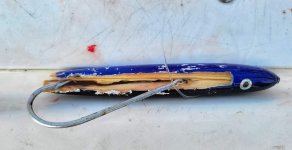
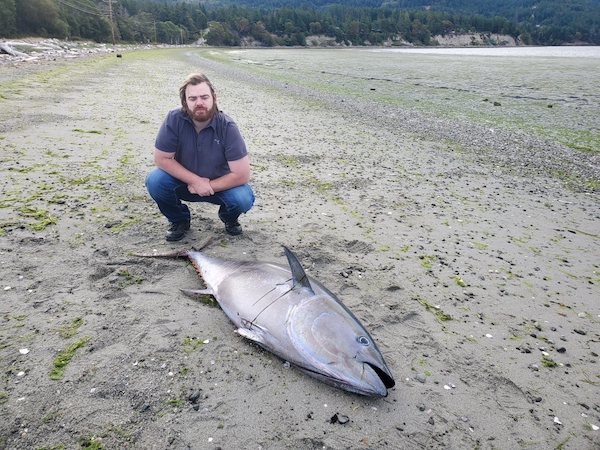
Pretty sure I'm not the only one itching to get on the popper board this year. So paging
@Nick Clayton for a mini tutorial. I know most of this has been covered before but would be nice to have a season start primer here.
Focus points I'm interested in:
1) A quick step by step on your tuna popper, or at least what you feel the key aspects of a good albacore popper.
2) What situations trigger your spidey sense to break out the floater rod?
3) How to fish it
1. Here's a video I made a few years ago showing how I typically tie mine. I will often experiment and substitute materials, but tend to stick pretty close to this.
IMO the biggest factors that I focus on is a semi anchovy-ish color scheme. Basically I tend to work with white/grey/barred grizzly, those kinds of colors. Since I'm trying to imitate an anchovy skittering along the surface I try to avoid unnatural colors.
I also like to use a head big enough that it will keep the fly right on the surface in any ocean condition I'd actually be fishing it on. This can be a bit challenging as it takes a lot of flotation to keep something on top when it's being stripped through ocean waves.
And IMO the most important thing is tying it slider style, and not as an actual "popper" that pops and gurgles and makes a commotion. (Those kinds of poppers can work at times but I find a slider that just leaves a steady V wake to be much more effective across the board).
I wish I could list exactly what heads I use, but I'm still kinda dialing that in. When I originally started tying these I had the perfect heads on hand, but I didn't pay too close attention to the specific brand/size as I didn't realize it might be difficult to find the perfect size. So now days I just go for the biggest slider head I can find. To me the head is simply about keeping it on top and helping to produce that V wake. Even if it looks abnormally large compared to the overall fly, it doesn't seem to matter to the fish.
In a nut shell this is simply a larger and simplified version of the Miyawaki Popper minus the trailing hook. Just no need for a trailer with albacore.
2. When I first started fishing these I would tend to bust out the floater only on a lake flat ocean when the fish were up and boiling on our chum regularly. And in these scenarios this fly works great. Over the last couple of years I've found myself fishing on top more and more in conditions that would seem less than ideal to do so, and have been impressed with the results. I dont really enjoy fishing topwater when the ocean is super choppy or mixed up. It can still be done, but I just prefer slightly calmer conditions to be able to see what's going on and it is easier to keep the fly on top. What I've been learning is that in just about any scenario where we can keep the fish focused on the boat, even if they aren't just right on the surface destroying anchovies, it is still a very effective method. My best day of topwater ever was a day when we could get them on cast flies well enough but we weren't seeing a lot of aggressive surface activity. I've basically come to believe that anytime we can get albacore on cast flies, they can most usually be enticed to eat a popper. I've fished topwater in a lot of conditions that didn't immediately scream "fish a popper dummy!" and the results have given me a ton of confidence.
3. I think the "how" to fish this fly is probably the most important aspect. I've mentioned this before but I started down this path because when I was a deckhand I used to chum the water with anchovies and sometimes I would pitch one into the water and it wouldn't swim down. It would just kinda skitter along the surface, almost with its head angled out of the water. Generally when this happened they would just swim in a circle. Always seemed like these were anchovies that didn't fare well in the bait tank and weren't long for this world. In these scenarios, if there were fish around, they would almost always just lose their minds and destroy that anchovy on top. Was always one of my favorite things to watch. I started thinking that Lelands popper would basically be a perfect imitation as that's essentially what his fly is tied to mimic. So that lead me down this road.
With that in mind, I find the absolute most effective way to fish this fly is to cast it out and then retrieve in a medium pace with steady strips. Just keeping the fly moving at a pace that leaves a nice V wake but isn't actually popping and making an unnatural commotion. I think most anglers natural inclination, mine too when I first started, is to really snap those strips and try to make that fly really lunge and pop, but this has resulted in piss poor results for me.
If you recall Abigail's amazing popper hookup that day last year, it took her probably a dozen casts or so to hook up. When she first started she was really popping that fly, and I stood there next to her and helped her get her retrieve dialed in. Soon as she relaxed and just made that thing glide across the surface it got destroyed. I truly think that's the single most important factor. Making it look as natural as possible like a dying anchovy that is just at the surface skittering along. That seems to be irresistible to those fish.
The last thing I'll mention is the hookset. This can be the hardest part. I find the best thing to do is keep your rod tip nice and low, pointed right in line with your line. On a calmer day you can generally see the fish come up on the popper at Mach 6 and it can be so difficult to hook them as it's very easy to react prematurely and pull it out of their face before they actually eat it. So I like to do basically nothing. Keep that rod tip low and just let them eat it and turn. They will come up and eat this fly and head back to the depths insanely quickly. If you try to lift the rod and set it often doesn't end well. Instead do nothing. Keep the rod low until the fish eats it, turns back down, and your line comes tight. Let them hook themselves. It's definitely easier said than done but it's pretty important.
I've developed a ton of confidence fishing on top and am convinced it can be an extremely effective method even when you aren't seeing them on top a ton. But if they can be caught 20' down on cast flies they can definitely be caught on top, potentially just as well. I obviously have a huge advantage in that I'm not a paying customer and I'm out there so often, so messing about with techniques that are new or don't feel as effective or whatever isn't a sacrifice. I totally understand how hard it could be to commit to topwater as a paying customer when its likely your only trip out for the year. But I'm convinced that this is a viable method of catching these fish and the only way to do so is to somewhat commit to it. If you wait until it looks like all the stars are aligned then you'll be missing some good opportunities.