"River of Garnet Sands"

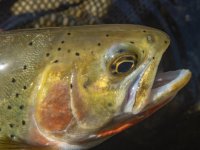
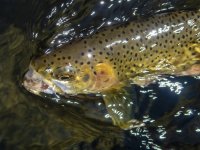
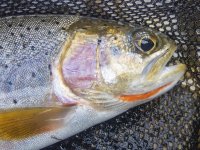
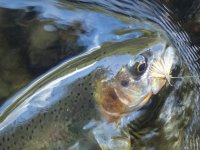
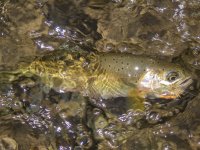
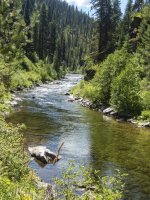
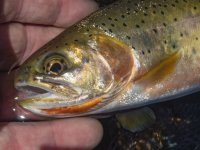
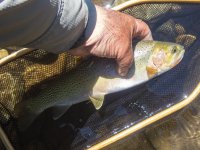
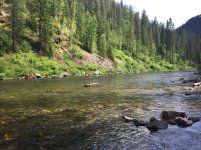
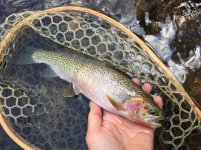
“River of Garnet Sands”, July 27 – August 1, 2025. Part A: “The Guide Hole”. I’ve fished this river just about every summer for the last 20+ years. Coming back is like renewing a friendship with an old friend. If you have been there, this picture is all you need to identify just which river this is: colorful cutts and patches of ruby-red garnets.
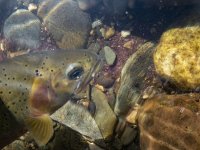
A01WedCutt6fP7300332.jpg
Some years but not all, morning hatches (especially caddis and PMDs) will have the fish looking up. In this crystal-clear water, a trout will have ample opportunities to scrutinize your fly. I prefer to fish biot-bodied parachute PMDs or cdc caddis patterns. On some casts you are simply prospecting likely water. However, if you see a fish rise and you can drop a quality cast in its direction, there is a very good chance that you will be rewarded.
Over the years, we’ve given nicknames to our favorite spots along an 8-mile stretch of this river. A favorite, albeit very popular, spot is the “Guide Hole”. The wading here is easy, there is little vegetation to catch a wayward backcast, and the pool holds many cutts. It is the perfect spot for a fishing guide to bring their greenest clients. After an early start, I reached the pull-out for the “Guide Hole” to find that it was unoccupied. Sweet.
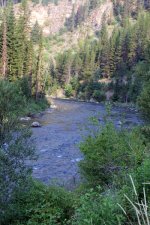
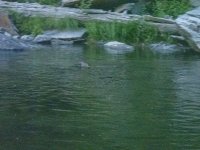
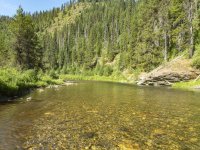
The “Guide Hole” lies below a long, shallow stretch of small rapids.
A02GuideHoleP7300272.jpg
Its center piece is a large bedrock outcrop that extends into the path of the river. The river has scoured a deep hole as it flows around the outcrop. The shallow rapid transitions quickly into this deep pool. Trout hovering below the dropoff are in the perfect position to ambush any food carried down by the rapid. Downstream of the outcrop, the pool becomes into a wide gentle glide that shallows out gradually to the tailout. This section is perfect for trout to harvest insects leisurely in the slow current. Finally, any fishers likely overlook the potential of a thin tongue of fast, shallow water that runs along the far bank upstream of the bedrock and the main pool. Trout lying in narrow slots under the fast surface current are in a perfect position to intercept food carried by this conveyor belt. It is best to wade halfway across the calf-deep rapid to reach the optimum casting location. A soft cast dropped into this fast water will achieve a short drift that is often sufficient to induce a strike. Trout in this lie have to make quick go/no-go decisions.
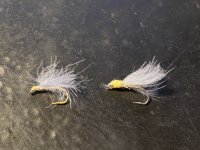
My favorite fly style here has a cdc wing. I had tied several biot-bodied, CDC PMDs just a day before I left on this trip just for this opportunity.
A03GuideHoleFlies9856.JPG
The yellow-dyed biot provides a segmented-appearing body. The gray CDC wing allows the fly to float right in the surface film. This fly pattern has two downsides. When dry, the huge surface area provided by the fine CDC barbules balances the resistance of water’s surface tension against the weight of the fly. It doesn’t take much turbulence to drown a CDC fly though. If a CDC wing gets wet or slimed, the barbules collapse and won’t provide the support to keep the fly floating. A quick dusting in a bottle of desiccant powder restores their fluffiness. The biot body (made by wrapping a single, dyed duck wing barb around the hook) is delicate. After just a few fish, the biot is often shredded by trout teeth. But this short life is still worth it in my opinion.
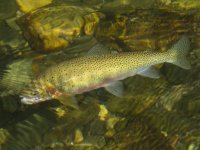
I had high expectation when I approached the head of the pool. My first casts landed just at transition from the rapid to the upstream edge of the pool. Twice in my first three casts, fish rocketed out of the depths of the pool to grab my fly.
A04WedCutt2aP7300288.jpg
It was going to be a great day.
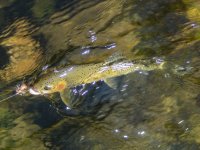
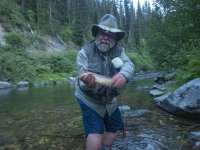
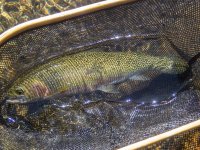
And it was just a sublime three hours of fishing – total bliss. There must have been something emerging, perhaps a few PMDs. A few fish occasionally rose to the surface to pick off prey. The fish were cooperative, but not pushovers.
A05WedCutt3cP7300294.jpg
Of course, I missed the biggest fish lying in the fast water along the far bank. It turned downstream to strike the fast-departing fly. One of three things happened. 1) In my eagerness, I pulled the fly out of its mouth. 2) It missed the fly in the turbulence. 3) It aborted its attack at the last minute. Even though I knew from past experience that it was futile to induce this old boy to come up a second time, I kept casting in this neighborhood, but no love. But I did hook and landed a few other nice fish from this stretch.
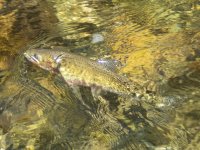
A06WedCutt6cP7300326.jpg
A07WedCutt6eP7300330.jpg
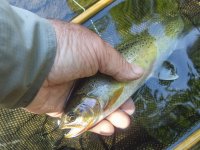
In the end, I caught fish from the slow water of the pool and everywhere in between. Even the sunk fly induced a few cutts to strike on the swing. After the fishes’ teeth had shredded the biot-body (see right fly above), the fly still caught fish. I probably that I hooked and released 30 fish from that pool, all on that same fly.
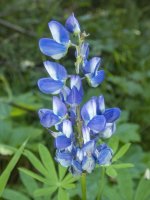
And the environment was just so zen. The pool is far enough from the road that I felt totally isolated and undistracted by anything but the river, the fish, the environment. Birds were singing. Swallows zoomed over the water. Patches of flowers, like lupine,
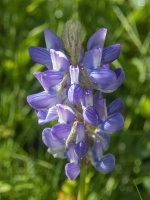
A08Lupine7300255.jpg
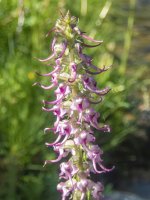
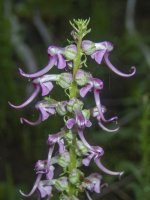
elephant’s head Pedicularis,
A09ElephantsHeadPedicularis7300250.jpg
cornflower,
A09fCornFlower7300352.jpg
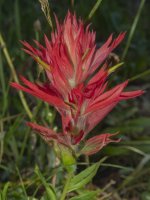
and Indian paintbrush
A10IndianPaintbrush7300261.jpg
provided explosions of color along the green shoreline.
When I brought one fish to shore for some pictures, I even encountered a spotted frog along the bank that was cooperative enough to stay until I released the fish and could come back to take its pictures.
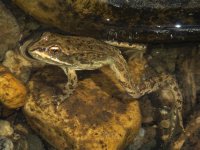
A11SpottedFrog7300393.jpg
Wow.
In fact, I came back to the “Guide Hole” the next morning after fishing a different spot to recapture the magic. And the fish were generous again.
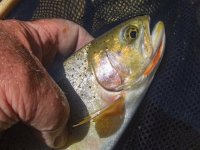
A12ThurCutt5bP7310462.jpg
Steve
 
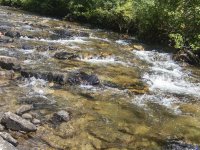
“River of Garnet Sands”, July 27 – August 1, 2025. Part B: “Steve’s Stomp”. For a half mile above the meadow, the river makes a wide 90o+ turn. From the road, this section looks like it is all fast rapids, but in reality this stretch provides for several hours of challenging, interesting, productive midday fishing with glides and pocket pools
B01SteveStomp2461.jpg
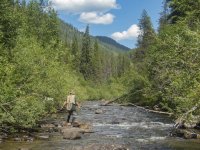
Although in full view of the road, I have NEVER seen another angler fishing here. It does require some “aggressive” (“fool-hardy”???) wading skills, beginning with wading across the river to the far bank (river left = the left bank of the river looking downstream). As a lefty, this just fits my upstream casting perfectly with my backcast over the river and not the riparian willows. During past excursions, my friends strolling on the road have observed me standing waist deep amidst standing waves as I cast to inviting pools against the steep roadside bank (river right)… I hadn’t felt healthy / comfortable enough to wade this section for the last few years. But with my new health / weight-loss regime, I felt strong enough to fish this half-mile stretch. As a concession to safety and stability in my advancing years, I have added a wading staff even with the current reduced flows (about 75% of the long-term median).
The bottom third of “Steve’s Stomp” consists of several flats with a few deeper slots. I was throwing an elkhair caddis. Some fish were lying at the top of the run, others were lurking in the deeper slots, and others were sitting right at the tailout of the pools. While I missed a few, I hooked and landed several small to medium cutts.
B02MonCutt1aP7280016.jpg
The middle third of the “Stomp” has the greatest bend and is the narrowest = fastest flows. Several large boulders midstream create deep pools in their lee. The wading is the trickiest here due to the combination of water speed and depth. But there can be some nice fish holding here too. I switched to a stimulator, a bigger fly that mimics the golden stoneflies that had emerged earlier in the summer, to provide more inducement for these fish to come up to the surface.
B03MonCutt3bP7280058.jpg
At one bankside pool, a long cast triggered a really nice fish to turn downstream as it attacked the fly. I tried to set the hook on the strike, but the fish either missed the fly as it was traveling downstream or the fly came out of its mouth without hooking up. One and done… I did have a few smaller fish try to grab the fly, but most were too small to be hooked.
The top third of “Steve’s Stomp” has a several more pocket glides with deep slots, especially against the steep bank on the road side of the creek. They are not that easy to fish because you have to wade at least to the mid-point of the river for your cast to reach the glides and even then your fly line is crossing seams traveling at different speeds. The wading itself is doable, but it is taxing after a long afternoon of wading the lower two-thirds. I have done well here when I have dedicated an evening to just fishing this top third. While I didn’t net any monsters (they are here, trust me) this afternoon, I did catch and release some quality fish that used the fast current to their advantage to extend the battle.
B04MonCutt6aP7280112.jpg
The path up the “Stomp” requires you to zig-zag between the middle of river and the bank. On one of those bankside meanders, I was distracted by the streamside flowers again, such as more lupine,
B05Lupine7280093.jpg
more elephant’s head Pedicularis,
B06ElephantsHeadPedicularis7280117.jpg
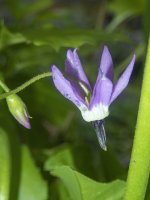
shooting stars,
B07ShootingStar7280123.jpg
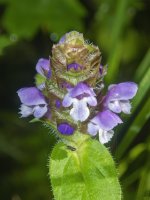
common selfheal,
B08CommonSelfheal7280091.jpg
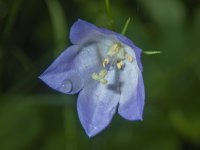
and harebells.
B09Harebell7280088.jpg
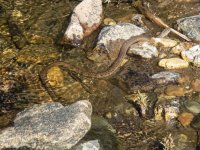
During another shoreside diversion, I disturbed a terrestrial garter snake who was hunting small cutts in the shallows.
B10TerrestrialGarterSnakeP7280041.jpg
After several attempts to hide from me, it finally decided that its safest bet was to disappear into the dense vegetation along the bank.
At the top of the “Stomp”, I successfully navigated across the river to the roadside bank and walked back to the meadow a happy camper.

Steve
 
“River of Garnet Sands”, July 27 – August 1, 2025. Part C: The Creek. Another good option for several hours of fun midday fishing is a small tributary creek to the River of Garnet Sands.
C01CreekP7290190.jpg
This creek is perhaps 20’ wide, with shallow rapids and scattered pools,
C02CreekP7290139.jpg
especially where fallen trees have created mini-waterfalls. Some surprisingly large fish lurk in these pools. These trout are very opportunistic. With more riparian cover, water temperatures in the creek are often several degrees cooler than the main stem. A rough trail parallels several miles of the creek. With the dense riparian shrubs overhanging the banks of the creek, it is best if you are casting over the creek (river left for me as a lefty). This work out perfectly when I’m fishing with a friend who casts right-handed.
We typically hike up the trail for 20-30 minutes until we find a convenient scree slope to drop down to the creek. After several hours of upstream wading/fishing, we bushwack back to the trail and hike the rough trail back to the truck. For reasons that neither of us could explain cogently, neither of us thought to bring wading staffs, a big mistake in retrospect as the wading was trickier than I was remembering. Fortunately, a beaver had been busy and there were a number of convenient-length sticks to use as ad hoc staffs. Still, we often grabbed the limbs of streamside willows to stabilize us as we waded upstream. I’m not remember what my friend was using, but I was casting a size 16 elkhair caddis, a solid searching fly for this small creek. As we waded upstream, we would take turns casting into individual pools. Or whoever had a better shot, left vs. righty, would take the cast. We consistently picked up small to medium fish,
C03TuesCutt1aP7290136.jpg
C04TuesCutt2cP7290173.jpg
but the bigger guys evaded us this day. One really nice fish chased after my fly in a pool but missed. Near the end of the afternoon, we spooked a very large fish from under a low waterfall; it bolted into the depths of its pool where it ignored several different flies that we tried. Due to overhanging branches, we wouldn’t have a shot at its original position anyway.
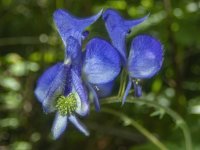
In practice, you are bushwalking along the stream edge because you can’t penetrate through the dense willows that line the bank. And wading more toward the center places you too close to fly-grabbing willows on the opposite bank when you backcast. At the stream edge, you are face-to-face with the riparian flora and fauna. I pulled out the camera for some shots of interesting plants, like this Columbian monkshood,
C04ColumbianMonkshood7290178.jpg
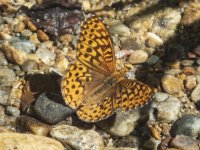
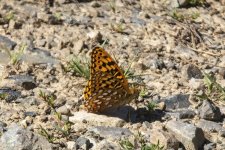
and interesting butterflies, such as this Northwestern fritillary butterfly that was rehydrating on damp gravel.
C05NorthwesternFritillaryButterflyP7290160.jpg
C06NorthwesternFritillaryButterfly3308.jpg
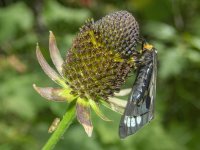
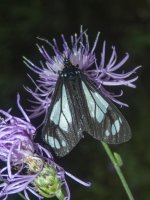
After a pleasant afternoon, we bushwacked through the riparian mess to the trail. Deliciously, the thimbleberries were ripening and I noshed on these delicate berries as we hiked back along the trail to the truck. At one point, we came across a distinctive black and white bug that looked like a butterfly. In fact, it was a police car moth sipping nectar, including from a corn flower blossom
C07PoliceCarMothOnCornFlower7290199.jpg
and wavy-leaf thistle.
C08PoliceCarMothOnWavyLeafThistle7290206.jpg
Unlike most moths, the adults of this species are primarily diurnal.

Steve
 
“River of Garnet Sands”, July 27 – August 1, 2025. Part D: “Eight and a Half”.
Eight and Half is a great evening spot.
D01EightAndAHalfP7300407.jpg
After a half-mile or more of rapids in a narrow canyon, the “River of Garnet Sands” transitions to this 40-50’-wide 300ish’-long run. This is the perfect spot for trout to congregate as the rapids bring in abundant insects. The bottom half of “Eight and a Half” consists of a very long flat glide. Several deep slots in the lower glide will hold cutts, especially in the evening when fish drift back into this softer water to pick off emerging insects. The sweet spot of this run, the about a third of distance from the top of the run, is centered around a massive submerged boulder that splits the flow and creates deep eddy in its lee. The two lateral chutes are a great place to drop a fly; fish lie under this conveyor belt or in the eddy and rise to intercept food. Softly dropping a fly into the calm eddy results in a short but enticing drift until the current in a lateral chute pulls your fly away. From the river left bank at these flows, you can wade around some bankside boulders to fish the very top of the run. Standing on the elevated boulders, you are in a great position to cast to several lanes spread from bank to bank. The depths in these slots are shallower and the currents are faster than in the sweet spot.
Three of us headed out to fish Eight and Half one evening. One angler would stay river right; he could maneuver along the bank via a series of large boulders as wading isn’t really an option. Another angler and I waded across the tailout and fished river left, a much easier wading option once you are across. This bank sets up well for a lefty like me whose backcast is over the water, but not for a righty who has to cast over the shoreside willows. For the last several years, I had stopped fishing this run because I wasn’t comfortable climbing down the steep bank, wading across the river, wading back to the other bank across the tailout by headlamp in the dark, and then scrambling up the steep bank at the end of the day. But in better shape and armed with a wading staff, I was confident that I could fish this section again and all went fine.
Just as we were getting started, we were startled by a beaver that was swimming into the glide of the run from downstream. Once it detected us, the beaver beat a retreat downstream.
D02BeaverP7300417.jpg
Later as we were walking back down the bank at the end of the evening, the beaver startled us with a loud tail slap in the dark as it encouraged us to vacate the pool.
As was the pattern for the week, the dusk bug activity and fishing were not red hot, perhaps as the result of the toasty daytime temperatures, but we all caught fish. I was fishing a PMD parachute with a nice white post – a real advantage in the gloaming. If I remember correctly, I hooked and landed only two fish that evening,
D03WedCutt8cP7300379.jpg
but one was quite respectable.
D04WedCutt9aP7300413.jpg
The other anglers also hooked and landed a nice fish each, but we’ve all had better evenings at Eight and a Half when the insect activity is stronger. Late in the evening, the other fisher on my side tied on a large fly (some flavor of Chernobyl ant) and cast it out. A really nice fish rose for this fly in the gloaming, but the fish either missed it or rejected it. Still, a nice evening for all.
Based on my success at the “Guide Hole” the previous morning, I decided to head back to “Eight and a Half” the next morning in the hope that there might be a morning hatch that would induce fish to take surface flies. Once I waded to river right, I tied on a cdc caddis and began prospecting. As I started, all the tailout was in the shade. I picked up a few nice fish from the chutes that divert off the submerged boulder at the heart of the sweet spot.
D05ThurCutt2aP7310434.jpg

D06ThurCutt5cP7310464.jpg
One really nice fish (at least 14”) came unbuttoned as I was trying to set up for some pictures of the fish in the water, alas.
At these reduced flows, I was able to continue further upstream after navigating some larger shoreside boulders to the top of the site. From the elevated boulders, you can cast into several slots at the head of the run. I switched to a stimulator to try for a larger fish. I had some looks, but only one hook-up. The action completely stopped once the whole run was in the sun.

Steve
 
River of Garnet Sands, July 27 – August 1, 2025. Part F: Birds, more plants, and more butterflies.
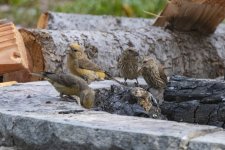
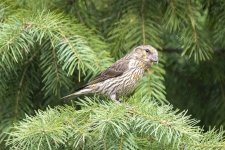
While fishing and sharing time with old friends are the major foci of any trip to this river, I and my cameras are always ready to capture anything else of interest. On our first morning in the meadow, I kept hearing high-pitched bird calls. I could see a flock of 20-30 birds extracting something from a nearby fire-ring. Most of these were red crossbills, primarily in family groups,
E01RedCrossbillFamily3206.jpgincluding this juvenile.E02RedCrossbillJuvenile3239.jpg

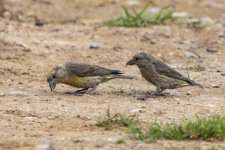
They were also extracting something from the gravel road, probably grit for grinding ingested pine seeds.
E03RedCrossbills3218.jpg
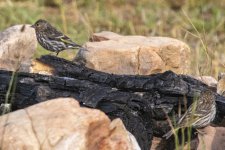
The activity of the crossbills also brought down flocks of noisy pine siskins.
E04PineSiskins3231.jpg
I had heard (and seen) the pine siskins in the trees before in this meadow, but never on the ground. And the crossbills were a new sighting in all my years of visiting here.
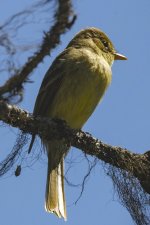
Several mornings, I took a short walk along the road that parallels the river in pursuit of targets for my cameras and binocs. Using the Merlin app to identify a bird song that I didn’t know, there had to be Western wood pewee in the vicinity. It took a bit, but I finally spied it perched on a bare branch that overlooked the river in the shade of the canopy of a Ponderosa pine.
E05WesternWoodPewee3259.jpg

This was a perfect spot to ambush any emerging aquatic insect that flew past.
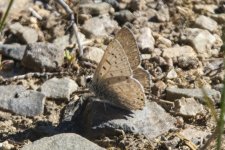
One morning walk ended in an isolated meadow with several flower species in bloom, a great spot for butterflies. In addition to more Northwestern fritillary butterflies, I encountered a species of blue butterfly,
E06BlueButterfly3380.jpg
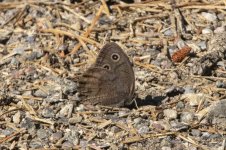
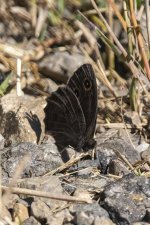
several common wood nymphs,
E07CommonWoodNymph3300.jpg
E08CommonWoodNymph3404.jpg
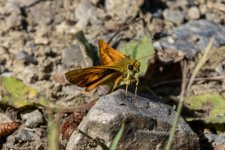
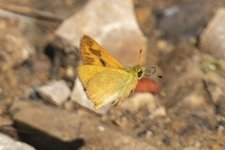
many woodland skippers,
E09WoodlandSkipperButterfly3324.jpg
E10WoodlandSkipperButterfly3396.jpg
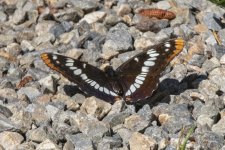
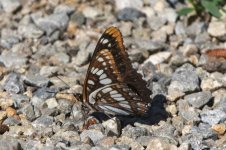
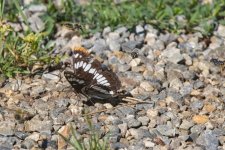
and several lorquins admirals
E11LorquinsAdmiral3345.jpg
E12LorquinsAdmiral3348.jpg
One patch of ground attracted several woodland skippers and lorquins admirals, but it also attracted a swarm of horned-faced mason bees that harassed the lorquins admirals.
E13HornedFacedMasonBeesHarassLorquinsAdmiral3355.jpg
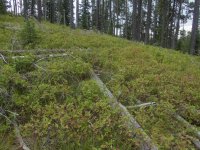
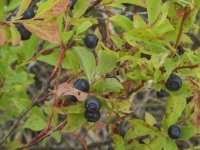
On the day that I was to depart for home, I knew that if I started the drive too early, I would simply run into the mess that is Friday afternoon traffic at Tacoma and JBLM. So, I decided to pick huckleberries on the mountain side for a few hours until the afternoon sun drove me off. The berries were thick, so thick.
E14BlueberryFieldP8010511.jpg
E15HuckleberriesP8010522.jpg
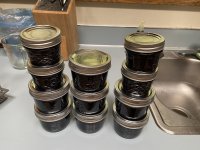
In four hours, I harvested 6 cups of ripe huckleberries, enough for a batch of huckleberry jam the next day.
E16HuckleberryJamJars9839.JPG
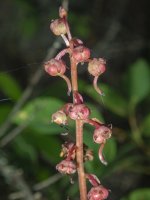
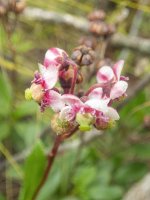
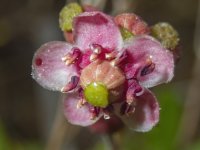
In addition to huckleberries, this hillside included other interesting forest plants such as pink pyrola
E17PinkPyrolaFruits8010497.jpg
pipsissewa,
E18Pipsissewa8010510.jpg
E19Pipsissewa8010506.jpg
and rattlesnake plantain, an orchid.
E20RattlesnakePlantainOrchid8010517.jpg
Steve
 
I agree with Josh that these are always great reports. Thank you, @Cabezon!

Your photo and description of the Guide's Hole had me looking through my photos from July 2023, when I last visited this river. It seems so familiar, and I thought it might be the same place where I hooked and lost a real nice one against that far ledge on the left bank, then came back the next morning and hooked and landed that fish on a different fly. It was in the exact same lie as the day before, and rose to take the fly so gently and with such confidence that it can almost break your heart. Alas, not the same spot, but similar.

Did your trip overlap with @Gary Knowels'?

Here is my “Guide’s Hole”:IMG_2531.jpegIMG_2530.jpeg

P.s. I also like simple CDC flies for this river
 
I agree with Josh that these are always great reports. Thank you, @Cabezon!

Your photo and description of the Guide's Hole had me looking through my photos from July 2023, when I last visited this river. It seems so familiar, and I thought it might be the same place where I hooked and lost a real nice one against that far ledge on the left bank, then came back the next morning and hooked and landed that fish on a different fly. It was in the exact same lie as the day before, and rose to take the fly so gently and with such confidence that it can almost break your heart. Alas, not the same spot, but similar.

Did your trip overlap with @Gary Knowels'?

Here is my “Guide’s Hole”:View attachment 164135View attachment 164136

P.s. I also like simple CDC flies for this river
No, I was the 8/10-14.

Pretty sure I fished the guide hole as well. If it is near the transition from pavement to gravel, then I certainly did. I had a REALLY good morning there. Fish were taking emergers of some sort about a foot below the surface, I watched big fish after big fish come up from the bottom, open their mouth, turn sideways and descend. I never did see what the insects were, but they must have been thick because a dozen swallows were working the air above to pool. I fished a double dry rig with a size 14 olive micro chubby, last year's hot fly up front. I got a couple of fish to the surface on a size 16 gray CDC caddis, but then it sank, which I didn't try to resuscitate, instead fish using it as a dropper off the olive chubby, which was VERY productive until I broke that off just above the tippet knot on a good fish. I think the tapered leader was old and brittle as that happened a couple more times before replacing the leader.
After that I switched to nymphing with a size 14 Aussie possum and peacock, soft hackle on a beaded jig hook, which was absolutely mobbed by fish.

Our last day there, we went for a swim in the guide hole, drifting from top to bottom. About 2.5 feet in depth at the head, 5 feet in the middle half, then tapering shallower in the lower section, but the lower section also has a 3' x 12' slot that is 7-8 feet deep.

We also ran into a pair of Idaho fish and game employees doing snorkel surveys upstream of there. We were having a TOUGH afternoon and kept saying "there HAS to be fish in there" after getting 0 action on a variety of tactics. Then they snorkeled it and told us there were 18 fish in the pool.
 
Back
Top