Lenice/Nunnally size of fish?

An interesting discussion to say the least. However one important aspect of lake management is what are the angler desires.

Clearly we all would like to be able to catch good numbers of large fish, however such fisheries exist in precious few locations. Thus foe most waters the managers are left with the game of adjusting strategies of attempting to balance the number and size aspects of the fishery. That balance generally becomes for larger few the numbers have to be reduced to encourage. It is pretty clear in this discussion that a wide range of angler desires that would be impossible to meet on a single water.

So the questions for the group becomes in a quality fishery -
What is the minimum size you consider to part of a quality fishery?
What do you consider to be a "large" fish in a quality fishery?
What you desire as the average size fish?
What kind of catch rate (fish/trip or fish/hour) in a quality fishery?
How important are a variety of fish (either species or size) in a quality fishery?

Food for thought
Curt
 
For me the answers to the questions I asked -
I looked for a quality lake fishery where the bulk of the catch has been in the lake for at least six months. I look where the bulk of the fish are between 14 and 18 inches (at least 12 or more) with a chance of occasionally have the opportunity to tangle with a fish over 20 inches. While I expect my success to vary from trip with some tough trips and some good trips but would like to average 2 or 3 fish/hour. My experience has been I generally those conditions are most likely met with a rainbow only fishery so other species are not important to me.

I also recognize there are a lot of different fisheries some of which can satisfy my ego needs for a numbers day after tougher trips or I wish to increase my chances to tangle with a larger fish over a high number day. I like variety of fisheries which over the calendar year my trips reflect that interest.

Your answers?

curt
 
And we have 5 pages of response. Glad to see interest, discussion, and opinions on two of my favorite lakes. Looking forward to a few stepping out into the alley.... o_O
Now my take:
These are very young lakes and are seeing a very rapid evolution. They started with very fertile ground flooded with inlet and springs as the Columbia Basin Project charged the aquafer. By the early 60's the "new" lakes inherited all the prolific insect and aquatic like of the Basin. Add fingerlings and bang, huge trout. Lakes were managed as selective fishery, which then was no bait, barbless hooks, and limit was three fish over 12". The fingerlings made it right to 12"+ by the end of April opener. And it was not hard to release until you had three over 18". Happy campers. Yup, we ate them back then, and if you scaled them, not too bad. And didn't even need a boat because you could walk the shoreline and fish anywhere. We drove to Nunnally on the west end and camped there. Many fond memories.
Management changed a bit, with fewer fingerlings planted and wow, they got even bigger! And there unfortunately developed an organized poaching effort. Saw it personally, two folks with a stout branch and a gunny sack full with the trot line haul.
But then things started to change. Russian Olives moved in, as did the reeds and tall grasses as well as the thick milfoil like stuff. And the .... pumpkinseed sunfish. Water warmed, and there was less oxygen. More summer kill as the plant life absorbs sunlight and water gets warmer, and doesn't circulate as well. The dense shoreline and weed growth makes poisoning the lake relatively ineffective, and the WDFW has a limited staff and budget. The sunfish just out compete the trout for food, they eat the same chironomids, damsels and callibaetis.
So our game guys try various strategies, browns and tigers to eat the sunfish, planting larger but fewer rainbows. Then the salmon police did away with the browns and tigers. And WDFW is trying to figure out how to best meet the perceived needs of the masses. And here we are today. I think the strategy is a numbers game, WDFW likes folks to get into numbers, like measuring the opening day take with success being as close to 5 per angler on a stringer as possible. Sorry we mess that up by releasing all the Pine, Cottage, Green Lake clones.
Experiments with fingerlings today, and still trying to have folks get 20 takes, doesn't seem to work. But planting "legals" and letting them grow a bit does allow for big numbers, some of which are over 18".
And there are other lakes, see above, where fewer fish, either by planting fewer, or having a few survive the opening power bait onslaught can in fact gorge on the abundant aquatic life and turn into pigs. So pick your poisen. I started this thing because I heard some reports of "numerous fish over 20". Hey a guy can dream, but my reality on the water this year was a whole lot of action, and a few really worth talking about.
Have fun out there and stay safe.
Ronbow
Thanks Ron for a well written and in depth review of the lakes and how they've evolved. I loved wading the west end of Nunnally before the reeds/grasses took that away from us.
 
I'm think the regional biologist is doing the best he can with these lakes. I did like them more 35 years ago, but had a great day on Lenice last month fishing "naked" during a sustained chironomid hatch. Things have changed a lot in this state in those thirty years and the basin lakes have changed a lot with global warming, increased pressure from population and the influx of people heading outside during COVID, and bucket biologists. My experience living Whitefish, Baker City, and then the Tricities has given me some perspective on different states and how they fish.

Montana is more like BC, lots of lakes, much less people. colder and great river fisheries with wild fish. They have great stillwaters too, but some of the same problems that we have. We owned waterfront on a good trout lake near Eureka, think Pearrygin lake with less people. It went through two rotenone treatments during the time I owned it and the fishing was different every year.

Eastern Oregon has great stillwaters, most are irrigation reservoirs or high lakes. The farmers own the water and if there is good snow pack for a few years fishing can be spectacular in a way I have not seen in our state. My favorite lake there grows fish from fry to 14-16 inch fish from November to June, but goes from 600 acres to empty about every other year. The best fall on that lake saw two classes of fish, 16-18 and over 20 three year olds, water low enough that you could not launch a boat, so float tube heaven. Last year it emptied again. Some reservoirs don't go totally dry, but the growth of bugs and fish is in a constant state of flux.

It's kind of the same fishing the Seep lakes in our state. Every year and water body is different depending on the severity of the winter and summer heat, depth, competing species, and how many fish the power bait guys keep. I think the best you can do is to search out some good ones, keep exploring and keep your lips sealed. It seems to be easy to blame WDFW for a bad fishing trip, but they can only react to all these changes.
 
Irafly

Give it a break. I can think of a lot of other reasons he does not want to keep conversing with you.

You still are a bully.
Again, you can’t argue for someone else to give it a break and not be a hypocrite.

I’ll ask again though, please give me an example of how the state has mismanaged the fishery that hasn’t already been clearly refuted in this thread. If you can’t, I think that proves my point.

All this energy to argue with me without actually addressing the problem.
 
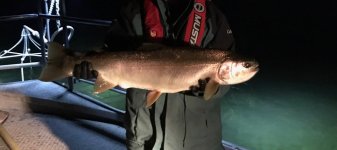
I think we have the same issue in our central Oregon lakes ...Back in "the day" Crane, Davis, etc. used to put out some trophy fish.... You rarely see pics of good fish anymore..... I think we have the same issues on the fishery side as we do on the big game hunting... Most hunters are upset with F&G on how they manage the big game #'s etc. Im sure that the biologist at one time or another made certain decisions about how to manage a lake that pissed off one group of anglers but made the other group happy..... Cant please everyone ....

A throw back photo of what once use to roam the CO lakes.


Cranebow.jpg
 
I think we have the same issue in our central Oregon lakes ...Back in "the day" Crane, Davis, etc. used to put out some trophy fish.... You rarely see pics of good fish anymore..... I think we have the same issues on the fishery side as we do on the big game hunting... Most hunters are upset with F&G on how they manage the big game #'s etc. Im sure that the biologist at one time or another made certain decisions about how to manage a lake that pissed off one group of anglers but made the other group happy..... Cant please everyone ....

A throw back photo of what once use to roam the CO lakes.


View attachment 62822
electroshocking?
 
For me the answers to the questions I asked -
I looked for a quality lake fishery where the bulk of the catch has been in the lake for at least six months. I look where the bulk of the fish are between 14 and 18 inches (at least 12 or more) with a chance of occasionally have the opportunity to tangle with a fish over 20 inches. While I expect my success to vary from trip with some tough trips and some good trips but would like to average 2 or 3 fish/hour. My experience has been I generally those conditions are most likely met with a rainbow only fishery so other species are not important to me.

I also recognize there are a lot of different fisheries some of which can satisfy my ego needs for a numbers day after tougher trips or I wish to increase my chances to tangle with a larger fish over a high number day. I like variety of fisheries which over the calendar year my trips reflect that interest.

Your answers?

curt

I agree with your basic premise on size and quantity of fish. I would add the word 'healthy' to it. Fish do not have to be pigs but have a lot of strength. Maybe the strength is related to time in the lake - I think so. I would much prefer a 14" fish pulling hard, stripping line, leaping out of the water than a larger cutt-boot. Tug is the drug. Based on observations of a number of fisher people I fish with there are 'slots' regarding fish size. 12"-14", 16"-18" and the 20"+ with 16"-18" fish being very satisfying and the alluring of 20"+ is always being in the back of one's mind. Once a fish is 20"+, memories are made. IMHO it does not matter if 20" or 24" it falls into the category of Big or Huge (enough said - others probably will not believe it anyways)...

If a lake can properly support warm-water fish, e.g. bass or crappie, it just adds to the intrigue and challenges.
 
electroshocking?
I’ve spent some time crewing on such a vessel.

For anyone interested….If you get the opportunity, volunteer with WDFW to do a few standardized lake samples and then speak to the local anglers. Not sure if these opportunities still exist but they did 15 years ago. Sometimes there’s a large disconnect between what is caught and taken home on the stringer and what gets worked up on the e-fishing boat. Working at night adds to the drama. Fun and strenuous work.
 
Back in the mid 80s, my buddy's fairly large stock pond was infested with smallies. This is in south central Washington, close to Goldendale.
They either washed down the seasonal creek or were dropped by birds. Either way, they were soon eating the bugs so the trout (fry plants every few years) stopped growing. While catching 12"-14" smallies on a stripped damsel nymph was a hoot, my buddy and his folks both wanted to get it back to a trout pond. The bass would've kept shrinking as well.

Curt may know him, but a Dept of Fish guy, Dick Thompson, came out and applied rotenone to the pond. Soon, smallies started popping up. The small ones first, and then the big ones. And then the few remaining grand daddy trout. We ended up chasing one down with the canoe. He was over 2 feet long and probably pushing 6 lbs.

There were only a few trout left as the previous year's fry had been eaten by bass and all the others had passed naturally or were starved out.

All the bass got put into a live-well truck and dumped in Horsethief or the Columbia. We asked Dick if he thought all the bass were out. He said there was no way to know. The pond had a fairly basic shoreline, but did have some nice tules on the north shore. The bass were never a problem again, but the new plants of trout never did take off like the original ones.

That was one pond on private property. No red tape, no worries about what it might do downstream. No special interest groups. No ESA listings.
I can't imagine the task of ridding all our Columbia basin "trout" lakes of sunfish, bass, carp, etc this many years later when we absolutely know that 1) many lakes like Lenice/Merry/Nunnally are getting less water, 2) that summers are hotter and longer and 3) all the science we now know about salmon & steelhead, water quality, etc and 4) ESA listings.

So when I go to Lenice and catch 15 or 20 trout between 15"-17", I'm pretty damn happy. Do I miss the good ol days when I could wade Merry and catch 5 pound monsters on a #4 Picket Pinn at the mouth of the incoming creek? Sure I do! But can I blame WDFW? Maybe for a tiny part of it? But not much of it. Everything changes, not just the WDFW.
 
Here are some of my opinions and recent experiences, based on fishing WA lakes now for 25 years and reading some of the content in this thread.

I prefer fry-planted trout, growing to catchable, respective sizes on their own, based on natural lake forage. Some lakes are better than others at doing this and lakes can change over time, based on several environmental factors. Some lakes do better at planting larger fish. The larger the fish at release, the more expensive the program is to manage. I think WDFW does a decent job of managing lakes but could do better in some areas, as far as what I like best. However, I don't recall them managing lakes just for me. I have taken the opportunity many times over the years to provide feedback to District Bios. I'm not afraid to move on to new lakes if I'm not satisfied with lakes I've enjoyed in the past.

I am a little confused at the term "put and take". Even after moving from fry plants to catchables in Lenice, I never thought it changed management style to put and take? My guess is anglers who follow the rules (poachers might be the exception) are not harvesting a majority of their fish but rather releasing them back to the lake. This practice seems contradictory to put and take.

To answer Curt's questions:

Regular Managed Lakes
10"
16"
12"
10-12 fish per hour

Quality Lakes
16"
Anything over 20"
18"
4-5 per hour

Other comments: I prefer trout diversity over strictly lakes with rainbows. Browns, tigers, brookies, cutthroat-I'd sacrifice smaller size for catching multiple species and I'd sacrifice smaller size but more numbers and solitude and scenery over larger sized fish.

On Saturday, I drove to Aeneas Lake, a long-time fly only lake with a long history. It's not the prettiest lake but does get browns and rainbows. And it gets pretty good pressure. There was more people there than I I like so I left (and it was "windier" than what I wanted to deal with). Over 2.5 days on the opening weekend, I stopped at 8 lakes and fished 3 for more than 3 hours, fished 3 for less than one hour, and stopped at 2 and didn't fish at all. Fishing was very good for size and quantity in 2 lakes and very good for numbers in a third lake.

The differences I have found to fishing BC lakes is there are more lakes and opportunity, better scenery and wilderness experiences, less pressure and garbage, better dry fly fishing opportunities, but less trout species available and shorter seasons and some lakes with terrible road access. And you can only use one hook on your line. If time and money were no considerations, I'd be all over interior BC lakes.

I was going to save this story for the report forum but here goes. The first lake I went to (brand new) on Saturday, a local had the boat launch blocked. He had his truck, a chair, lots of rods and other gear, not one but 3 bags of marshmallows strewn all over the exact spot where I would have launched my pram. He was the only one at the lake and didn't even look up when I took a closer look. I decided to leave him alone and went to another lake a short distance away. I came back about three hours later (with good fishing) hoping to try it again. I patiently waited for a few minutes and another guy showed up and they talked for about 10 minutes. I just listened to their conversation. Then the other group left and I finally asked the guy if he could move his truck so I could launch. He said, I couldn't launch because the water was too low and I'd get stuck. I told him I'd launched in much worse places than this. Then he said I couldn't launch because there were no motors allowed. I replied I did not have a motor. He then said I couldn't launch because there were rocks and I'd tear up the boat. I informed him that I could easily avoid the rocks. He then said he only needed one for fish for his limit and then he'd move. I responded that this was the second time I tried to launch and gave him 3 hours to move his truck. He then got visibly upset, started throwing his chair, marshmallows, and gear around, cussing under his breath and generally pitching a tantrum like a 3 year old not getting his way. He then moved his truck but by then, I decided I didn't want to be around this guy and left for another spot. I couldn't help but chuckle, knowing he'd finally moved his truck and I left for a spot that would not be so confrontational. I would like to go back another time and try it as I did some research and got a tip from a friend on the lake. This was a good reminder that WDFW needs to take into account people of all opinions, preferences, experiences, and temperaments when they manage lake fishing.

After the first two weeks of opening day for lakes, I've found a majority of people leave and there is a short window before Memorial Day that you can have regular managed lakes to yourself and catch some nice fish without the bait crowd. By mid to late June, many of the lowland lakes become too warm for good trout fishing and I turn my attention to streams anyway. But oh how I've enjoyed lake fishing in WA and BC from March thru May each year.

Reminds me of an old lake management saying: You can have lots of small fish, or a few really large fish. But it's hard to have lots of big, dumb, easy to catch fish in one spot unless you are feeding them pellets.
 
Last edited:
These 2 lakes must be doing great as the parking lots where FULL of cars and R/V's yesterday as I rolled home from a long 900 mile ride. I've now made reservations for Big Twin next week.
 
I don't know if the has been mentioned or not, as I did not go back and read every post, but I believe BC has a policy to close a trout lake to fishing if it has been found to have illegally introduced fish (i.e., bass).
 
This thread reminds me I live in a state without trout. Except in a lab.
 

Attachments

  • 0B0CBD83-F835-42EC-A469-7EBA6B16AEDF.jpeg
    0B0CBD83-F835-42EC-A469-7EBA6B16AEDF.jpeg
    424.2 KB · Views: 18
I called the biologist for Lenice a few years back. I had been missing the fish there from the early 80’s and 90’s. And for the past 20 years the lake has been a shadow of itself.

He told me that the lake is now stocked for numbers. So fishermen could catch more fish. I personally get tiard of the cookie cutter sized fish out of the lake. That said I will continue to fish this lake till I can no longer walk in. At that point my son can take me in a wheelbarrow.

Anyway I would suggest we all call the Biologist and let him know our thoughts.
 
Back
Top