How do you rig 2 flies?

How do you rig a chironomid and a leech?

  • 1. Leech as the upper fly and midge on the bottom.

    Votes: 9 31.0%
  • 2. Midge as the upper fly and leech on the bottom.

    Votes: 13 44.8%
  • 3. Do both and don't think it makes much a difference.

    Votes: 7 24.1%

  • Total voters
    29

ifsteve

Steelhead
Ok after a cooling off period and a bunch of fishing maybe I'll post again. So here goes.

When you are fishing two flies, specifically a chironomid and a leech how are you rigging them. Historically I have almost always had the leech as my upper fly and the midge on the bottom. But the other day while I was catching great numbers of fish my buddy was just destroying them.. There were several differences in our rigging but the biggest was that he had the midge as the upper fly and the leech on the bottom.

Next time out I am going to try it his way and its hard to get much intel on just one trip but he was putting a hurting on the fish compared to me. Twice as many and caught the bigger fish. His logic was that rigged this way it casts better, he gets less tangles, and the leech on the bottom helps the midge sink quicker.
 
Glad you're back, the balanced leech thread is a good one.
I'm a leech on the bottom, chironomid on a short dropper 12-18" above rigger.
 
Ok after a cooling off period and a bunch of fishing maybe I'll post again. So here goes.

When you are fishing two flies, specifically a chironomid and a leech how are you rigging them. Historically I have almost always had the leech as my upper fly and the midge on the bottom. But the other day while I was catching great numbers of fish my buddy was just destroying them.. There were several differences in our rigging but the biggest was that he had the midge as the upper fly and the leech on the bottom.

Next time out I am going to try it his way and its hard to get much intel on just one trip but he was putting a hurting on the fish compared to me. Twice as many and caught the bigger fish. His logic was that rigged this way it casts better, he gets less tangles, and the leech on the bottom helps the midge sink quicker.
Welcome back!
 
Makes sense to me to have balanced leech on bottom, sitting horizontal.......I like to use a loop knot so it bounces more.

If you put the leech off a horizontal dropper might as well not use a balanced leech.

I think the same applies to nymphing rivers. If I'm using a big jigged point fly, I put it on it bottom......non-jigged, sometimes I put it off the dropper
 
I don't do a lot of lake fishing, so take this for what it is worth. In slow rivers, I have had some banner days under an indicator by tying a heavy nymph on a dropper and then trailing a small, light nymph or wet fly (like a size 16 wet ant) off the heavy nymph. I guess that makes the ant the "point fly."

The small ant is brought down deep by the heavy nymph and floats/swims freely at that depth.

Maybe a similar set up would work in lakes (heavy leech as a dropper, small mid trailing off the leech)?

I do find it much easier to cast a rig with the heaviest fly on point. Having the heaviest fly as a dropper often leads to tangles for me.
 
As mentioned in another thread, I put the leech on top tying both leader and dropper line in the leech’s hook eye. The tension makes the leech lay horizontal aka. balanced. Then a bead head chromie..
I think Ira mentioned rigging both leaders to a hook eye also. I seem to struggle to get both leaders in. I should probably practice and try some more. The reservoir is getting filled so I'll get a chance to play with more riggings soon. Always more to figure out, love this pastime.
 
I fished today, caught bunches of fish, missed three times that many because I like to fish two rods. I will put the leech on bottom if I’m fishing any chironomid except a bloodworm, because bloodworms should be on the bottom. I feel like the bottom fly usually catches 90% of the fish because it’s in the zone.
 
After reading a book written by a noted tournament lake flyfisher, if fishing in an average of 8' to 12' of water I rig my top fly 6' above my bottom fly, and find it produces more takes than when I spread the flies only a couple of feet apart.
 
After reading a book written by a noted tournament lake flyfisher, if fishing in an average of 8' to 12' of water I rig my top fly 6' above my bottom fly, and find it produces more takes than when I spread the flies only a couple of feet apart.
I like this thinking. I typically fish two Chironomids one on a dropper about 2’ up from the point. Fish two rods one on the bottom and the other 4’ off. This gives a greater spread so to speak. I do think getting ‘in the zone’ is more important than the exact fly to a degree and this would do it better. I do think fish often are feeding higher off the bottom and this would help us figure that out.

Dave
 
I like this thinking. I typically fish two Chironomids one on a dropper about 2’ up from the point. Fish two rods one on the bottom and the other 4’ off. This gives a greater spread so to speak. I do think getting ‘in the zone’ is more important than the exact fly to a degree and this would do it better. I do think fish often are feeding higher off the bottom and this would help us figure that out.

Dave
I agree that being in the zone / in front of fish is much more important than the fly…especially with chironomids. The lake I fish most often only allows one rod, so I converted to a slidable system that allows me to adjust my dropper fly from 2’ to 6’ above the point when indicator fishing. I play around with depth on the top fly, but most days still get at least 75% of fish on the point.
 
Maybe it’s just coincidence, but I have noticed a seasonal link with how critical it can be to get our bugs near the bottom. Spring and summer, and especially during hatches, seem like the conditions when we gotta get our stuff down to within a couple feet. In the fall, when hatches are winding down, I often have better success starting with mid-column depth (like setting up to fish 6’ down in 12’ of water), and generally target water less than 20’ deep.
 
I agree that being in the zone / in front of fish is much more important than the fly…especially with chironomids. The lake I fish most often only allows one rod, so I converted to a slidable system that allows me to adjust my dropper fly from 2’ to 6’ above the point when indicator fishing. I play around with depth on the top fly, but most days still get at least 75% of fish on the point.
Would you be willing to share how you set up your sliding adjustable system? Sounds handy.
 
Would you be willing to share how you set up your sliding adjustable system? Sounds handy.
I use the general concept from Troutbitten’s “adjustable dry-dropper”, but modified for indicator fishing.

-10’ Tapered indicator leader to tippet ring 3x or 4x
-4’ 3x or 4x flouro to double surgeons knot (this is the sliding section)
-2-3’ 4x or 5x flouro to point fly

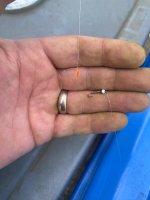
This allows for targeting fish on the bottoms in up to 18’ depth, but you can shorten up if you know you’ll be in a shallower lake. In the “sliding section” you tie a backing barrel. Above the backing barrel I attach a pre-tied 6-8” tag (4x) with a perfection knot…then I tie on the dropper. Moving the backing barrel controls the depth of the dropper across the full length of the “sliding section”.

Besides the advantage of being adjustable I find that it never twists around the main tippet (unlike the traditional tag method). It is also easy to change flies (unlike tying off eye or shank). It also has the most natural hang from what I can tell. The only drawback is the potential wear on the sliding section, but I haven’t found it to be a major issue as long as you check line condition semi-regular. I’ve had no problems hauling in 6lb+ jumbos in the dropper. Photo of my dropper below. I use orange backing in this version like a hot spot, but white has worked also.

IMG_2188.jpeg

Here’s the link where I found the original idea: https://troutbitten.com/2017/06/21/slidable-dry-dropper-system/
 
I should also add that I only use this for indicators. I still prefer the tag method for casting and trolling. If I fished dry droppers in the river I’d probably try it though.
 
Ok after a cooling off period and a bunch of fishing maybe I'll post again. So here goes.

When you are fishing two flies, specifically a chironomid and a leech how are you rigging them. Historically I have almost always had the leech as my upper fly and the midge on the bottom. But the other day while I was catching great numbers of fish my buddy was just destroying them.. There were several differences in our rigging but the biggest was that he had the midge as the upper fly and the leech on the bottom.

Next time out I am going to try it his way and its hard to get much intel on just one trip but he was putting a hurting on the fish compared to me. Twice as many and caught the bigger fish. His logic was that rigged this way it casts better, he gets less tangles, and the leech on the bottom helps the midge sink quicker.
Which fly was he catching most of his fish on?
 
Of course, a lot depends on the day and what the fish are doing, but I voted leech on bottom, because that's just what's intuitive to me in most cases. I also fish my indicator setups shallower than a lot of people in general, because my experience has been that fish look up when they're feeding, and if they want something (especially a bigger bite like a leech), they'll move several feet to get it. At their level is ideal, but if you fish below them, most fish won't see your flies, so I'd rather err on the side that gets my flies SEEN (if not necessarily eaten) more. Obviously, in a deeper lake, you may have to fish deeper to avoid being too far above them (they're probably not going to move up 10 feet to eat your chironomid), but in most of the water I fish, active fish can be caught in the top 3-5 feet of water, no matter what they're keying on.

When a leech/nymph combo is working well for me, I usually catch most of my fish on the leech, and I typically only need to fish about mid-depth at most. Sure, I sometimes have to go deeper down, and I'll fish that way when the water's cold, but under most lake conditions I fish (spring and summer), the fish are often spread out in the water column and moving around.

This season, I have caught almost all my fish on a mini-leech. Olive, black, and purple all are working, but olive is king. My top fly has varied, and a perdigon dropper has produced several fish (to include a couple big ones, so don't sleep on that smaller fly!), but the mini leech has probably produced 5:1, and most of my bigger fish have come on the leech.

Whatever your setup preferences, the two-fly indicator setup is effective in a wide variety of conditions, and that's why it's accounting for so much of my effort in lakes lately. It seems to produce when nothing else will. I doubt how much it matters where you rig your flies, so long as they are rigged in a way that presents them both naturally. Sometimes, that doesn't even seem to matter, but in the interest of setting up for success....
 
Back
Top