
Navigation
Install the app
How to install the app on iOS
Follow along with the video below to see how to install our site as a web app on your home screen.
Note: This feature may not be available in some browsers.
More options
Style variation
You are using an out of date browser. It may not display this or other websites correctly.
You should upgrade or use an alternative browser.
You should upgrade or use an alternative browser.
Hook size inconsistency
- Thread starter adamcu280
- Start date

See, this is the kind of information that is useful. I didn’t know Firehole hooks were relatively large until I bought some and found out the hard way. I’ll use them for other stuff than I initially intended but it’s still annoying.Mostly, every major brand offers a wide variety of hooks that are relatively interchangeable and the differences are usually subtle.
Some brands have certain trends. For example, Firehole hooks are often far larger for their stated size while Gamakatsu hooks are often thinner and smaller These trends don’t necessarily hold true for all hook models by the companies, though.
As stated previously, I like Ahrex not because their hooks have some magic properties but because they remove the mystery. I can buy a new-to-me hook model and know exactly how it will compare to other hooks I’ve used or what patterns I can expect it will do well with.
Same with Ahrex. I have found that they run larger than other similar hooks from other manufacturers.
@Mike Cline what is the standard baseline hook that all sizes are based on?

I think Mike was saying that the baseline hook would be per manufacturerSee, this is the kind of information that is useful. I didn’t know Firehole hooks were relatively large until I bought some and found out the hard way. I’ll use them for other stuff than I initially intended but it’s still annoying.
Same with Ahrex. I have found that they run larger than other similar hooks from other manufacturers.
@Mike Cline what is the standard baseline hook that all sizes are based on?

I think hook sizes are like many other things in fly fishing, with nothing being standardized.
Not all 6 wt rods are the same. Some are stiff as mop handles and then some are whimpy.
Lines vary even more than rods. Just look at the grain weights and profiles.
Not having standardization can definitely be confusing, but having all the different choices is great in my opinion. We’ve never had it so good as far as the options available for materials, hooks and gear.
SF
Not all 6 wt rods are the same. Some are stiff as mop handles and then some are whimpy.
Lines vary even more than rods. Just look at the grain weights and profiles.
Not having standardization can definitely be confusing, but having all the different choices is great in my opinion. We’ve never had it so good as far as the options available for materials, hooks and gear.
SF
There technically IS a standard for line size, which is supposed to roll over in to rod size as it hits a certain range on a deflection board for a standard amount of weight.I think hook sizes are like many other things in fly fishing, with nothing being standardized.
Not all 6 wt rods are the same. Some are stiff as mop handles and then some are whimpy.
Lines vary even more than rods. Just look at the grain weights and profiles.
Not having standardization can definitely be confusing, but having all the different choices is great in my opinion. We’ve never had it so good as far as the options available for materials, hooks and gear.
SF
AFFTA has their line standardization chart which is based on the grain window for the first 30ft. I just feel like the fast/stiff rod trend, mostly pushed by Sage for some time, kind of pushed the industry away from that a bit.
Edit: adding said chart
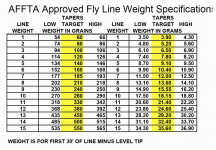
There is a standard system but it’s applied arbitrarily by every manufacturer.If only there were standard systems of measurement in place they could have been using this whole time....
Like, is it so hard to have a 5mm gap hook, and 8mm gap hook, and a 12mm gap hook?
No? Arbitrary numbers it is!
Even that would be good to know.I think Mike was saying that the baseline hook would be per manufacturer
I still think we, as consumers, could benefit from an Xzibit of hook size inconsistency.
There technically IS a standard for line size, which is supposed to roll over in to rod size as it hits a certain range on a deflection board for a standard amount of weight.
AFFTA has their line standardization chart which is based on the grain window for the first 30ft. I just feel like the fast/stiff rod trend, mostly pushed by Sage for some time, kind of pushed the industry away from that a bit.
Edit: adding said chart
View attachment 129393
Well aware of it and well aware of how many lines fall so far out of the grain window, yet still get marked as a certain size. My current beach line is marked as a 6 wt, but grain weight wise is a 8 wt. I’m in the camp where I’m glad there are no absolutes as far as standards and that we get lots of choices.
SF
We can have standards and still have lots of choices. Standards would make it much easier to make said choices.Well aware of it and well aware of how many lines fall so far out of the grain window, yet still get marked as a certain size. My current beach line is marked as a 6 wt, but grain weight wise is a 8 wt. I’m in the camp where I’m glad there are no absolutes as far as standards and that we get lots of choices.
SF

See, this is the kind of information that is useful. I didn’t know Firehole hooks were relatively large until I bought some and found out the hard way. I’ll use them for other stuff than I initially intended but it’s still annoying.
Same with Ahrex. I have found that they run larger than other similar hooks from other manufacturers.
@Mike Cline what is the standard baseline hook that all sizes are based on?
In my work with Joe Mathis of Firehole Outdoors the typical convention is to design a hook style, then dimension the largest hook in the planned range for whole # sizes. If the planned range includes both small and large hooks then the “master hook” is usually the #1. #s 2 thru X are proportionally smaller and numbers 1/0 thru X/0 are proportionally larger. Shank length, eye size, gap size, wire size, wire coating, bend shape, barb or barbless, angling purpose
and manufacturer capability/methodology are all criteria considered in the standard dimensions of the design.
This article might provide some additional insight.

How to Design a New Fishhook | Fly Tyer
Creating new hooks is about more than just sharpening and bending thin pieces of wire. And with all the hooks already on the market, why would you even
 www.flytyer.com
A standard for hook sizing would be a disaster for the fly fishing industry. First, who sets the standard? Which of the current Brands would hold sway in establishing the standard. Whose hooks would be left out of the standard? A fly hook standard would put most of the smaller brands out of business and there would be no new innovation in hook design. Standards are established for two important reasons—product safety and product compatibility. Neither of those criteria apply to fly hooks. Consumer convenience is not, and never should be a criteria for establishing an industry standard.We can have standards and still have lots of choices. Standards would make it much easier to make said choices.
Interesting! Thanks for the article.In my work with Joe Mathis of Firehole Outdoors the typical convention is to design a hook style, then dimension the largest hook in the planned range for whole # sizes. If the planned range includes both small and large hooks then the “master hook” is usually the #1. #s 2 thru X are proportionally smaller and numbers 1/0 thru X/0 are proportionally larger. Shank length, eye size, gap size, wire size, wire coating, bend shape, barb or barbless, angling purpose
and manufacturer capability/methodology are all criteria considered in the standard dimensions of the design.
This article might provide some additional insight.
How to Design a New Fishhook | Fly Tyer
Creating new hooks is about more than just sharpening and bending thin pieces of wire. And with all the hooks already on the market, why would you even
Ok, so the master hook size for any given style of Firehole is a #1, and the rest of that style are proportionally up/down. I know how hook sizes are assigned so that part's not new to me. Are all Firehole #1s based on the same "standard" size criteria? Obviously style of hook will dictate some differences in the final product; I'm talking ballpark here.
The problem I'm finding is that a Firehole (or any brand) #1 is different than any other brand #1; there's no consistency as to what a #1 actually is.
As a casual tier that ties for specific fisheries, I have my preferred brands and styles for the patterns I normally tie. However, as I branch out, the hooks I use for patterns for staging coho and SRC in WA and BC are not going to cut it for stripers in SF Bay or dorado in Mexico. So I either have to find what I can locally (preferable) or order online, which is a crapshoot. Hence the desire for a standard. Yes, I can still tie on the hooks I've purchased that turned out to be different than what I wanted, but I'd rather get what I want right off the bat.
A standard for hook sizing would be a disaster for the fly fishing industry. First, who set the standard? Which of the current Brands would hold sway in establishing the standard. Whose hooks would be left out of the standard? A fly hook standard would put most of the smaller brands out of business and there would be no new innovation in hook design. Standard are established for two important reasons—product safety and product compatibility. Neither of those criteria apply to fly hooks. Consumer convenience is not, and never should be a criteria for establishing an industry standard.
Sure, there would be some teething as brands agreed on a standard but I completely disagree with your statement that standards would put smaller brands out of business and stifle innovation.
I'll just take solace in the fact that Brita Fordice and many others are just as frustrated about hook size inconsistency as I am.
What would be disastrous about it? Create your hook lineup: Each being exactly the hook they want to make. Then measure each hook in millimeters. Done.A standard for hook sizing would be a disaster for the fly fishing industry. First, who sets the standard? Which of the current Brands would hold sway in establishing the standard. Whose hooks would be left out of the standard? A fly hook standard would put most of the smaller brands out of business and there would be no new innovation in hook design. Standards are established for two important reasons—product safety and product compatibility. Neither of those criteria apply to fly hooks. Consumer convenience is not, and never should be a criteria for establishing an industry standard.

Wayne Kohan
Life of the Party
Stupid really. By the way, there is the AFFTA standards for fly lines, not a safety issue. And not really a compatibility issue since many of the newer fly rod designations are best used with lines that are overweighted.Standards are established for two important reasons—product safety and product compatibility. Neither of those criteria apply to fly hooks. Consumer convenience is not, and never should be a criteria for establishing an industry standard.
And it would not be any harder for a fly hook company to come out with their "master hook", see how it measures on a "standard" and then base the rest of their lineup on that. Just stupid reasoning, and a reason not to buy hooks from smaller manufacturers.

Well, exact consistency no. But if you factor in the secondary specs, ie, 1x/2x short, 1x/2x wide gape, strength etc. I do think you can get close enough.there's no consistency as to what a #1 actually is.
For instance. You can probably guess the what a Ahrex TP610 1/0 with Standard Shank and Wide Gape looks like compared to a Kona BGH 1/0 with a 1x short shank and 2x strength.
I can surmise the rough difference in shape based on those secondary factors, but I can only assume that the Ahrex will be much larger than the Kona based on my previous experience with the brands sizing difference relative to each other.Well, exact consistency no. But if you factor in the secondary specs, ie, 1x/2x short, 1x/2x wide gape, strength etc. I do think you can get close enough.
For instance. You can probably guess the what a Ahrex TP610 1/0 with Standard Shank and Wide Gape looks like compared to a Kona BGH 1/0 with a 1x short shank and 2x strength.
If I have no previous knowledge then I’m just guessing.
I totally get it. I think for me, just trying to learn these subtle differences is giving me one up in a educated guess vs just throwing spaghetti at the wall. This is also why I just stick to the same brands. Firehole for nymphs. TMC/Ahrex for Drys. Ahrex, Kona and MFC for streamers. This pretty much sums up all my tying.I can surmise the rough difference in shape based on those secondary factors, but I can only assume that the Ahrex will be much larger than the Kona based on my previous experience with the brands sizing difference relative to each other.
If I have no previous knowledge then I’m just guessing.

As old as we are, Brian, we remember choices being limited to just a couple manufacturers. Where I lived it was Mustad or Mustad (slight exaggeration). I forget when Tiemco's came on; Bill Marts with the Blue Dun introduced me to them. Lo and behold: I didn't have to sharpen hooks out of the package. I love having all the choices we have now and have found some favorites whose sizes did surprise me; a pleasant surprise but my mileage obviously varies from @adamcu280 and whoever Brita is. ;-)I think hook sizes are like many other things in fly fishing, with nothing being standardized.
Not all 6 wt rods are the same. Some are stiff as mop handles and then some are whimpy.
Lines vary even more than rods. Just look at the grain weights and profiles.
Not having standardization can definitely be confusing, but having all the different choices is great in my opinion. We’ve never had it so good as far as the options available for materials, hooks and gear.
SF


It's one of my biggest pet peeves in the industry. Hook size literally means nothing in terms of consistency. It's something we've dealt with for years and the problem is we are always adding new hooks. We carry Ahrex, Firehole, Gamakatsu, Core, Hanak, Daiichi, not all of their full lines but it's a nightmare. The companies have sizes I would assume for manufacturing purposes so they should be the ones putting it out. Would make things a lot easier for there retailers!I like Ahrex hooks too and try to use them when I can, and I agree that it's not on them to compare sizes. This is why I suggested that @SpawnFlyFish (or any other online retailer that sells multiple brands of hook) to put a comparison chart together so consumers can have a better idea of what size to get. Sounds like this is an age-old problem and if we can't get brands to get consistent, maybe it's time for retailers to take up the slack.
haha that would be a lot of hooks that is for sure!