NFR Got any Herp pictures?

Non-fishing related
View attachment 150573

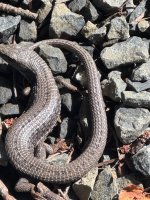
This is the only one of these I have ever seen. I believe it is a western yellow-bellied racer.
fast a hell and always got a chip on their shoulder! That's why I love 'em!


hoping that I'll be able to add to this thread after Saturday....I'll be lookin'
 
Southern Arizona, late March 2025. Reptiles and Amphibians. During our trip to Southern Arizona last month, we didn’t neglect to keep our eyes pealed for herps. As often as not, they were responsible for the rustling leaves that distracted me on our hikes. And we didn’t do more than scratch the surface of the reptile and amphibian diversity.
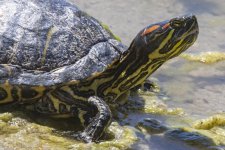
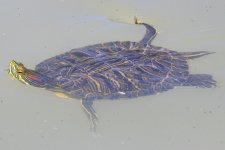
We saw three turtle species, two of which were new to me. We saw many sunning pond sliders at Sweetwater Regional Park north of Tucson and at Aqua Caliente Regional Park, northeast of Tucson.
A03PondSlider6905.jpg
A04PondSlideHeadShot6963.jpg
Pond sliders are native to the Central and Southern U.S. and Northern Mexico. This species has also become established throughout the U.S. and around the world via released pets – a weed... A limit on its distribution in Arizona is its requirement for perennial water.
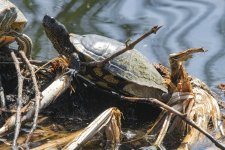
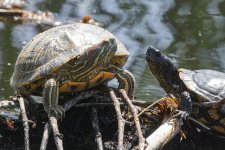
Sweetwater also had a few Sonoran mud turtles mixed in with the pond sliders.
A01PondSlider&SonoranMudTurtle9589.jpg
A02SonoranMudTurtle9588.jpg
Sonoran mud turtles also require permanent water. This species ranges from Southwestern U.S. into Northern Mexico; populations in California and Nevada are now extinct. It is considered a near-threatened species, primarily through habitat loss.
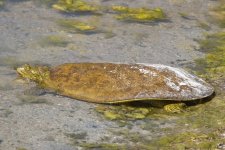
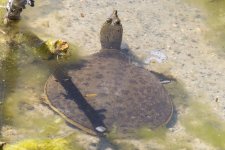
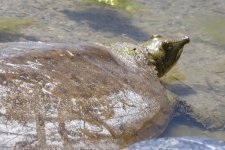
At Aqua Caliente, we encountered spiny softshell turtles, a type of turtle that I had never seen before. Turtles in this group replace the bone normally found in the outer sections of the carapace with a pliable leathery material, while the center of the carapace is still supported by solid bone.
A05SpinySoftshell6968.jpg
A06SpinySoftshell6971.jpg
A07SpinySoftshellTurtle6972.jpg
This species not only breathes air, but it can also acquire significant oxygen through cutaneous absorption via its mouth and skin. This species is found through large parts of the Mississippi River system, in the Southeast, and eastern Texas. It is not native to Arizona but has been introduced. It can exploit slow-moving rivers, irrigation canals, and permanent and urban lakes.
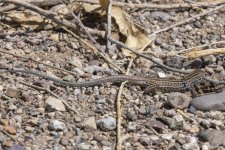
We encountered the Chihuahuan spotted whiptail lizard (probably… Identification is tricky.) at Sweetwater Regional Park.
A08ChihuahuanWhiptailLizard9615.jpg
This is an interesting “species” because it is one of about twenty all-female parthenogenic whiptail species. New offspring are produced without fertilization and are clones of their mother. This species is triploid, the result of reproduction between different bisexual whiptail species. It is found in the desert Southwest, Southwestern Texas, and Northern Mexico.
At Sweetwater, we had brief glimpse of a desert spiny lizard before it disappeared deeper into the shrubs while carrying a mallow flower as a snack.
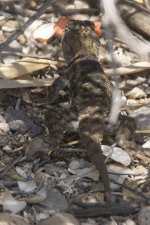
A09DesertSpinyLizard9620.jpg
While we were hiking in Ramsey Canyon, we watched an ornate tree lizard doing a “push-up” display on a boulder in the dry creek bed.
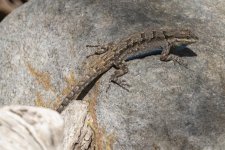
A10OrnateLizard8433.jpg
This species is found in several color morphs that play a role in intraspecific competition and reproductive strategies. This species ranges from California through to Texas, including Nevada, Utah, Colorado, and Wyoming and into Northern Mexico.
While hiking in the western section of Saguaro National Park a very hot afternoon, we encountered a solitary zebra-tailed lizard that posed for us along the trail.
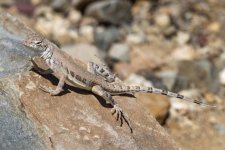
A11ZebratailedLizard6676.jpg
This species is found in the Mojave and Colorado deserts and into the southern parts of the Great Basin.
Also in Ramsey Canyon, the Nature Conservancy has been working with the U.S. F&W Service to reintroduce and rebuild populations of the Chiricahua leopard frog. This species is considered threatened due to habitat loss, non-native predators like bullfrogs and the fungal disease chytridiomycosis. This species looks like a small bullfrogs with spots. We encountered several leopard frogs in two engineered ponds along Ramsey Creek.
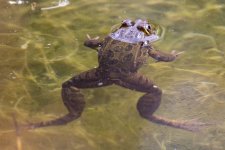
A12ChiricahuaLeopardFrog8511.jpg
In Ramsey Canyon and other sites (e.g., Beatty Ranch at Miller Canyon), these ponds are enhancing leopard frog populations in the mountains of Arizona and New Mexico.

Steve

 
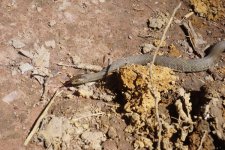
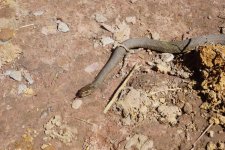
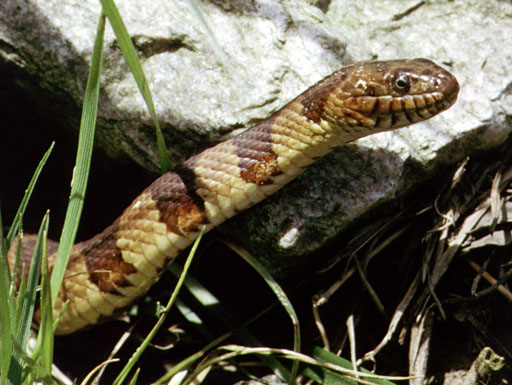
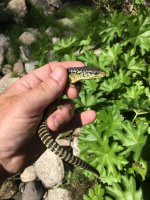
We got more herps in the future rain garden site. Not really sure what variety this is; closest I can come up with in Pennsylvania is a Queen snake, but I'm not convinced. Was about 3 feet long, fairly docile (it was warm in the sun) and not terribly spooked by me, actually, very nonchalant.

1746049105579.jpeg

1746049491384.jpeg

Saw another snake under water in the pond, when it became aware of me, shot under the pond muck on the bottom. Didn't get a good look, and obviously, no pic.

cheers
 
We got more herps in the future rain garden site. Not really sure what variety this is; closest I can come up with in Pennsylvania is a Queen snake, but I'm not convinced. Was about 3 feet long, fairly docile (it was warm in the sun) and not terribly spooked by me, actually, very nonchalant.

View attachment 151571

View attachment 151572

Saw another snake under water in the pond, when it became aware of me, shot under the pond muck on the bottom. Didn't get a good look, and obviously, no pic.

cheers
Maybe a Northern Water Snake that's about to molt so it's got that milky/ashy look to its pattern.
 
Maybe a Northern Water Snake that's about to molt so it's got that milky/ashy look to its pattern.
Thanks, but I'm afraid I'm not convinced of that either. From what I understand, the Northern Water snakes are a nasty sort, their head is also more distinct from the body, and they have a much heavier body, this guy was slender.
 
Thanks, but I'm afraid I'm not convinced of that either. From what I understand, the Northern Water snakes are a nasty sort, their head is also more distinct from the body, and they have a much heavier body, this guy was slender.
Meh. They ain't all fat and nasty! 'Specially the cold ones that have just recently emerged from dormancy!

from wikipedia:
 
We got more herps in the future rain garden site. Not really sure what variety this is; closest I can come up with in Pennsylvania is a Queen snake, but I'm not convinced. Was about 3 feet long, fairly docile (it was warm in the sun) and not terribly spooked by me, actually, very nonchalant.

View attachment 151571

View attachment 151572

Saw another snake under water in the pond, when it became aware of me, shot under the pond muck on the bottom. Didn't get a good look, and obviously, no pic.

cheers
@Matt B 's assessment seems closest.

most water snakes are nasty as hell, but as a kid in TX, I caught enough that weren't (definitely in the minority though). Possibly a little skinny due to coming out of brumation recently....

The only other one that's similar in pattern in your area would be a mole kingsnake, but their scales are not keeled like the one in the pic.
 
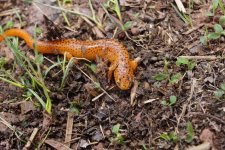
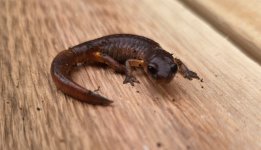
Was getting ready to fill raised beds this morning and almost smashed this little guy. Not sure I've seen a reddish one like this before.

View attachment 151582
That looks like Ensatina eschscholtzii. The constriction where the tail meets the body is one of the diagnostic features. They have a wide distribution west of the Cascades. They belong to the family Plethedontidae in which all members are a) lungless and b) direct developers. The first means that they respire entirely through their skin and the tissues lining their mouth. The second reflects that they lay eggs on land; the eggs hatch into miniature adults without any aquatic larval phase. The family is quite diverse worldwide with over 500 species. They are especially diverse and abundant in the Southeast.
Steve
 
That looks like Ensatina eschscholtzii. The constriction where the tail meets the body is one of the diagnostic features. They have a wide distribution west of the Cascades. They belong to the family Plethedontidae in which all members are a) lungless and b) direct developers. The first means that they respire entirely through their skin and the tissues lining their mouth. The second reflects that they lay eggs on land; the eggs hatch into miniature adults without any aquatic larval phase. The family is quite diverse worldwide with over 500 species. They are especially diverse and abundant in the Southeast.
Steve
I recall 22 years ago doing a project in my HS biology class about the various subspecies that live in California, with a variety of physical features, some of which can interbreed with each other. We were learning about evolution and phylogenies. I don't recall any of the specifics, but the Latin name hit me like a thunderbolt despite not hearing it in the last 2 decades.
 
I recall 22 years ago doing a project in my HS biology class about the various subspecies that live in California, with a variety of physical features, some of which can interbreed with each other. We were learning about evolution and phylogenies. I don't recall any of the specifics, but the Latin name hit me like a thunderbolt despite not hearing it in the last 2 decades.
Their biological claim to fame is that they are a "ring" species (and here). The species has several morphological subspecies that are along the California coast and the Sierra with the inhospitable dry San Joaquin Valley acting as a barrier. Neighboring subspecies can interbreed where these subspecies overlap, but where the southernmost coastal subspecies and the southernmost Sierra subspecies meet, they cannot. The hypothesis has been that Ensatina expanded southward from Northern California, it evolved various subspecies, but the differences are not complete enough to block interbreeding totally. However, enough differences accumulated in the Sierra subspecies and the coastal subspecies due to their long independent evolutionary history that they cannot interbreed where they overlap in Southern California. Another example of a ring species are the herring gull and lesser black-backed gulls in Northern Europe. Evolutionary biologists have described ring species as example of incipient speciation.
Steve
 
Their biological claim to fame is that they are a "ring" species (and here). The species has several morphological subspecies that are along the California coast and the Sierra with the inhospitable dry San Joaquin Valley acting as a barrier. Neighboring subspecies can interbreed where these subspecies overlap, but where the southernmost coastal subspecies and the southernmost Sierra subspecies meet, they cannot. The hypothesis has been that Ensatina expanded southward from Northern California, it evolved various subspecies, but the differences are not complete enough to block interbreeding totally. However, enough differences accumulated in the Sierra subspecies and the coastal subspecies due to their long independent evolutionary history that they cannot interbreed where they overlap in Southern California. Another example of a ring species are the herring gull and lesser black-backed gulls in Northern Europe. Evolutionary biologists have described ring species as example of incipient speciation.
Steve
Yes! Now I recall it was framed as a "mystery" where we were supposed to come to this conclusion based on our understanding of evolution and the data given to us. Shouts to Mr. Bergholz and thanks for sharing!
 
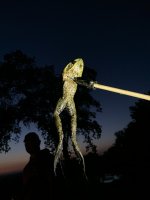
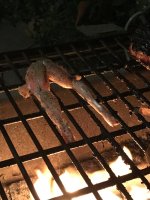
When I was a little kid my great Uncle would go out at night and catch them and fry us up the legs for breakfast.

He’d see their eyes shining in the flashlight beam, then dangle a fly down in front of them to catch them. They were good eating.

Talking about the bullfrog, not the lizard 😂
 
Back
Top