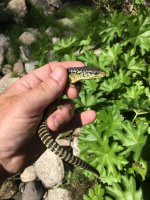
Southern Arizona, late March 2025. Reptiles and Amphibians. During our trip to Southern Arizona last month, we didn’t neglect to keep our eyes pealed for herps. As often as not, they were responsible for the rustling leaves that distracted me on our hikes. And we didn’t do more than scratch the surface of the reptile and amphibian diversity.
We saw three turtle species, two of which were new to me. We saw many sunning pond sliders at Sweetwater Regional Park north of Tucson and at Aqua Caliente Regional Park, northeast of Tucson.
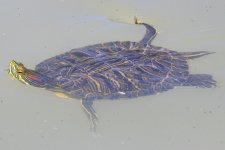
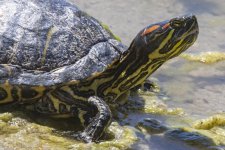
Pond sliders are native to the Central and Southern U.S. and Northern Mexico. This species has also become established throughout the U.S. and around the world via released pets – a weed... A limit on its distribution in Arizona is its requirement for perennial water.
Sweetwater also had a few Sonoran mud turtles mixed in with the pond sliders.
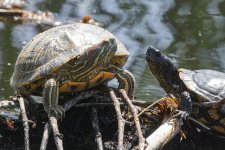
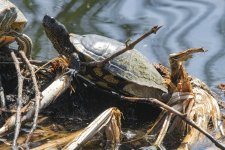
Sonoran mud turtles also require permanent water. This species ranges from Southwestern U.S. into Northern Mexico; populations in California and Nevada are now extinct. It is considered a near-threatened species, primarily through habitat loss.
At Aqua Caliente, we encountered spiny softshell turtles, a type of turtle that I had never seen before. Turtles in this group replace the bone normally found in the outer sections of the carapace with a pliable leathery material, while the center of the carapace is still supported by solid bone.
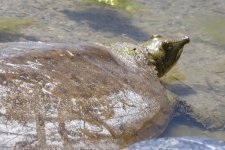
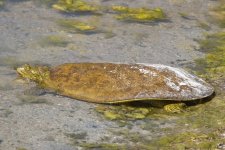
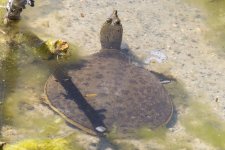
This species not only breathes air, but it can also acquire significant oxygen through cutaneous absorption via its mouth and skin. This species is found through large parts of the Mississippi River system, in the Southeast, and eastern Texas. It is not native to Arizona but has been introduced. It can exploit slow-moving rivers, irrigation canals, and permanent and urban lakes.
We encountered the Chihuahuan spotted whiptail lizard (probably… Identification is tricky.) at Sweetwater Regional Park.
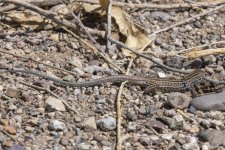
This is an interesting “species” because it is one of about twenty all-female parthenogenic whiptail species. New offspring are produced without fertilization and are clones of their mother. This species is triploid, the result of reproduction between different bisexual whiptail species. It is found in the desert Southwest, Southwestern Texas, and Northern Mexico.
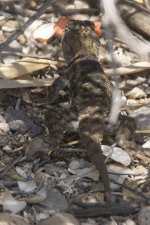
At Sweetwater, we had brief glimpse of a desert spiny lizard before it disappeared deeper into the shrubs while carrying a mallow flower as a snack.
While we were hiking in Ramsey Canyon, we watched an ornate tree lizard doing a “push-up” display on a boulder in the dry creek bed.
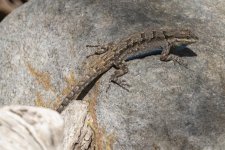
This species is found in several color morphs that play a role in intraspecific competition and reproductive strategies. This species ranges from California through to Texas, including Nevada, Utah, Colorado, and Wyoming and into Northern Mexico.
While hiking in the western section of Saguaro National Park a very hot afternoon, we encountered a solitary zebra-tailed lizard that posed for us along the trail.
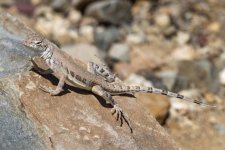
This species is found in the Mojave and Colorado deserts and into the southern parts of the Great Basin.
Also in Ramsey Canyon, the Nature Conservancy has been working with the U.S. F&W Service to reintroduce and rebuild populations of the Chiricahua leopard frog. This species is considered threatened due to habitat loss, non-native predators like bullfrogs and the fungal disease chytridiomycosis. This species looks like a small bullfrogs with spots. We encountered several leopard frogs in two engineered ponds along Ramsey Creek.
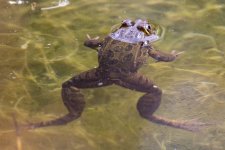
In Ramsey Canyon and other sites (e.g., Beatty Ranch at Miller Canyon), these ponds are enhancing leopard frog populations in the mountains of Arizona and New Mexico.
Steve