NFR Got any Herp pictures?

Non-fishing related
I go to Malaysia practically every year, and as you can imagine, I was bound to see a few herps visiting one of the world's megadiverse countries with more than 550 species of reptiles and 240 species of amphibians.

Here are a few highlights:

Saltwater Crocodile (Crocodylus porosus). Floating down a river in Borneo, must've seen more than 20, stopped counting after a while. This was one of the biggest. You would think the regular sight of something like this would stop anyone from swimming in the river. You would be wrong.
AP1GczMhLMrc7HSsr5ln5GJRSU1q5pA6LB0Q8zrc_paP-Pr5Znjp7KkP43O_RCLjkt1NPlYBet8HXZoQI9TBKdSt2A3pnMB7YGSwovXvBziipP4qKpCfDB_wX8ewNN4TyePSXWH2ZvB2688j9BnZndAuqJWc=w1400-h788-s-no


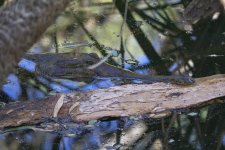
My 8-year old kid goes, "Look, there's a snake!" and I'm like, "Where??!!"
AP1GczMpGuUjOwps95FYCsTmDc5yN1vs_sM4zSImLeHD6DjILR8Y0ERBIbsqSEgK-O2low3wfuIQIMSVjoFwh57hAY1AhWwQEZXB2b_ulXwuCRSjh9WHI_QSHc5C2HmP1stSIogXcVfFLE1QqNig6Za47jRi=w1024-h577-s-no


"Ohhhhhh, there!" (Almost dead center in the photo above). A Bornean Keeled Pit Viper (Tropidolaemus subannulatus).
AP1GczOjnMeY_Ax-4hfy7n7njY4qdgfkCZ6c8LrmOOwWTNwlN6zjXMHzZvsSUXoWEzn985TmwSMU60m5eCc49Jp8A7xs7LLlsnTcdxiSD0ecAF_VMSIodxm6nl8g1aMJH1J9gvZxoiK2BEOHPlxNcPEK46du=w992-h558-s-no


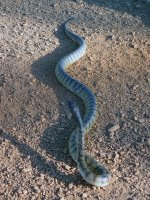
This Wagler's Pit Viper (Tropidolaemus wagleri), closely related to the Bornean Keeled PV above, was almost a backyard animal, saw it about a hundred yards from my parents' home. BTW, Asian pit vipers are related to your rattlesnakes, they all have these heat sensing pits between their eyes and nostrils that make them really effective hunters in the dark. These two pit viper species are unusual in that their venom is mainly neurotoxic -- viper venom is usually mainly hemotoxic.
AP1GczOs62lsyIl1F7PfSltFXS5iLioyLXxxxifB81Vmm2Vy8Dk6Dy88yGfERc8HlxPANtrqzPxSzbYkFWD9oKzmcXpBnGBqMkSTyj25Cc5IMcpkfE62UjQQH8R5g64pUi9Kh33XquQSquUyjQCQ_CfFjO96=w1024-h576-s-no


And here's a Mangrove Pit Viper (Trimeresurus purpureomaculatus). They're pretty sedentary, so once you see one, you know that you'll find it more or less in the same area the next time you go by. Their venom is a powerful hemotoxin, and they have a reputation among locals for being irritable, so approach with caution!
AP1GczN-CxgyRDsJs6UvL1rEnv8xZwmKEhU7tk5hieuT93T_KCMpoUCknc39E6SQGQNpWAuH-_33CNj8IpoeID6k9Myv3lqhoyjYIFrjvNjPozldTR800VJ3u28KI7H2qrFYd8jN_lqoT24DZWeNZGjWhpx4=w1024-h576-s-no


My favorite gekko, the Tokay (Gekko gekko), one of the world's largest, reaching 15 inches in length. You hear it way more than you see it. When you do see it, on the side of a wall, for example, it's like, "Woah, that's big!" Not venomous, but aggressive when handled and has a strong bite that will draw blood.
AP1GczPJa8v4axHCjSnK_dmBNBJ0gDkJbPlxiAw3o8EW5RC_8YYdelAtbQy1h1HTNOxgXapXCrtvfK6otIaV8YVV5FkzYjBB69igux2CtyeJn5b_9Id3RTjhhsJW4XI_0gIfolckAYCokm_C6tdxLJR8CQlv=w1024-h670-s-no


Going underwater, found a Yellow-lipped Sea Krait (Laticauda colubrina). Related to the cobras, its neurotoxin is pretty potent, but it's not an aggressive snake -- this one was rather curious and actually followed me for a few seconds, always at a safe distance.
AP1GczPD8UHsJmHoJGKN1eNHwICF0j0VdMa0IheF0p4KRyiRjIfjTklbYB2Ey7UARg2SmvBZCtCiqibd4n9t98KQLH5rjIRnWkG8-rKBp0TlEzlcB7Wq1OSRO7SKi_RSG-S12788RMkCwuqk6E33oukU6IuC=w1024-h576-s-no


One of my favorite photos of a turtle. This is a plain tuckered out Green (Chelonia mydas).
AP1GczNQ0c-Q18JmVeJMwy2AGuWVvhGFWQBRYQJ4rb3eZTD3-yQHJU6C9mlDmuroWVPR2PYVBAN9v54XIksEq4CEDrSYqaf_aTepjLw4xDDyHRO4NS8paEOhrHGd6Pq1NHwwjSgBOkaCpnJDZIyEx6beCqNG=w1024-h576-s-no


Thanks for looking,
Kenneth
Absolutely amazing photographs. Wow!
 
This little guy narrowly missed being run over by my mower last week.
View attachment 123562
I'm no expert but am guessing that it's a Western Skink. We recently had a bigger one on our front porch but this one was only a couple of inches long so probably a juvenile. The vividness of the neon blue tail is amazing.
Yup. Our cats used to come in with their detachable blue tails.
 
It's a herpy time of year around here. They are out and about for sure. I've been seeing lots of common gartersnakes and a skink or three.
 
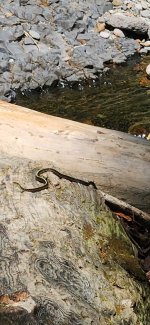
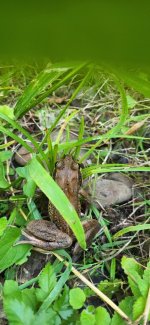
I have been seeing a frog here and a snake there. I have even gotten a couple of picturesimage000003.jpg
image000002.jpg
.

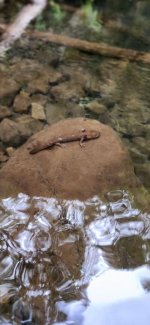
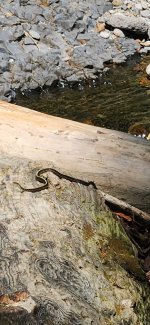
I saw a Blue Skink last week but I didn't get a picture of that. Yesterday I came across something interesting. I think it's a Cope's Giant Salamander. I had to look it up so I could be wrong. Maybe someone more knowable can let us know.

image000001.jpgimage000000.jpg
 

Attachments

  • image000003.jpg
    image000003.jpg
    418.7 KB · Views: 3
Herps of Australia: Part 1 of 6: Crocodilians. I was pleased to see this thread start. I love taking pictures of herps, especially those from the deserts of California and Arizona and from Washington state. But when I think “herps”, I think of Australia with the largest and with some of the most dangerous species. My wife and I spent a month exploring the wildlife of Australia in summer 2016 and another month in summer 2018. The primary emphasis of trips to Oz for two marine biologists would be the scuba diving (me) and snorkeling (my wife) in live-aboard ships along the northern Great Barrier Reef (bucket list…). But as biologists, we also arranged guided trips exploring the Northern Territory (especially Kakadu NP and the outback), Queensland (especially Daintree NP and the outback), and Western Australia (especially Cape Range National Park and Ningaloo Reef).
In prep for our trip, we read “In a Sunburned Country” by humorist Bill Bryson. A biological wimp, Bryson describes, in hyperbolic terms, some of the more dangerous members of the Australian fauna. These include some of the most venomous snakes on land (such as the eastern brown snake and inland taipan) and in the sea (yellow-bellied sea snake), venomous fish (stonefish, leaf fish, and common lionfish), man-eating sharks (e.g., tiger shark and great white shark), dangerous invertebrates (Sydney funnel web spider, box jellyfish, and blue-ringed octopus), and the largest, most dangerous living reptile (saltwater crocodile). And in 60ish days, we did see (or come close to) several from this list (and many other cool herps) that I will describe in a series of posts.

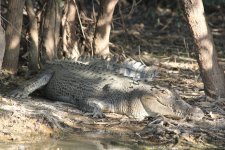
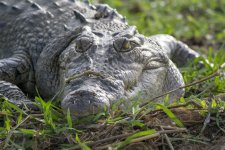
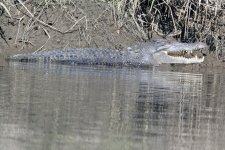
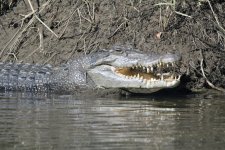
Saltwater crocodile (Crodylus porosus). I will start with the crocodilians, especially the saltwater crocodile (aka, salties in Oz). Male saltwater crocodiles can reach a length of 21 feet and a weight of 3,300 pounds.
A01SaltieOnBank8275.JPG
Females max out at about 10 feet and about 450 pounds. They are found in freshwater rivers, estuaries and salt marshes, and in coastal areas. This species ranges from Sri Lanka eastward through Indonesia to New Guinea and Northern Australia. In Australia, they range from the northern edge of Western Australia, through the Northern Territory, and as far south as Central Queensland in the east of Australia. Fortunately, saltwater crocodiles do not range very far offshore. While they are a threat along coastal beaches, they are not a huge concern when exploring the Great Barrier Reef. most of which is 20-30 miles from the coast near the eastern edge of the Australian continental shelf.
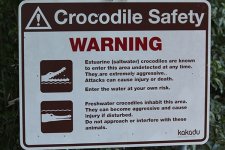
Generally, crocs migrate upstream in coastal rivers during the rainy season (November to April in the Northern Territory) and downstream toward saltwater in the dry season. Because of this, you have to treat just about any waters in their potential range as having saltwater crocs present. The government posts warning signs at likely spots.
A02CrocWarningSign8424 copy.jpg
But still there are multiple attacks by saltwater crocodiles every year and several fatalities typically. Recently, a 40-year-old doctor was killed by a croc while he was vacationing with his wife and children in far northern Queensland (https://www.cbsnews.com/news/crocod...hogbin-saved-wife-australia-family-statement/). Apparently, when the bank of a riverside trail gave way, he was dumped into the Annan River and could not climb out. His remains were found in the stomach of the croc after it was captured and killed. Search YouTube “Cahill Crossing” between Kakadu NP and Arnhem Land for another spot where salties and humans come in conflict.
While this recent fatality was an opportunistic attack, crocs are known for deliberate ambush attacks. In such a dry continent, land mammals (originally kangaroos, more recently feral pigs and water buffalo) rely on rivers and lakes for drinking water. And they tend to use the same drinking spots because they are familiar and presumably safe. But crocs watch their activity and stake out these locations. A river tour guide told a story of an encounter that another guide had with a saltwater croc on the Daintree River in Queensland. Customarily, the guie leaned over the stern of his boat to pull up his outboards at the end of the day. A croc had observed this and lurked under the boat. One afternoon, the croc lunged out of the water up at the guide, barely missing him…
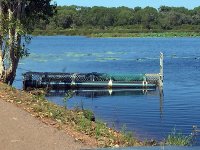
Problematic crocs are captured, typically using specialized heavy-duty traps.
A03SaltwaterCrocTrap3309.jpg
Captured crocs are then transferred to a croc farm or destroyed. Relocation is not an effective strategy because individuals will travel long distances to return to their territories.
In Australia, unrestricted hunting for skins and meat had decimated saltwater crocodile populations almost to the point of extinction. But since the mid-70’s, they have been largely protected in the wild. Some eggs and live crocs can be taken by permit for croc farms (70,000 eggs / year and 1500 live crocs / year in the Northern Territory). [The farmed croc that I ate at a restaurant in Cairns tasted like pork tenderloin.]. As a result of these protections, populations of saltwater crocodiles have rebounded and the average size has increased dramatically (individuals can live at least 70 years).
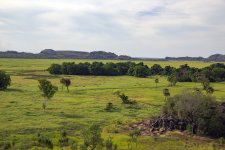
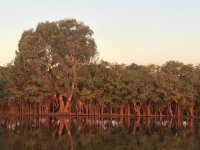
We saw salties at multiple places in the Northern Territory, but the most memorable encounters were on a sunset birding cruise on the Yellow Waters Billabong, an oxbow lake that was created by a channel change by the misnamed East Alligator River.
A04 EastAlligatorRiverFloodplain6464.jpg
A05SunsetYellowWaters0536.JPG
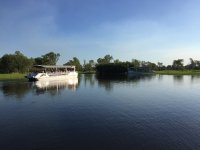
This was an amazing 2+ hour wildlife cruise. Most guests traveled on 50+ passenger boats
A06aTourBoatsYellowWaters0513.JPG
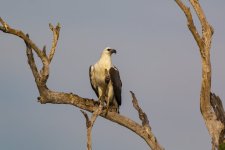
whose major focus is the megafauna, especially the crocs and white-bellied sea eagles.
A06bWhiteBelliedSeaEagle6044.jpg
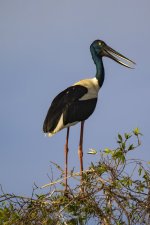
But by virtue our private guided tour of Kakadu, we were in a much smaller boat with just our group of 4 clients, our guide/s, and a driver. This small boat was able to quietly approach waterbirds along the billabong banks and the forest birds in the trees along the edge of the billabong, such as a black-necked stork,
A06c BlackNeckedStork6055.jpg
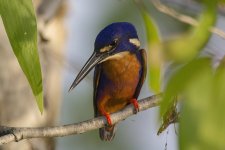
a tiny azure kingfisher,
A06dd AzureKingfisher6120.jpg
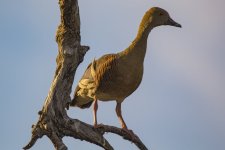
flocks of plumed whistling ducks,
A06d PlumedWhistlingDuck6080.jpg
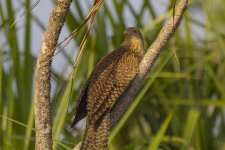
And a pheasant coucal (a type of cuckoo, but which raises its own young).
A06e PheasantCoucal6084.jpg
and we could get quite close to the salties.
A07aSaltwaterCrocIMG_5945 copy.jpg
A07bSaltieInWater8341.JPG
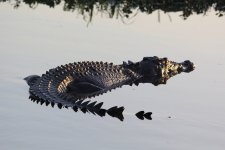
In 2016, we watched as this individual quietly, calmly swam across the billabong, lazily pass our boat (10-15’ at its closest approach), and crawl up a narrow channel leading deeper into the freshwater marsh. The fulvous whistling ducks and shorebirds along the banks and in the channel were wary of the approaching croc but not frantic. We asked one of our guides, Ian Morris, why the birds were so unconcerned by their close proximity to the croc. Ian, a tremendously experienced biologist who was one of the first rangers at Kakadu NP and literally wrote the book on Kakadu, said that their studies indicated that the dominant diet items for Kakadu salties were fish and mammals. Birds were not a major dietary item. Maybe they don’t like the feathers? [a paraphrase of his words] As evidence that the universe has a perverse sense of humor (especially for “experts” – I’ve been bitten by this myself once or twice…), less than two minutes after Ian said these authoritative statements there was an explosion among a flock of white ibises 50 yards from us. One of the ibises had become a sunset snack for a different saltie…
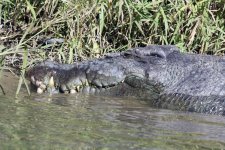
In Queensland, we had great looks at saltwater crocs in the Daintree River, the southern border of the tropical rainforest of the Cape Tribulation section of Daintree National Park. In both visits, we took guided tours along the lower section of the river. Per usual, one focus of the tour would be crocs. Typically, a large male croc, like this 13’,
A08aMaleCroc9006Trim.jpg
A08bMaleCrocJaws9013Trim.jpg
will exclude any other males from within his territory but allow females, like this 8’, to coexist.
A09aFemaleCroc9026 copy.jpg
A09bFemaleEstuarineCroc9037.jpg
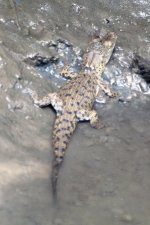
During the wet season, she will lay 40-60 eggs in a mound of mud and vegetation. The rotting vegetation provides some warmth to speed incubation. She also protects the eggs and newly-hatched juveniles from predators. During our visit in 2016 during the “dry season”, we were shown several juvenile saltwater crocs that had been hatched just a few months earlier.
A10YOYSaltie0143.jpg
Freshwater crocodile (Crocodylus johnstoni). Australia is home to a second species of crocodile, the Australian freshwater crocodile (“freshies”). While tolerant of salt water, this species is more common farther inland than saltwater crocodiles. Their range overlaps with saltwater crocodiles, except the freshwater crocodile is absent from coastal Queensland. They are much smaller and slenderer than saltwater crocodiles. Males may reach 13 feet and weigh 220 pound and females top out at 7 feet and 90 pounds.
A11a FreshwaterCrocodile6896.jpg
They have long, slender snout,
A11b FreshwaterCrocodile5560.jpg
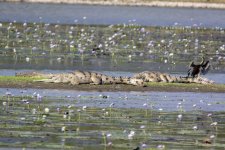
and a brown body with dark bands. They are far shyer than salties; we found a group sunning along the shore at Bird Billabong in Kakadu and they fled when we approached for some closer pictures. They are not considered dangerous, though they will bite in error or in self-defense. They feed on invertebrates (crustaceans, insects, spiders), on fish, frogs, other reptiles, birds, and smaller mammals like wallabies. In regions where cane toad populations have been expanding, populations of freshwater crocodiles have been declining, perhaps due to poisoning from eating invasive cane toads. Salties appear to be more resistant to the toxins.
Steve
 
Herps of Australia: Part 2 of 6: Snakes.
Black-headed python.
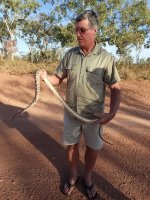
We had anticipated that we might encounter snakes during our guided and self-guided hikes in the parks and outback. That anticipation was reinforced as we had just entered Kakadu with our guides and encountered a black-headed python while driving along a gravel track.
A01 BlackHeadedPythonP6300083.jpg
This is a very docile species and was calm when handled.
A02BlackheadedPythonP6300089.JPG
I was surprised at how muscular it felt, but I should have expected that for a constrictor. Our guides indicated that this individual was probably headed back to its den after a night of foraging. While this species will eat bird and mammals, the major component of its diet would be reptiles, especially other snakes.
But this initial snake encounter was not followed up by many other encounters with the thin and slithery. On one hike in Daintree NP, our guide specifically brought us to a site where the extremely venomous eastern brown snake had known to frequent. But on a cool drizzly day, it wasn’t to be seen.
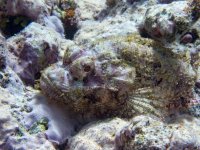
I was really hoping to see adult yellow-bellied sea snakes during one of my 60+ dives on the GBR and Osprey Reef, but it wasn’t to be. I did see several venomous fish, such as a tassled scorpionfish (Scorpaenopsis oxycephalus),
A03 TassledScorpionfish7211460.jpg
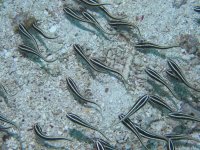
striped catfish (Pletosus lineatus),
A04 StripedCatfish7180474.jpg
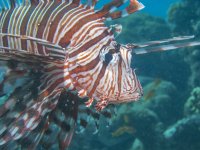
and common lionfish (Pterois miles).
A05 CommonLionfish7221824.jpg
But they aren’t herps, the topic of this thread. One night two pencil-thick/pencil-long yellow-bellied sea snakes (Hydrophis platurus) hunted small baitfish attracted to the lights off the stern of our live-aboard dive boat on the GBR (no pics in the bad light). Interestingly, the giant trevallies and red snappers that were also attracted to the lights and baitfish off the stern of the ship were NOT interested in these sea snakes as a snack.

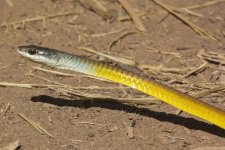
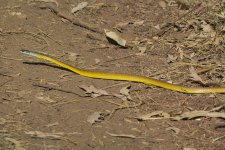
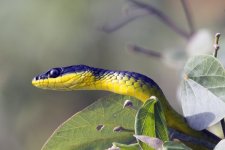
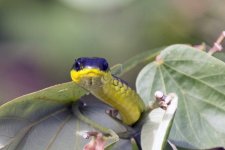
Australian tree snake (Dendrelaphis punctulasus). We were especially wary of encountering snakes when we were hiking without guides. On our way back to our hotel on self-guided hike near coastal Darwin, we turned a corner and this thin, bright yellow-green snake was stretched out along the trail ahead. I had a chance to take two pictures before it just vanished into the thick shrubs. Back in our room, we searched the web for its identity – an Australian tree snake.
A06 CommonTreeSnake7317.jpg
A07 CommonTreeSnake7319.jpgThis is a non-venomous species that feeds on frogs, skinks, and other small reptiles. We actually encountered it again a few weeks later on a guided boat trip on the Daintree River. Our guide pointed out several tree snakes sunning themselves in the riparian shrubs overhanging the river.
A08TreeSnake8936 copy.jpg
A09TreeSnake8929 copy.jpg

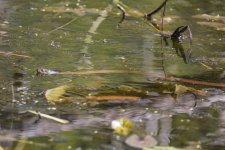
Keelback snake (Tropidonophis mairi). While wandering through the Cairns Botanical Garden, we had a brief view of a keelback snake in a pond before it swam into deep cover. This is another non-poisonous species that feeds primarily on frogs. It is apparently immune to the venom of introduced cane toads.
A10 KeelbackSnake7658.jpg

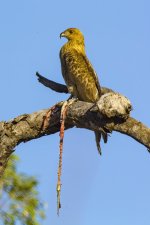
Unknown snake. I was at an extreme disadvantage in trying to identify a snake that we encountered on a hike in Kakadu NP. It wasn’t hard to see and it wasn’t trying to escape. But the whistling kite that caught it had already skinned it when we saw the kite perched in a tree .
A11 WhistlingKiteWSnake6609.jpg
Steve
 
Herps of Australia: Part 3 of 6: Lizards. We actually saw quite a few interesting lizard species in our travels. Some were sought out specifically and others were encountered serendipitously. What struck me was how site-specific some of these very large lizards were. Our guides brought us to specific groves of trees to see specific individuals.
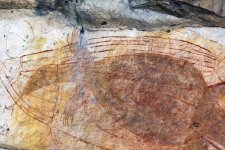
Especially large varanid lizards, aka goannas (a corruption of the word “iguana”), have a prominent place in Aboriginal culture and diet [And in Australian culture “How do like your goanna? Medium? Well done?” from Crocodile Dundee.]. When we visited Ubirr in Kakadu National Park, the Aboriginal rock art at this site highlighted drawings of many food animals available in the area (the flood plain of the East Fork of the Alligator River), including fish, wallaby, turtles, and varanid lizards.
01 GoannaArt6421.jpg
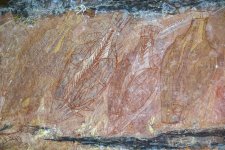
Drawing of animals are often in “X-ray” style in which the artist draws the outline of the animal and then includes internal structures, like the skeleton. At this site, we saw drawing of mullet, catfish, and especially barramundi, a very important food source in the Alligator River region.
02 BarramundiXRayArt6426.jpg
or the location of internal fat pads (turtles – see later).

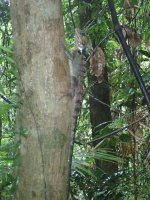
Boyd’s forest dragon (Lophosaurus boydii = crested lizard). This interesting species is native to the rainforests of the Wet Tropics of Northern Queensland. Our guide sought out a known individual in a grove of trees on a drizzly day in Daintree NP. As expected, we found it perched about five feet off the ground on the trunk of a tree. When we approached closer, it moved around the far side of the trunk out of sight.
A03 BoydsForestDragonP7262106.JPG
This adult was about 20” long. Each lizard has a nuchal (nape) crest and a crest of scales along its back. They are not known for basking (which makes sense as they live in dense rainforest locations). They feed primarily on invertebrates, especially earthworms (arboreal earthworms???).

Merten’s water monitor (Varanus mertensi). This is a coastal and inland lizard found across Northern Australia. As the name implies, it is always found near water. This was a species that we deliberately sought out at a small stream in inland Queensland. But it took two visits before we had a brief view of this 3’ long varanid lizard. It quickly disappeared into the water after it noticed us watching it through binocs.
B04 MertensWaterMonitor8460.jpg
It has a diverse diet and can locate and eat prey underwater. This species is listed a vulnerable because they can be poisoned by the toxins found in cane toads.
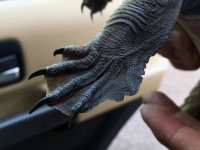
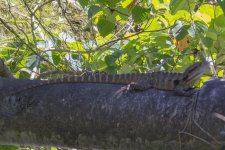
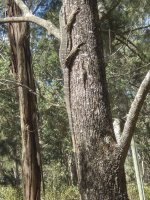
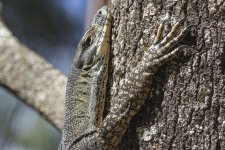
Lace monitor (Varanus varius). The lace monitor is also known as a tree goanna; it is one of 25 species of Varanus lizards in Australia. We encountered this 4’-long individual serendipitously. I saw something scramble behind a tree trunk while we were walking down a gravel road through open woodland / savannah. As we walked along the track for a better perspective, it held its position on the tree trunk.
C05 LaceMonitorP7260929.jpg
C06 LaceMonitor8448.jpg
This individual was the typical color morph with scattered cream-colored spots on a dark gray background; the Bell’s morph has white and yellow bands along the body. They are closely-related to Komodo dragons and have venom glands. They are predominantly carrion eaters, but they can capture insects, reptiles, small mammals, and birds. They also raid chicken coops and garbage heaps. While their populations initially declined in areas where poisonous cane toads invaded, their populations have stabilized as the monitors have learn to avoid poisonous cane toads after non-fatal initial exposures.

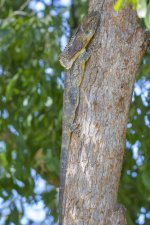
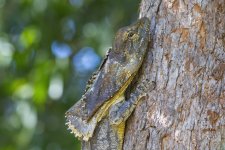
Frilled lizard (Chlamydosaurus kingii). This is another arboreal lizard found across the top of Australia from northern Western Australia, across the Northern Territory, and through the coastal and near inland areas of Queensland. Our guide knew the glade of trees on a public golf course where we would find this 3’-long individual. We searched several trees before we found it.
D07 FrilledNeckLizard9185.jpg
This lizard has a neck frill, much like that depicted in the venomous spitting dinosaur (Dilophosaurus) from Jurassic Park. The frill was not extended as this individual kept itself tight to a tree.
D08 FrilledNeckLizard9188.jpg
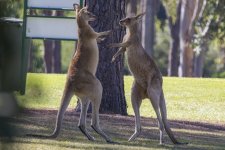
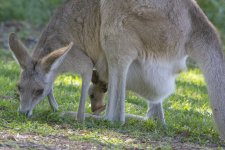
A frilled lizard will raise that fringe when threatened or when a male is asserting its territoriality. This diurnal species comes down to the ground to feed (mostly on insects, such as termites and ants), to interact with other frilled lizards, or to move to another tree. The golf course also had a herd of gray kangaroos that included boxing juveniles
D09 BoxingKangaroos9193.jpg
and grazing moms and joeys in mom’s pouches.
D10 Mom&JoeyGrazing9198.jpg
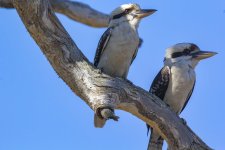
Our guide pointed out several laughing kookaburras (oversized kingfishers) in the trees
D11 LaughingKookaburra9247.jpg
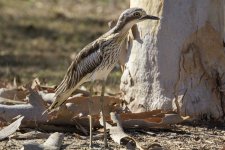
and bush stone curlews like statues under the trees.
D12 BushStoneCurlew9253.jpg

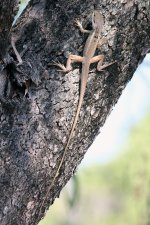
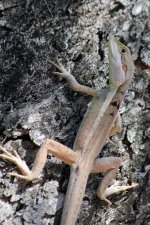
Swamplands lashtail lizard (Northern water dragon = Tropicagama temporalis). This is a common lizard in the Northern Territories (into far Northern Queensland and parts of New Guinea and SE Indonesia). This lizard reaches about 15” long. They primarily feed on insects, especially termites. We saw this species at several different sites in the Northern Territory. This individual was out foraging in the open.
E13 SwamplandsLashtailLizard8774.jpg
E14 SwamplandsLashtailLizard8777.jpg
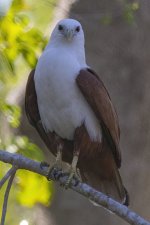
The abundance of these lizards apparently supports raptors, such as brown goshawks and Brahminy kites in the Darwin area.
E15 BrahminyKite7120.jpg

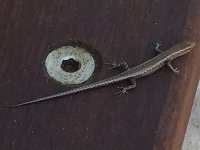
Delicate skink (Lamprophilis delicata). There are at least 389 species of skinks in Australia, with the massive common blue-tongued being perhaps the best known. We encountered delicate skinks around a picnic area at Kakadu. When not begging scraps from passing visitors, they feed primarily on insects and other invertebrates.
F16 DelicateSkink0332.jpg

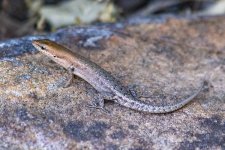
Bauxite rainbow skink (two-lined rainbow skink = Carlia amax). This diurnal skink is common in rocky and open woodland areas along the Top End of Australia. Males, like this one, develop a reddish head. It is an omnivore whose diet includes invertebrates such as insects, spiders, and worms and plant matter such as fruits, flowers, and leaves.
G17 BauxiteRainbowSkink7915.jpg
Steve
 

Attachments

  • IMG_6448PandanusGrove.jpg
    IMG_6448PandanusGrove.jpg
    262.7 KB · Views: 2
Herps of Australia: Part 4 of 6: Geckoes.
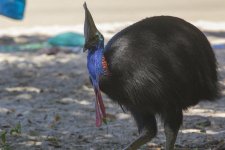
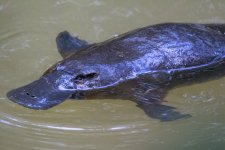
As part of our 2018 visit, I was looking for a wildlife guide for a 5-6 day trip around Queensland to cap the trip. We selected Patrick De Geest, owner/operator of “Eyes on Wildlife” to build an itinerary. Our overall priority was wildlife and habitat diversity. But I also wanted another view of a Southern cassowary and to see my first platypus. On the first day, Patrick brought us within 30 feet of a Southern cassowary by lunchtime
A01 SouthernCassowary8130.jpg
and we had great looks at a platypus diving for dinner in muddy creek by late afternoon – check and check.
A02 Platypus8181.jpg
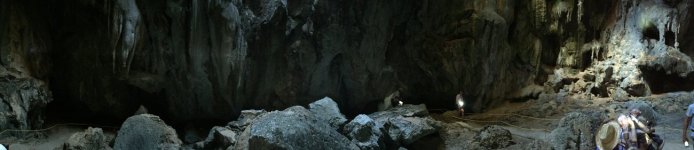
My wife’s priority was to visit the limestone caves of Chillagoe-Munganan Caves National Park, 3 hours inland from Cairns (definitely “Outback”). In the middle of our trip, we explored several caves in this system including the Royal Arch Cave.
A03 IMG_3851RoyalArchCavePanorama.jpg
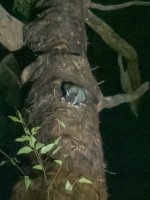
What really attracted me to Patrick’s guiding service was that he organized night walks to see nocturnal marsupials. These were really cool; we walked in the dark along gravel mountain roads surrounded by the dense canopy of native rainforest. Patrick used spot lights and a thermal imager to find arboreal marsupials in the canopy. These included species like this common ringtail possum.
A04 RingtailPossumP7252292.jpg

The eyeshine reflected from the spot light also revealed nocturnal geckoes (and spiders, lots of spiders at some locations…).

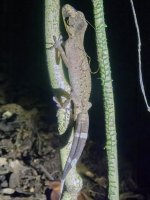
Northern leaf-tailed gecko (“horned keeper of the forests - Saltuarius cornutus). On our first nocturnal tour, we saw several large (foot-longish) northern leaf-tailed geckos high on the limbs of the rainforest trees. This species has a very broad (wider than body), flat tail. Their body coloration and skin tubercles resemble the lichen-covered bark of rainforest trees. They could be located first by their eye-shine. They are active even on cool nights where they forage for insects and spiders.
B05 NorthernLeafTailedGeckoP7252288.jpg

Australian chameleon gecko (Carphodactylus laevis). Near the end of our first nocturnal tour, we caught reflected eye-shine from our headlamps just off the trail and just a foot or two off the ground. It was an Australia chameleon gecko with something in its mouth.
C06 ChamelionGeckoP7252320.jpg
This gecko species reaches about a foot-long with a laterally-flattened tail. Whatever was in its mouth looked like a very thin strand of cooked spaghetti. After thinking about it, I believe the strand was a nematomorph (horsetail) worm.
These are VERY strange invertebrates. Their larvae are internal parasites of insects like crickets, beetles, and grasshoppers. Eventually, the parasite induces the insect to seek water and drown itself. The adult worm then emerges and lives out its life and breeds in water. There is a published study [https://hal.umontpellier.fr/hal-02992927/file/Ponton et al 2006 nature.pdf] that described observations of these worms escaping from the predators of their hosts, such as fish or frogs. So, it might be that this gecko ate a grasshopper or cricket that harbored a nematomorph. But the worm may have been attempting to escape when we encountered the two species.
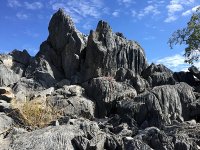
From the Dividing Range that separates the coastal rainforest from the dry Outback, we drove for several hours west to Chillagoe, a mining town and the jumping off point to explore the limestone caves of the Chillagoe-Mungana Caves National Park. After settling into our rooms at the former post office, we headed out that evening to hike some of the trails around the limestone karst cliffs.
D07 IMG_3786KarstLimestoneCliffsTrezkinn.jpg
We weren’t the only things wandering around these trails in the dark. We encountered an agile wallaby just off the trail.
D08 AgileWallabyP7262359.jpg
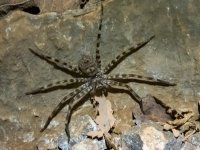
I was amazed at all the gleaming spider eyes on the limestone boulders. One of these spiders was a beautiful 3” diameter cave huntsman spider (Yiinthi chillagoe).
D09 YiinthiChilagoeHuntsmanP7262363.jpg
This spider hunts in the caves and among the limestone outcrops. They are not aggressive spiders, but they could give a painful bite and inject some venom if mishandled. And we did encounter three species of geckoes.

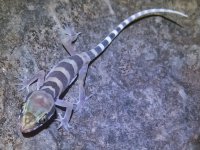
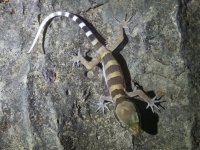
McDonald’s ring-tailed gecko (Chillagoe ring-tailed gecko, Cyrtodactyulus mcdonaldi). This individual was about 8” long.
D10  McDonaldsRingTailedGeckoP7262356.jpg
D11 McDonaldsRingtailedGeckoP7262350.jpg
It wasn’t very happy that we were interrupting its hunt, but we managed to confine it long enough for me to take a few pictures. It was likely out searching for arthropods.

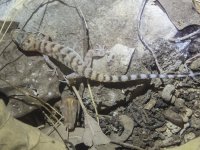
Bynoe’s gecko (Heteronotia binoei). The species name, bynoei, is named in honor of the naturalist/surgeon on the HMS Beagle, Benjamin Bynoe. This is a widely-distributed gecko species endemic to Australia, including urban areas.
E12 BynoesGeckoP7262372.jpg
It has small spines in ridges along its body. Some populations are capable of parthenogenesis. It hunts invertebrates at night.

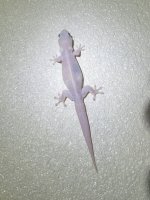
Common house gecko (Hemidactylus frenatus). The last of the gecko species that we saw on the hike was the invasive common house gecko. It is spreading around the globe, likely due the increased rate of transcontinental shipping. It preys on a variety of arthropods. They are primarily nocturnal.
F13 AsianHouseGeckoP7262369.jpg
Steve
 
Herps of Australia: Part 5 of 6: Turtles. An ancient split (at least 210MYA) separates living turtles into two clades (groups), the Pleurodira (side-necked turtles) and the Crytodira (hidden-necked turtles). The latter includes sea turtles, snapping turtles, soft-shelled turtles, tortoises, and most (all?) freshwater turtles in the Northern Hemisphere (Laurasia). The Pleurodira are freshwater turtles of Pangaea (i.e., South America, Africa, and Australia). A major morphological distinction between the two taxa centers on how they withdraw their heads into their shells. In both cases, the cervical vertebrae allow the neck to bend into an S-shape between the forelegs. In the Cryptodira, that S is oriented vertically, but in the Pleurodira, the S is oriented horizontally, hence the name side-necked. These different movements are facilitated by articulations between the centra of the neck vertebrae.

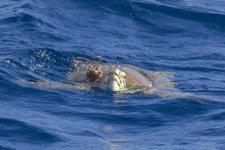
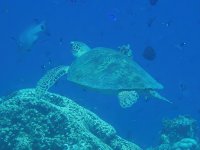
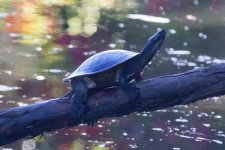
Green sea turtles (Chelonia mydas). After spending 60+ scuba dives and over two weeks offshore over two GBR trips, I would have expected to have seen more sea turtles. But I only saw a single individual of a single species, a green sea turtle. This species is found worldwide in tropical and subtropical waters. They prefer coastal tropical and subtropical waters. Green sea turtles are predominantly herbivorous, especially on sea grasses. So, it was a bit surprising to see green sea turtle individual off Lighthouse Bommie (“bommie” is Australia slang for a columnar outcrop of coral reef, a tall pinnacle of reef). Lighthouse Bommie lies 20+ miles from the coast; the bottom of this bommie was at least 100’ deep – not sea grass habitat. But we were not far from one of the long barrier reefs of the Ribbon Reefs, a long north-south finger whose inside shallows would be perfect habitat for sea grasses.
We first saw this individual on the surface as we tied up at one of the permanent moorings that the Queensland Diving Cooperative have installed at the most popular dive sites. [These mooring buoys provide secure moorage without the need to risk anchor damage to the reefs. The boats are supposed to cooperate via a roster on which boat will use which mooring which day/night. During our week-long liveaboard dive boat, we did get “low-holed” by another dive boat early one morning. They thought that they could sneak in and finish their clients’ dives, before we would arrive from offshore. That led to a heated radio exchange between our captain and that of the intruder who headed off to another nearby mooring. The matter was settled in true Aussie fashion when a peace offering of a case of beer was delivered to our boat.]
From the surface, we noticed that this individual had a substantial chuck of coral attached to plates in the upper right of its carapace.
A01 GreenSeaTurtle7862.jpg
Obviously, a coral larva thought that the turtle’s shell would be a good place to settle and metamorphose into a polyp. Normally, a sea turtle will visit a coral reef where the local reef fish (surgeonfish/tangs, damselfishes, angelfish, wrasses, and gobies, for example) will pick any algae or invertebrates (barnacles, corals, etc.) off the shell and skin. But this coral juvenile wasn’t removed and the colony is now too large to be removed by typical cleaners. Once my dive partner and I hit the water, we encountered this same individual on the reef as indicated by the epizootic coral growing on its shell.
A02 GreenSeaTurtle7180198.jpg

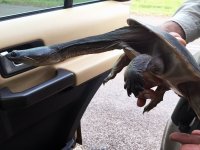
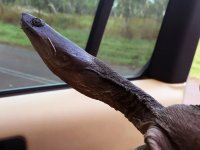
Northern long-necked turtle (Chelodina rugosa). We encountered a 15”ish northern long-necked turtle just outside Kakadu on our way to Fogg Dam south of Darwin. It was about to attempt to cross a busy road. After stopping our vehicle, our guide carried the turtle across the road to a freshwater marsh. We had a chance to take some nice pictures of this non-aggressive species. It does have an amazingly-long neck. You can see what appears to be a tick (round orange dot) behind its left forelimb and under the shell.
B03 NorthernLongNeckedTurtle3234.jpg
B04 NorthernLongNeckedTurtle3236.jpg
B05 NorthernLongNeckedTurtle3237.jpg
This species found across the Top End (Northern Territory and Northern Queensland) (and Southern New Guinea). Its preferred habitats are seasonal wetlands and coastal floodplains. When the dry season returns, individuals either migrate to permanent water bodies or aestivate while buried in the mud of dried waterholes for several months. They emerge when the rains return.
The northern long-necked turtle has a unique nesting biology. In the wet season through early dry season, a female will lay a dozen or so eggs in nest that is submerged in shallow water. Embryonic development is arrested while the nest is flooded. But development begins as water level drops (and oxygen levels rise) during the dry season. Hatchlings emerge at the beginning of the next wet season when rains have softened the ground.
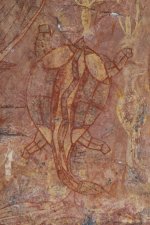
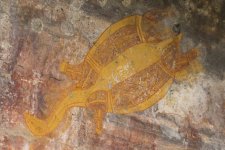
This species is highly prized by Aboriginal people. There were several drawings of this species at Ubirr in Kadadu NP.
B06 YellowSideNeckedTurtleDrawing6419.jpg
In several of the X-ray drawings of northern long-necked turtles, the artists emphasized the fat pads that are localized at the base of the limbs and along the core under the shell.
B07 SideNeckedTurteWFatPadsArt6431.jpg
These fat deposits (at their maximum at the end of the wet season) were a big draw for Aboriginal hunters in a diet often dominated by lean meat.

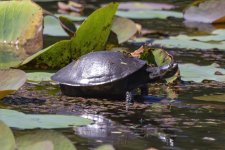
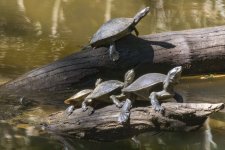
Krefft’s turtle (Emydura kreftii or E. macquarii = Macquarie’s turtle if you are a lumper). This species is endemic to coastal Queensland, east of the Dividing Range which separates the dry inland Outback from the coastal plain. They prefer more permanent rivers, swamps, and lakes. They are carnivorous as juveniles but transition to an omnivorous diet as adults. We encountered single individuals and small aggregations of this turtle species basking at the Botanical Garden at Cairns and at several protected areas to the south.
C08 KrefftsTurtle7663.jpg
C09 KrefftsTurtle8055.jpg
C10 KrefftsTurtlesSunning8109.jpg
An unusual aspect of the biology of this species is that sex is determined genetically (an XY sex-determination system, like mammals). In many turtles (and in all crocodilians), sex of offspring is determined by nesting temperature.

Saw-shelled turtle (Myuchelys latisternum). This species is found from the northeast coast of Queensland as far south as northern New South Wales. They prefer the headwaters of larger rivers, but they are quite adaptable. Males are 2/3rds the size of females, which max out at about 11 inches. They are omnivores, weighted toward carnivory. They are one of the few native Australian predators that is relatively immune to the toxins found in cane toads.
D11 SawShelledTurtle8171.jpg
Steve
 
Herps of Australia: Part 6 of 6: Amphibians. Frogs are the only group of native Australian amphibians. A newt species, the European smooth newt, has been introduced. Australia has about 230 native frog species, a relatively low species diversity for a continent of that size, but 93% of the frog species are only found in Australia (= endemic). Australia is known as a very dry continent overall and this paucity of frog species is not surprising. Many Australian frog species have an accelerated tadpole period to allow them to complete development through metamorphosis during a short wet season. One unique species, the sandhill frog of Western Australia completes embryonic and tadpole development to a juvenile entirely within the egg. Like other parts of the world, the populations of many Australian frogs have been declining since the 1980’s. Some of this has been due to habitat loss and some has been attributed to chytrid fungal infections. The expansion of invasive cane toads has also impacted native frog populations through predation on native frog tadpoles and food competition with native frogs. As our visits were in the dry season, amphibian sightings were limited.

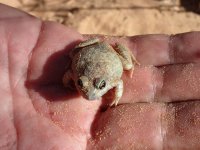
Ornate burrowing frog (Platyplectrum ornatum). This species is found across the Top End and as far south as Sydney along the east coast of Australia. It occurs in forests with a Mediterranean climate and in woodlands. During the dry season, individuals burrow into the soil. We encountered this frog buried in the sand adjacent to a pool off the Marrakai tract in the Northern Territory. We were there to watch honeyeaters dive-bomb into a pool along a stream to drink water.
A01 OrnateBurrowingFrogP6300107.JPG
Adults emerge after a heavy rain to breed. Their tadpoles can transition from fertilization to metamorphosis in as short as 11 days, a critical factor in pools that can disappear rapidly during the dry season. This is facilitated by a massive reduction in the size of its genome compared to a typical frog (less DNA to copy translates into faster rate of cell division).

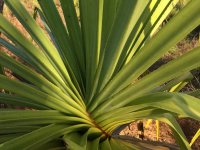
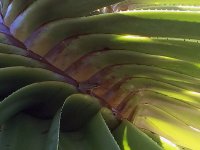
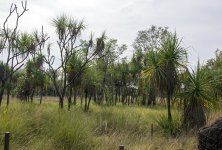
Northern dwarf tree frog (Litoria bicolor). This small tree frog is another “Top End” species (northern edge of Western Australia, Northern Territory, and across to the northern edge of coastal Queensland). During our 2016 trip to Kakadu, we saw many of these tree frogs sheltering among the 3+’ long blades of Pandanusspiralis trees as we hiked along the trails of the Mamukala Wetlands. The plants look superficially like palm trees, especially their blades, but they are not related closely to palms (even though a common name is “spiral palm”). The green of the frog camouflages well against the green Pandanus blades.
B02 Pandanus0300.JPG
B03 NDwarfTreeFrog0303.jpg
Though we looked for northern dwarf tree frogs in 2018 on the same hike, they were not to be found.

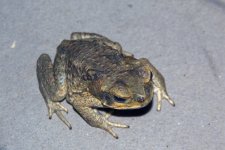
Cane toad (Rhinella marina). The cane toad is native of South and Central America. It is the largest toad in the world; a female cane toad captured in North Queensland had a body length (excluding limbs) of 10” and weighed 7 pounds.
C04 CaneToadIMG_6953 copy.jpg
This species is an omnivore with a voracious appetite. Prey include small mammals, reptiles, other amphibians, and a wide range of invertebrates. Cane toad tadpoles are cannibalistic, especially at the high densities observed in Australia. The skin of the toads is toxic and they can secrete bufotoxin from their glands, especially the parotid glands behind the eyes. Bufotoxins act as cardiac glycosides, similar in impact to digitalis, interfering with cardiac muscle function by blocking a critical ion pump. The components in bufotoxin also have minor hallucinogenic effects. Eggs and tadpoles are protected by defensive compounds placed there by the mother. But juvenile toads that have not yet developed their own parotid glands are vulnerable to predators. Some Australian predators of cane toads are resistant to the toxin and other animals have learned to process the cane toads in ways that minimizes consumption of the toxin.
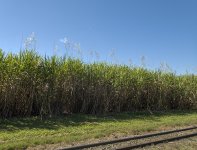
Cane toads, native to South and Central America, were originally introduced to the sugar cane fields of Queensland in 1935 from Hawaii to try to control two native Australian beetles that were impacting sugar cane fields. At that time, cane toads were reported to have success against similar beetle pests in sugar cane fields of Puerto Rico. Sugar cane farming took off in Queensland in the 1860’s and it is still the second most valuable agricultural export from Queensland. As you drive north from Cairns to Port Douglas, you see vast sugar cane fields, a narrow-gauge railroad that parallels the road for transporting the cane to mills, and a large sugar refining complex near the town of Mossman.
C05 P7290001MatureSugarCane.jpg
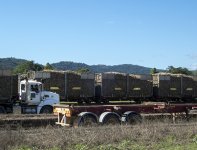
C06 P7290008TruckTrainCarsLoadedWithSugarCane.jpg
Unfortunately, the cane toads were not effective at controlling the beetles in Queensland, but the toads quickly expanded their populations throughout Queensland, across the Northern Territories, and into northern Western Australia. As a result of the explosive growth and expansion of cane toads across the Top End, the populations of many native predators that normally fed on native frogs have suffered dramatic declines. These predators include northern quolls (a small predatory marsupial), monitor lizards / goannas, freshwater crocodiles, several turtle species, and some snakes. Attempts to control the expansion or even the population size of cane toads at specific locations have been largely unsuccessful. Thus, the cane toad has joined a long list of invasive species (European rabbits, foxes, cats, camels, water buffalo, horses, rats, and pigs just to start) that have messed up Australia’s ecology and biodiversity. There have been some locally successful efforts to train native predators to avoid cane toads and a few native predators have learned strategies to eat the cane toads.
Steve
 
Super Mega LIKE!

Wow, Steve, that was a truly absorbing read, and with superb accompanying photos.

In the late 1980s and early 1990s, I spent several years working on herptile taxonomy, and still have more than a passing interest. In those years we did collecting trips in much of Southeast Asia and what was for me the super highlight, Australia. Everywhere you turned you found an endemic species. Thanks much for the walk down memory lane.

Kenneth
 
I am so impressed, and humbled, by the knowledge imparted by so many. Although this is a fishing site, it is so nice to share other aspects of what so many of you add to my knowledge of critters and such. Please keep it up.👍👍
 
Unfortunately, the cane toads were not effective at controlling the beetles in Queensland, but the toads quickly expanded their populations throughout Queensland, across the Northern Territories, and into northern Western Australia. As a result of the explosive growth and expansion of cane toads across the Top End, the populations of many native predators that normally fed on native frogs have suffered dramatic declines. These predators include northern quolls (a small predatory marsupial), monitor lizards / goannas, freshwater crocodiles, several turtle species, and some snakes. Attempts to control the expansion or even the population size of cane toads at specific locations have been largely unsuccessful. Thus, the cane toad has joined a long list of invasive species (European rabbits, foxes, cats, camels, water buffalo, horses, rats, and pigs just to start) that have messed up Australia’s ecology and biodiversity. There have been some locally successful efforts to train native predators to avoid cane toads and a few native predators have learned strategies to eat the cane toads.
What a great series, thanks Steve!

Particular kudos for including the Aboriginal art. It's interesting to think a lot of the dot painting sold now and perhaps most associated with Aboriginal art is from about 1970 on, and particularly focused on the Alice Springs area. The x-ray animal, hand and Wandjina art from further north where you were is sometimes eerily similar to US Southwest Petroglyphs

My Brisbane cousins had (have) about 1001 ways to kill cane toads. Does it count as a predictor for psychopathic deviancy if a pre-teen tendency to kill small animals is applied to invasive species?

When staying at my Grandmas place as about a 7 year old, the sight of the frill-necked lizard hanging around the tree near her clothes line absolutely petrified me. But on the other hand me and my brother spent hours trying to catch the black 3 inch garden lizards. The shoebox, stick and string method was abandoned very quickly for just the straight up chase....

The only close issue with a super dangerous creature I've had was when an Eastern brown snake slide right in front of me while hiking through some parkland near our place. They are very shy and most people never see one. I walked through that area near weekly for 6 years and only ever saw one...

Growing up one of my winter chores was starting the stove fire to heat the house. The lights were on as were the gloves, there were plenty of huntsmen and redback spiders hanging in that wood pile. Maybe its just reflex, but ever since I always stomp my garden gloves about ten times before putting them on....As much as huntsmen aren't dangerous, their sheer size is startling.
 
What a great series, thanks Steve!

Particular kudos for including the Aboriginal art. It's interesting to think a lot of the dot painting sold now and perhaps most associated with Aboriginal art is from about 1970 on, and particularly focused on the Alice Springs area. The x-ray animal, hand and Wandjina art from further north where you were is sometimes eerily similar to US Southwest Petroglyphs

My Brisbane cousins had (have) about 1001 ways to kill cane toads. Does it count as a predictor for psychopathic deviancy if a pre-teen tendency to kill small animals is applied to invasive species?

When staying at my Grandmas place as about a 7 year old, the sight of the frill-necked lizard hanging around the tree near her clothes line absolutely petrified me. But on the other hand me and my brother spent hours trying to catch the black 3 inch garden lizards. The shoebox, stick and string method was abandoned very quickly for just the straight up chase....

The only close issue with a super dangerous creature I've had was when an Eastern brown snake slide right in front of me while hiking through some parkland near our place. They are very shy and most people never see one. I walked through that area near weekly for 6 years and only ever saw one...

Growing up one of my winter chores was starting the stove fire to heat the house. The lights were on as were the gloves, there were plenty of huntsmen and redback spiders hanging in that wood pile. Maybe its just reflex, but ever since I always stomp my garden gloves about ten times before putting them on....As much as huntsmen aren't dangerous, their sheer size is startling.
Australia is a truly fascinating country, so different from the PNW. About the size of the continental U.S., two months is only enough time to scratch the surface. I really enjoyed exploring its flora and fauna on land and in the ocean. The potentially dangerous fauna actually excited me. I tend to be pretty cavalier (too cavalier...) about wildlife dangers (probably been too close to some grizzly bears in various NPs according to my wife).
I was fortunate to have guides who led us to some outstanding Aboriginal art sites in Kakadu NP. And I've done some reading to educate myself further. It is amazing that there may be as much as 50,000 years of cultural continuity...
According to one of our guides, Ian Morris who grew up in an Aboriginal village in Arnhem Land, the rock art is connected to the religious and cultural beliefs of the local Aboriginal clans. But there are layers of meaning that are only revealed to specific groups based on their cultural standing. Outsiders (and children) will be told a story about the art at one level, but elders and other initiated individuals share stories at a much deeper level. Many of the scenes in these galleries were repainted by Najombolmi (“Barramundi Charlie”) as late as 1963-64. The art in the Angbangbang gallery is different when you compare pictures taken by David Attenborough in early 1963 and by another individual in late 1963. Najombolmi was a renowned rock and bark painter and fisher/hunter from the Badmardi clan. Painting over the older paintings is part of the Aboriginal tradition, perhaps by individuals who want more ownership of the stories underlying the art. But no one has repainted these scenes since Najobolmi’s death over half a century ago. The act of painting may have as much or even more significance than the painting itself.
But the paintings do deteriorate over time and fade without someone to repaint them periodically. The paintings are damaged by ant trails and wasp nests. Some colors fade the longer they are exposed to light. Rain can be carried over the lips of the overhangs and down the rock face. In a few places, channels have been added to the overhangs to divert rainwater away from the paintings. Without some maintenance, the paintings will deteriorate. But Aboriginal tradition limits who has the right / responsibility to maintain these sites. Because of the high mortality rate among Aborigines, even in the present day, some clans / families have been in major declines or even died out completely and responsibility for particular art (and the stories linked to the rock art) have been orphaned. The original clan that was responsible for this area has died out and the neighboring clans have taken responsibility now for these sites.
Steve
 
Last edited:
I woke up this morning to mostly cloud cover and a hint that it could sprinkle. I thought, hmmmm, snake weather. My wife and headed up Beezley on our usual little loop. Not ten paces past the lower gate what do I see?

IMG_4432.jpg
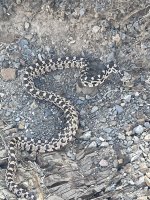
A skinny little gopher snake. Unlike @clarkman, I don't like handling snakes but I do appreciate their beauty and benefits. (Crummy cell phone picture.)
 
Buzzy how's that weather = snake weather? Just first hint of fall means they come out in the open a mite more or something? Out here west of the mountains it is spider weather, I got the whole orb spider move-like-water kung fu web avoidance going on on my way to the car each morning....
 
Back
Top