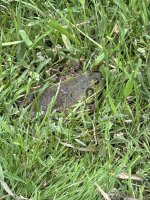
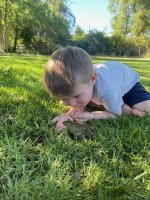
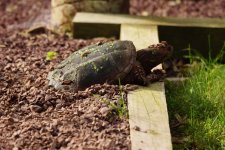
Saw this Snapping Turtle today in a Rhode Island pond.
Not the best cellphone shots, but they were the best I could get.
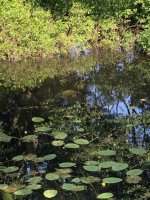
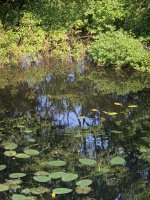
Not the best cellphone shots, but they were the best I could get.

Follow along with the video below to see how to install our site as a web app on your home screen.
Note: This feature may not be available in some browsers.

No noodling in THAT pond....Saw this Snapping Turtle today in a Rhode Island pond.
Not the best cellphone shots, but they were the best I could get.
View attachment 118597View attachment 118598

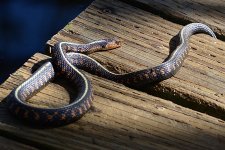
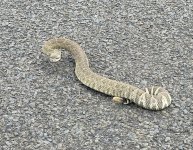
I guess not hydrophilic. Engee and I were anchored up in my 14-foot Hewescraft when I spotted the snake floating down the lake. It was cold, mid-March. We were bundled up, I don't know what the water temp was but very cold. The way the breeze was blowing, it looked like the snake would blow right into the back of a guy fishing from an anchored pontoon boat. I hollered at the guy, he ignored me until I took it up a notch hollering and then he got pissed off at me for not killing the snake. ;-)It slays me how that thing looks to be practically sitting on a pane of glass. Otherworldly and unsettling. Are rattlers hydrophobic? Made of CDC? Did you dust it with fumigated silica powder?


Great shot—composition, lighting, focus—artsy!

Yes, she's great. Also, the guys that fix the sore hooves on cows is pretty inline and really soothing to watch ! Man, when they scrape open a nasty pocket infection or pull a nail out of hoof I feel real sympathy pleasure. TMI? Haha.Thank god folks aren't sharing Herpes pictures. On the other hand Pimple Popping vids are amazingly successful for Dr Pimple Popper
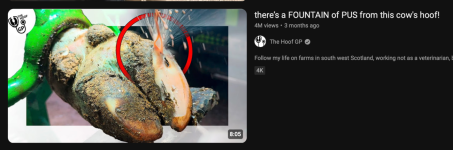

I prefer Nate the Hoof Guy to the Hoof GP...a lot less sensationalist just as thorough of work and explanation.Yes, she's great. Also, the guys that fix the sore hooves on cows is pretty inline and really soothing to watch ! Man, when they scrape open a nasty pocket infection or pull a nail out of hoof I feel real sympathy pleasure. TMI? Haha.
Sorry for drift

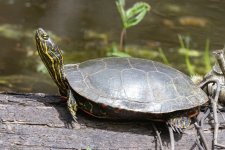

Outstanding post!McLane Creek, Odds and Ends and Biological Tales – Reptile and Amphibians. On a warm day, the turtles were taking advantage of the sun to work on their tans. Several painted turtles had climbed out on floating logs. They are not native to Western Washington. But they have been introduced across the mountains and have spread widely.
View attachment 118802
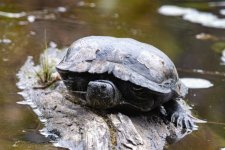
At another section of the boardwalk, a massive grizzled Western pond turtle sunned itself on a log.
View attachment 118803
This native species has been declared endangered in Washington State. Major threats include bullfrogs and introduced warm-water fish species, such as largemouth bass, that prey on juvenile turtles. There is a conservation program at the Woodland Park Zoo that raises young turtles in captivity for later release in the wild.
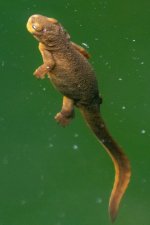
The pond at McLane Creek is a popular breeding area for rough-skinned newts.
View attachment 118804
The male rough-skinned newts migrate from the forest into the pond at McLane Creek in the winter and spring. The females invade the pools in the spring to mate and lay eggs on vegetation. These newts are known for producing a neurotoxin called tetradotoxin. This neurotoxin is also found in pufferfish [A genus of pufferfish is names Tetraodon. Pufferfish is an especially prized and expensive fish for sushi in Japan, but it must be prepared by specially-trained chefs to avoid tetradotoxin poisoning.] and blue-ringed octopi, among other organisms. In other organisms that possess tetradotoxins, the ultimate source of the toxin is symbiotic bacteria, but these bacteria have not yet been isolated from rough skinned newts. The toxin binds to sodium channels, blocking nerve signals from being transmitted, leading to paralysis and death by asphyxiation. The newts have evolved some resistance to their own toxin. If you ingest one of these toxic newts, you are likely to die as happened to a 29-year—old individual in 1979.
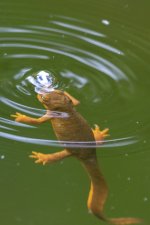
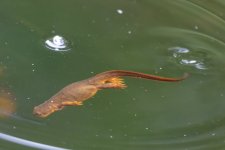
So, you would expect that these newts would be pretty bold and unafraid in the pond. But they spent most of their time on the bottom with only an occasional rush to the surface for a quick breath of air before dashing back to the bottom of the pond.
Mammals and birds are “negative-pressure” breathers. On inhale, we expand the volume of the thoracic cavity to decrease lung pressure a millimeter or two below ambient (pressure x volume is a constant, therefore if you increase thoracic volume, the pressure in the lungs drops); this drives air in. On exhale, we compress the volume of the thoracic cavity, increasing pressure in the lungs, and forcing air out.
Air-breathing fishes (e.g., tarpon, gars, etc.) and amphibians are “positive-pressure” breathers. They exhale by simply relaxing the sphincter muscles and allowing water pressure to empty the air in their swimbladder (fish) or lungs (amphibians). They then take a mouthful of air, clamp the jaws closed, use muscles in the head to compress this air, and relax the diaphragm muscle. Air refills the lungs. You can see the bubble created by exhale.
View attachment 118805
Then, back to the bottom of the pond. The males develop a flattened tail in the breeding season, presumably to facilitate swimming.
View attachment 118806
Now, the newts may have been focused on doing “newty” things at the bottom of the pond (e.g., searching for food / mates, keeping cool to conserve energy), but there may be more to this story.
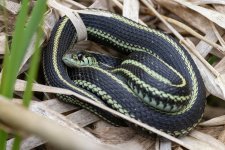
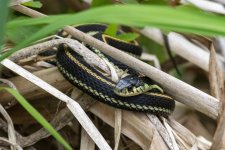
While we were on the pond overlook boardwalk, I noted not one, but two Puget Sound garter snakes (a subspecies of the common garter snake) sunning themselves just off the boardwalk. The two snakes were perhaps three or four feet off the boardwalk and about two feet from each other (and we saw two others slithering across the trail as we circumnavigated the pond). These two garter snakes were nestled in some brown reed blades in a sun patch.
View attachment 118807
View attachment 118808
Many garter snakes are associated with water and feed on fish and frogs. But Puget Sound garter snakes are also known for eating rough-skinned newts. Populations of this snake have evolved genetic mutations that result in sodium channels that tetradotoxin cannot block (or to which it binds poorly). A garter snake that has protective mutations will sample a rough-skinned newt that it catches to assess if it can handle its toxicity. If the newt is not very toxic, the garter snake will eat it; if it is too toxic, the garter snake will release it. The levels of tetradotoxin vary among newt populations and levels of resistance to tetradotoxin vary among populations of common garter snakes – a classic example of an evolutionary arms race.
Steve
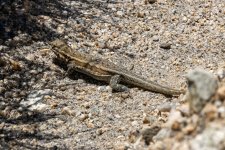
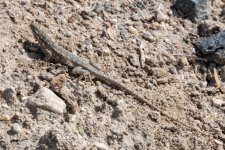
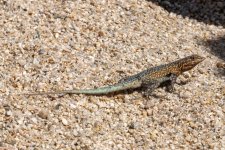
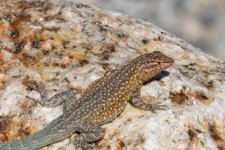
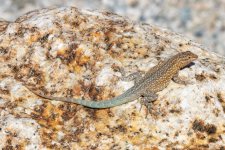
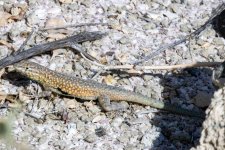
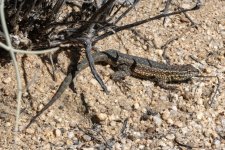
One thing I miss about growing up in TX is that diversity of the herps. CA is similar in that regard.The deserts of Southern California – Anza Borrego State Park and Joshua Tree National Park are great places to see lizards in the spring. I previously posted some bird pics from a trip that my wife and made in late March. Walking stealthily and scanning the ground carefully, we commonly encountered side-blotched lizards (Uta stansburiana) basking around the base of the shrubs. If approached carefully, I could snap a few pictures before the individuals scrambled into deeper cover under the shrubs. They are easily identifiable by a dark spot behind the front leg. A female often has stripes along the side of her body and may have blue chevrons along her back.
View attachment 118929
View attachment 118930
A male will be more brightly colored with blue speckling along his back, tail, and limbs. A male may have an orange, blue, or yellow throat, most prominent in the breeding season.
View attachment 118931
View attachment 118932
Scientists, especially Barry Sinervo and Curt Lively, have investigated the very interesting alternate reproductive behavior of this species. Males demonstrate one of three different reproductive strategies as indicated by throat color: blue, yellow, or orange. Like a game rock-paper-scissors, the three different male strategies have relative strengths and weaknesses in their relative reproductive success. [There are also two reproductive strategies among females: more, smaller eggs vs. fewer, larger eggs.]
An orange-throated male shows the most aggressive (high testosterone) reproductive strategy.
View attachment 118933
He defends a large territory that contains the smaller territories of several females. Defense consists of “pushups” through rushing and biting the interloper. Orange-throated males have shortest life spans among the three strategies.
A blue-throated male defends a small territory containing a single female. He can drive out yellow-throat males who try to mate with the female but he loses in contests with an orange-throated individual. In a few cases, a yellow-throated male can develop into a blue-throated male if a blue-throated male dies.
View attachment 118934
A yellow-throated male mimics the coloration and behavior of a female.
View attachment 118935
A yellow-throated male does not defend a territory. He sneaks into the territories of orange-throated males and tries to sneak matings with these females. But he can’t fool a blue-throated male and is driven off before he can mate with his female.
The overall success of a specific strategy is dependent on the frequency of that strategy vs. the others. The success of a specific strategy sows the seeds of its demise to one of the other strategies, leading to cycling of the frequencies over a four- to five-year cycle.
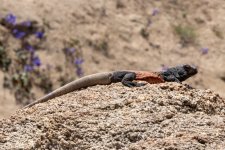
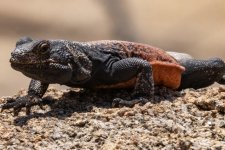
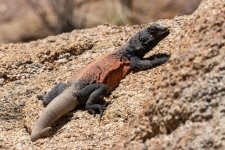
One lizard that my wife had hoped to see on this trip again was the common chuckwalla, Sauromalus ater. This is a large (up to 20”, 2 lb.) herbivorous iguand lizard with long, thick tails. A male, like this individual, has a dark head and pelvic region, but his torso is reddish.
View attachment 118936
View attachment 118937
View attachment 118938
They are known for basking in the sun after a morning meal; they flatten out their bodies to increase surface area and heat absorption. Basking increases their body temperature and speeds digestion. When threatened, a chuckwalla will dive into a nearby crevice and expands its lungs. That locks the lizard in place and makes it difficult for a predator to extract it. We caught a brief view of a second animal near the end of our hike.
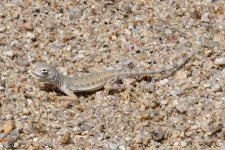
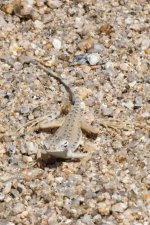
In Joshua Tree, as we hiked along the wash from the Cottonwood Springs oasis, I spotted a light-colored lizard that dashed away from us in the sandy wash. It was a juvenile zebra-tailed lizard.
View attachment 118939
View attachment 118940
They have very long toes on their hind limbs to aid in traction on the soft sand. We saw a larger adult later, but it scampered into deep cover before I could take its picture.
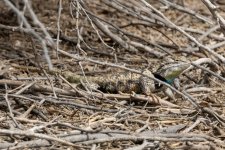
At the visitor center of the Sony Bono Salton Sea National Wildlife Refuge, the volunteer told us to keep an eye out for a male desert spiny lizard, Sceloporus magister, that had been seen recently in the area. They are chunky lizards that can reach 5.5” in length. Due to their keeled, pointed scales these lizards have a spiny appearance. And while we were eating lunch under a sun shelter, it appeared from under the cover of large creosote bushes into sight.
View attachment 118941
It made several territorial pushups (I was intimidated…) and kept its eye out for anything that it might fit into its mouth.
Steve