Billie Frank Jr. - Nisqually NWR, early-mid April. Part 2: Geese and Ducks. There has been a flock of 100ish cackling geese at Nisqually since late fall.
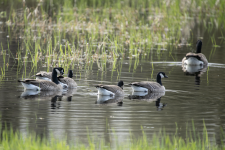
They are especially vigilant when a bald eagle cruises by, exploding into the air and noisily repositioning
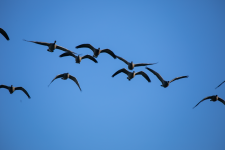
to a quieter meadow to graze. They are feathered lawn-mowers as they move across the meadow like a horde of locusts nipping the new grass growth. However, one lone cackling goose has been on its own along the dike trail for the last several months. It is smaller than the other cackling geese and has darker breast feathers.
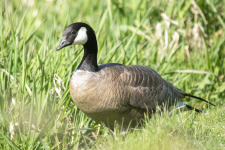
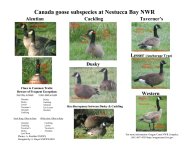
This may be the cackling goose subspecies minima. Members of this subspecies are described as barely larger than a drake mallard, which fits this individual. This subspecies typically overwinters in the Willamette Valley and breeds in northwest Alaska. Given how tight the other cackling geese are when feeding and resting, it is surprising to find this individual on its own. But it may have learned that people, at least here, are not a threat and provide some protection from a marauding bald eagle.
Two weeks ago, I spotted four greater white-fronted geese foraging on the edge of the cackling flock. They are slightly larger than the cackling geese and were more aggressive toward any cackling goose that encroached on what a greater white-fronted goose thought was its “personal space”.
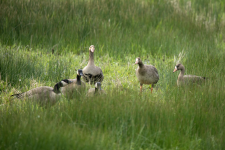
While a flock of 20ish greater white-fronted geese overwintered last year at Nisqually, they were absent this winter. A major traditional overwintering region is the Central Valley of California and some spots along the coast (e.g., Morro Bay). On a recent visit, at least a dozen greater white-fronted geese (the original four plus “friends” or a new flock???) formed a flock completely separate from the cackling geese.
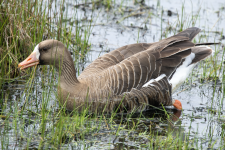
I suspect that this is “refueling stop” before they continue their migration to their breeding grounds in the tundra of Alaska and Northern Canada.
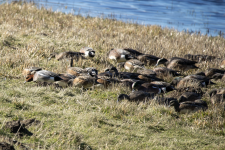
Most Canada geese that overwinter at Nisqually are likely resident birds that will breed in the refuge or nearby. In the winter, they formed small flocks or even pairs away from the cackling geese. While watchful of passing eagles, they appear to be less threatened by their presence than do the cackling geese. At this point of the spring, the Canada geese are almost exclusively in pairs.
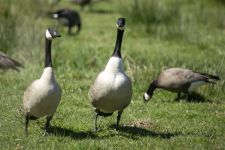
[The bird on the right background is a cackling goose. Note the smaller size (perspective doesn't help the comparison) and the much darker breast when compared to the Canada geese.]
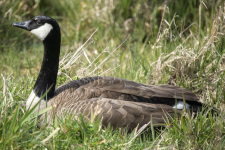
The male in a pair will noisily drive off any other pair of Canada geese that approaches too close. Some pairs are clearly exploring possible nesting mounds in the freshwater marsh or in the main pond. Goslings should be appearing in the next month or so.
Only a few pintails remain from the winter peak.
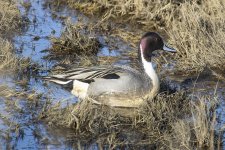
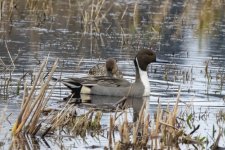
But they are easy to spot from a long way away as their long pointed tails tip up as they probe the bottom for as they nip roots of flooded grass and other vegetation.
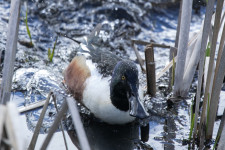
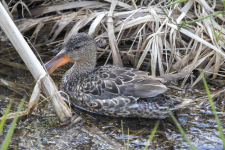
Similarly, most shovelers have migrated north. But a few remain in the refuge. With the long lamellae on their bills, they actively sieve food from the flooded meadows or from the edges of the freshwater marsh.
American wigeons appear to be one of the most versatile foragers among the ducks. They will tip up like a typical puddle duck, sieve fine materials from the mud flat like a green-winged teal, or nip fresh grass like a cackling goose.
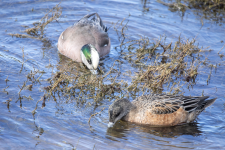
Their numbers at Nisqually have dropped off as spring has progressed. Among the American wigeon, you can find one or two Eurasian wigeon drakes (cinnamon head) among the American wigeons.
The number of green-winged teals appear to have increased recently.
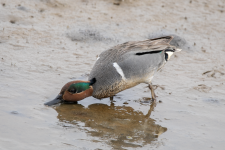
They are especially common in the salt-water mud flats. They sweep their bills back and forth through the surface mud.
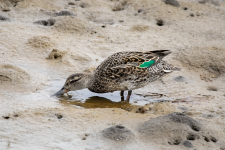
You can hear a low-clattering as they repeatedly clap open and close their bills. I suspect that they are filtering out the abundant diatoms from the mud. These diatom populations explode with the longer days of spring, forming a golden sheen on the surface at times.
Flocks of mallards tip up to feed or just rest in the flooded meadow south of the Twin Barns. I suspect that these may be migratory birds soon to depart for points north. In contrast, the mallards in the canals and main pond are paired up. These may be resident birds and should be nesting very soon.
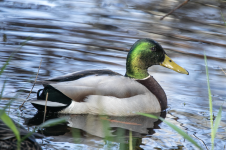
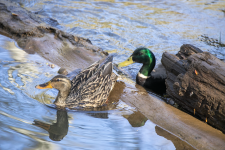
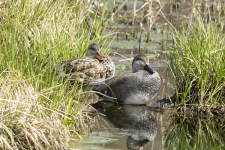
A gadwall pair been a consistent presence in the main pond. Perhaps they intend to nest on the refuge as well.
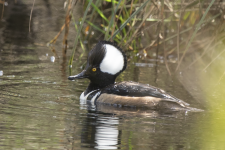
The refuge has several nest boxes mounted on trees over water. And there are a number of tree holes present as well. These are perfect nesting sites for hooded mergansers. I have spotted several pairs diving for meals in the main pond / canal on recent visits.
The nest boxes are also great nesting sites for wood ducks, like this hen.
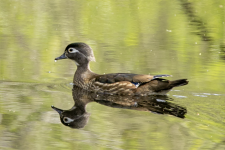
Several times, I have heard / seen wood ducks flying out of the branches in the forest - arboreal ducks...
[Reached the maximum number of images in a single post... Other ducks that I have seen at Nisqually recently include ring-bills, buffleheads, cinnamon teal]s, common goldeneyes, common mergansers, and red-breasted mergansers. A good slice of the Anatidae diversity in the PNW…]
Steve