“Like grass through a goose”. Except for some deep-sea communities (e.g., hydrothermal vents), all life on Earth ultimately depends on photosynthesizers. These organisms capture the energy in sunlight and combine this energy with carbon dioxide and water to synthesize organic molecules. On land, this base of the food web is dominated by plants, especially flowering plants.
Plants are potentially very rich in energy. Not only do they synthesize glucose in photosynthesis, but they store chains of glucose as larger molecules (such as starches) and in structural materials (cellulose) that dominate their cell walls. But unlike starches which most organisms can digest, to break cellulose back to individual glucose molecules requires special enzymes, called cellulases. These enzymes are only produced by some fungi, some protozoans, and some bacteria. Therefore, multicellular organisms that are major herbivores have evolved symbiotic interrelationships with microbes that can synthesize cellulases.
In ruminants (cows, deer, goats, sheep, antelopes, etc.), these symbionts are concentrated in sections of an elaborate 4-chambered stomach. The microbes ferment the plant material and convert the cellulase molecules into smaller organic compounds. The ruminants then absorb some digestive products of microbial fermentation and the microbes themselves. Even with the chemical assistance of microbes, plant material can be time-consuming to digest. Repeated chewing fragments the plant material into smaller pieces (with more surface area) speeds the digestive process. We’ve all seen cows and deer “chewing their cud”, i.e., additional mechanical digestion of plant material that speeds digestion.
But herbivorous birds have several issues that mammals do not face if a bird wants to be a herbivore. First, birds lack teeth to perform mechanical digestion. Second, the weight of large quantities of incompletely digested plant material would be a burden in flight.
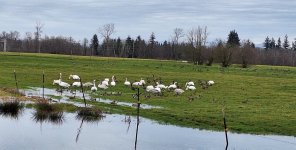
So, how do herbivorous birds, such as some ducks (such as American wigeons) and or these white-fronted geese, sustain themselves on a plant-dominated diet?
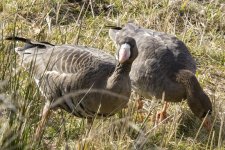
First, they preferentially select new plant growth which has less tough cellulose.
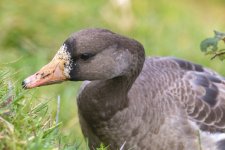
Second, they don’t try to be as efficient as mammalian herbivores, such as ruminants. Third, while they do harbor cellulase-producing microbes in caecae (two long blind pockets between the end of the small intestine and the large intestine), their strategy focuses on skimming the easiest to digest plant contents – the cytoplasm of the cells and to excrete most cellulose from the cell walls largely undigested. The digestive tract of a goose is relatively short. Food is not retained very long; a blade of grass can move from ingestion to defecation in two hours. Therefore, they process a large quantity of grass (from which they are quite inefficient at extracting all the potential energy) to acquire their daily nutrients. That accounts for the large volume of “goose pellets” that appear in an area where they are actively feeding.
And how does an organism without molars or teeth of any type break through the cellulose cell walls to reach the energy-rich interior? Birds use geology – rocks, gravel, grit, sand. Ingested plant and rock material are ground together in a muscular gizzard (aka, the gastric mill) which acts much like a rock tumbler.
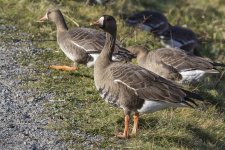
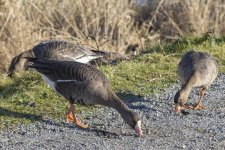
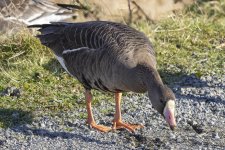
Physical abrasion rips open the plant cell walls. This releases the cytoplasm provides enzymatic access to the cytoplasm. Over time, these gizzard stones themselves become ground down and their surfaces become worn and smooth. Paleontologists have discovered gizzard stones (gastroliths) in the stomach locations of fossilized herbivorous dinosaurs, such as duck-billed hadrosaurs and the long-necked
Brachiosaurus in
Jurassic Park).
Steve