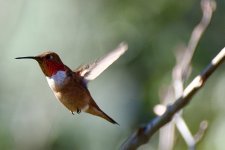
Got any bird pics?

IMG_5150.jpeg

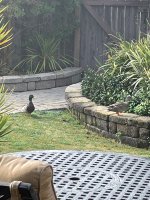
This morning our seven year old grandson was pulling on his socks and looked out in the backyard and said "there's a duck". His mom thought there might be a raven in the yard but Keiji was spot on.

IMG_5152.jpeg
A drake mallard and a few minutes later out of the yard vegetation pops his girlfriend. Looking for a nest site?

IMG_5155.jpeg

The marine layer was pretty heavy this morning; I gone out earlier to squeegie the glass on the cars and thought I heard a duck quacking. A block and a half from the ocean, half a block from the Pacific Coast Highway in very urban Redondo Beach. Pretty cool.
 
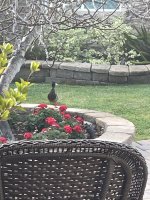
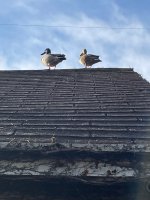
Absolutely looking for a nest site. We've been seeing single drakes and pairs of mallards hanging out in our neighborhood over here on the Oregon Coast. I saw a drake on our lawn this morning - never did see the hen but I'm sure she was close by. They also like perching on roof tops around here - I find that behavior very interesting.

neighborhoodmallards.jpg
 
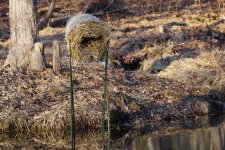
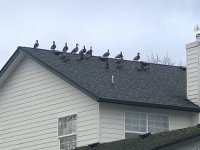
I’ve been watching the local rookery for 3 weeks now. I have actually visited 3 close by, one had a pair of bald eagles hanging out in the rookery tree, the other two are active. Watched a male on the ground select sticks to bring to the nest, first one was a reject.
IMG_4309.jpeg
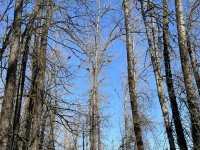
Poor cell pic, 9 heron in 3 trees today, one lazy male, 8 females on nests.
 
“Like grass through a goose”. Except for some deep-sea communities (e.g., hydrothermal vents), all life on Earth ultimately depends on photosynthesizers. These organisms capture the energy in sunlight and combine this energy with carbon dioxide and water to synthesize organic molecules. On land, this base of the food web is dominated by plants, especially flowering plants.
Plants are potentially very rich in energy. Not only do they synthesize glucose in photosynthesis, but they store chains of glucose as larger molecules (such as starches) and in structural materials (cellulose) that dominate their cell walls. But unlike starches which most organisms can digest, to break cellulose back to individual glucose molecules requires special enzymes, called cellulases. These enzymes are only produced by some fungi, some protozoans, and some bacteria. Therefore, multicellular organisms that are major herbivores have evolved symbiotic interrelationships with microbes that can synthesize cellulases.
In ruminants (cows, deer, goats, sheep, antelopes, etc.), these symbionts are concentrated in sections of an elaborate 4-chambered stomach. The microbes ferment the plant material and convert the cellulase molecules into smaller organic compounds. The ruminants then absorb some digestive products of microbial fermentation and the microbes themselves. Even with the chemical assistance of microbes, plant material can be time-consuming to digest. Repeated chewing fragments the plant material into smaller pieces (with more surface area) speeds the digestive process. We’ve all seen cows and deer “chewing their cud”, i.e., additional mechanical digestion of plant material that speeds digestion.
But herbivorous birds have several issues that mammals do not face if a bird wants to be a herbivore. First, birds lack teeth to perform mechanical digestion. Second, the weight of large quantities of incompletely digested plant material would be a burden in flight.
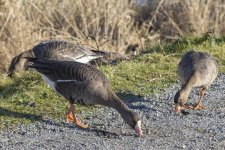
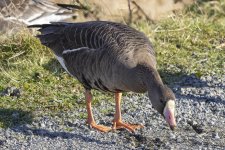
So, how do herbivorous birds, such as some ducks (such as American wigeons) and or these white-fronted geese, sustain themselves on a plant-dominated diet? A01WhiteFrontedGeeseFeeding1148.jpg
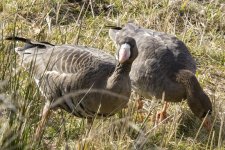
First, they preferentially select new plant growth which has less tough cellulose.
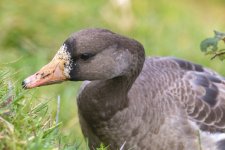
A02WhiteFrontedGooseFeeding4705.jpg
Second, they don’t try to be as efficient as mammalian herbivores, such as ruminants. Third, while they do harbor cellulase-producing microbes in caecae (two long blind pockets between the end of the small intestine and the large intestine), their strategy focuses on skimming the easiest to digest plant contents – the cytoplasm of the cells and to excrete most cellulose from the cell walls largely undigested. The digestive tract of a goose is relatively short. Food is not retained very long; a blade of grass can move from ingestion to defecation in two hours. Therefore, they process a large quantity of grass (from which they are quite inefficient at extracting all the potential energy) to acquire their daily nutrients. That accounts for the large volume of “goose pellets” that appear in an area where they are actively feeding.
And how does an organism without molars or teeth of any type break through the cellulose cell walls to reach the energy-rich interior? Birds use geology – rocks, gravel, grit, sand. Ingested plant and rock material are ground together in a muscular gizzard (aka, the gastric mill) which acts much like a rock tumbler.
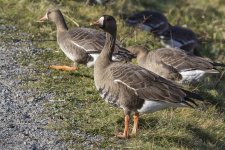
A03WhiteFrontedGooseAdult0327.jpg
B04WhiteFrontedGeeseEatingGrit0320.jpg
B05WhiteFrontedGooseEatingGrit0322.jpg
Physical abrasion rips open the plant cell walls. This releases the cytoplasm provides enzymatic access to the cytoplasm. Over time, these gizzard stones themselves become ground down and their surfaces become worn and smooth. Paleontologists have discovered gizzard stones (gastroliths) in the stomach locations of fossilized herbivorous dinosaurs, such as duck-billed hadrosaurs and the long-necked Brachiosaurus in Jurassic Park).
Steve
 
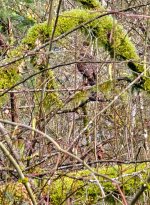
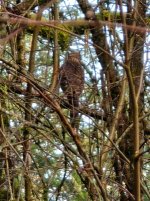
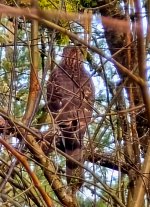
Random raptor moment today. I was backing into our side yard to work on a project when a medium sized raptor flew not more than 30' in front of the truck. Right across the driveway and into some very thick brush. He spent a few minutes of the ground before perching in a branch. At least it stayed put long enough to snap a few crappy pics. No idea what it is but I got a glimpse of bands on the tail, and a striped pattern on the head (head is turned in the 2nd pic).

20250301_152107.jpg
20250301_152126.jpg
20250301_152130.jpg
 
Last edited:
Random raptor moment today. I was backing into our side yard to work on a project when a medium sized raptor flew not more than 30' in front of the truck. Right across the driveway and into some very thick brush. He spent a few minutes of the ground before perching in a branch. At least it stayed put long enough to snap a few crappy pics. No idea what it is but I got a glimpse of bands on the tail, and a striped pattern on the head (head is turned in the 2nd pic).

View attachment 143672
View attachment 143673
View attachment 143671
Juvenile cooper's or possibly sharp-shinned.
Steve
 
I am under no illusion that spring has truly arrived after a few days of relatively balmy weather. But spring is coming. In the morning, my truck is lightly dusted with pollen, daffodils are developing flower buds, and leaves are already emerging from the buds of salmonberrys. Many resident birds are transitioning from their winter mixed-species flocks to the more typical territorial behavior of the breeding season.
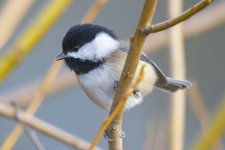
As you walk through the woods, you can be guided to these flocks by the “chickadee-a- dee-dee” calls of black-capped chickadees from all around.
A01BlackCappedChickadee5046.jpg
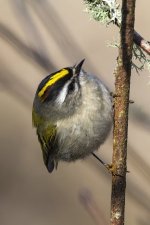
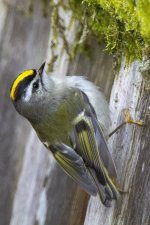
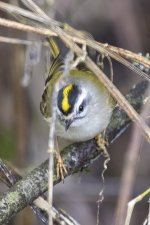
Often mixed in with chickadees will be golden-crowned kinglets with their high-pitched “tsee-tsee-tsee” calls.
A02GoldenCrownedKinglet0896.jpg
A03GoldenCrownedKinglet1038.jpg
A04GoldenCrownedKinglet4691.jpg
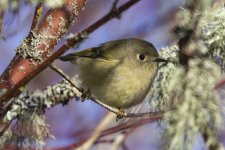
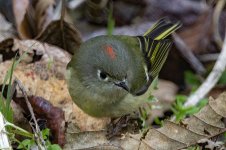
Traveling with the flock may be a frenetic ruby-crowned kinglet or two.
A05bRubyCrownedKinglet0129.jpg
A05RubyCrownedKinglet1099.jpg
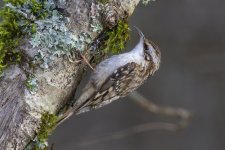
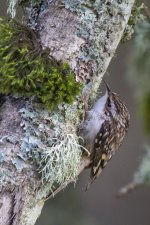
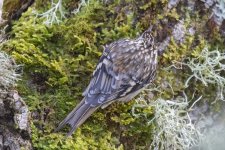
As you scan the tree trunks and larger branches within the footprint of this mixed flock, you might find a brown creeper or two effortlessly defying gravity as it climbs up to probe any likely hiding spot for insects or spiders.
A06BrownCreeper0851.jpg
A07BrownCreeper0857.jpg
A08BrownCreeper4956.jpg
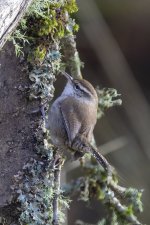
I’m not sure if wrens, such as Bewick’s wrens, actually travel with these mixed flocks or if they just feel more comfortable revealing themselves when there are so many other eyes in the area.
A09BewicksWren0827.jpg
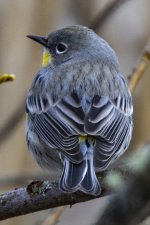
Finally, while I have seen fewer yellow-rumped warblers this winter at Nisqually NRW than I have in previous winters, I did encounter a female Audubon’s harvesting midges that were emerging from a pond.
A10YellowRumpedWarbler1225.jpg
A09
Steve
 
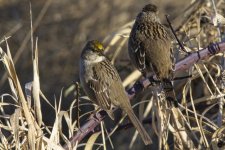
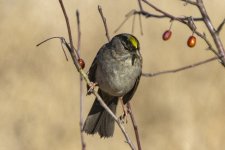
During my near weekly walks through the Billie Frank Jr. Nisqually NWR this winter, I have learned where several flocks of golden-crowned sparrows hang out. In the fall, they were foraging heavily on blackberry fruits (and insects attracted to blackberry fruits); but now their green-stained bills reveal that they are primarily consuming young grass shoots (and remnant crabapple fruits). They have grown accustomed to the birders and walkers and will generally allow a close approach.
B01GoldenCrownedSparrow0920.jpg
B02GoldenCrownedSparrow0158.jpg
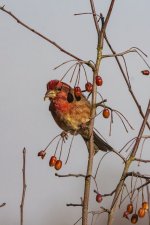
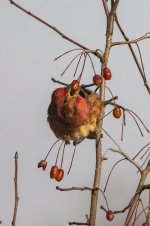
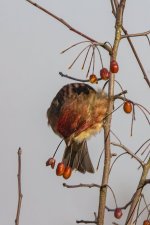
But it would be a mistake to just dismiss the whole aggregation as golden-crowned sparrows. Other species may be traveling with the golden-crowneds. These include purple finches. They joined several golden-crowned sparrows that were feeding on the last of the crabapples.
B03PurpleFinchMale0162.jpg
B04PurpleFinchMaleFeeding0165.jpg
B05PurpleFinch0172.jpg
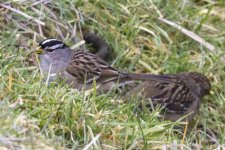
And if you are observant, you might have a “one of these things is not like the other” moment as there has been a single white-crowned sparrow mixed in with one of the flocks along the dike trail.
B06WhiteCrownedSparrow1150.jpg
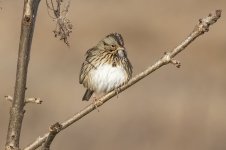
And while I haven’t seen it in a month, there was also a Lincoln’s sparrow intermingled with the golden-crowns.
B07LincolnsSparrow4980.jpg
Steve
 
Back
Top