Navigation
Install the app
How to install the app on iOS
Follow along with the video below to see how to install our site as a web app on your home screen.
Note: This feature may not be available in some browsers.
More options
Style variation
You are using an out of date browser. It may not display this or other websites correctly.
You should upgrade or use an alternative browser.
You should upgrade or use an alternative browser.
Got any bird pics?
- Thread starter Wadin' Boot
- Start date
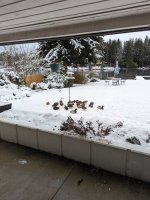
Had another Cooper’s hawk kill at the office today. She is a good hunter. Of course, feeding rock doves helps. She is rather tolerant of me being around.

How cool is thatHad another Cooper’s hawk kill at the office today. She is a good hunter. Of course, feeding rock doves helps. She is rather tolerant of me being around.

We had a hawk swoop through yesterday but it missed. I’ve been waiting to see a kill…my wife, not so much

Last edited:
A little intentional thread drift here…..
There have been an unusually high amount of bird/window strikes at my house the last couple days. What do you all do to avoid this?
We have some of the UV or IR decals but they don’t seem to matter.
For a while we hung some large beads in an effort to break up the reflections but this got knocked all over in the breeze or wind.
What works for you?
There have been an unusually high amount of bird/window strikes at my house the last couple days. What do you all do to avoid this?
We have some of the UV or IR decals but they don’t seem to matter.
For a while we hung some large beads in an effort to break up the reflections but this got knocked all over in the breeze or wind.
What works for you?
Last edited:

It really seems to help if you can bring your feeders closer in. It doesn’t necessarily eliminate window strikes, but it certainly can minimize the birds impact and results in less trauma and death.
The side benefit is that obviously you get much better views of your birds when they’re closer to you!
The side benefit is that obviously you get much better views of your birds when they’re closer to you!


A little intentional thread drift here…..
There have been an unusually high amount of bird/window strikes at my house the last couple days. What do you all do to avoid this?
We have some of the UV or IR decals but they don’t seem to matter.
For a while we hung some large beads in an effort to break up the reflections but this got knocked all over in the breeze or wind.
What works for you?
We put up a 8 x 11 sheet of white paper on the inside of each window. Ugly as hell, disturbs the view of the lake too. But would rather have live birds...
Hope to see better solutions here...

We have dream catchers and strained glass pieces to hang on those little rubber suction cup things for the windows that don't have screens. Got new removable plastic clips for the xmas lights though so may use those. Anyway, that reduced small bird strikes quite a bit. Have to remove them to open a window more than a 1/3 in warm weather however because of how the windows open.

That is great, novel idea.

Ridgefield NWR, River ‘S’ Unit, 21 December. Part 1 of 3
On Wednesday, we saw a gap of decent weather in the forecast and decided to go for it. Our destination would be the River ‘S’ Unit at Ridgefield NWR, on the bank of the Columbia River near Vancouver, WA. In this section, you drive on a gravel road that winds around a series of ponds, grassy fields, marsh, forest, and canals in the refuge. Your car is your “blind” during this 4-mile auto route. The NWS forecast was for above-freezing temperatures and partly cloudy skies – no precipitation. But as we prepared to leave Olympia, a high fog sat overhead. And with the below-freezing morning temperatures, the moisture in the fog fell as fine ice pellets. These pellets coated the 4Runner and the roads. But once we were south of Tumwater, the fog was gone and the sun began to break out through the clouds.
By the time, we reached Ridgefield, we were in bright sun, well, as bright as the sun gets on the shortest day of the year. While the air temperatures were in the upper 30’s, there was a biting wind. Over 3 hours, we would drive the 4-mile loop (see https://ridgefieldfriends.org/wp-co...-PRINTING_RIVERS-Updated-1-14-2020.pdf?x25981) for a nice map of the loop) twice with the windows down (better for picture taking and viewing with binocs). The heat in the 4Runner was on high and that helped cut the cold a bit.
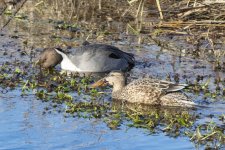
We did not hear any shotguns firing and the branch road off the Loop Road to an area that allows waterfowl hunting was closed this day. That probably relaxed the waterfowl and everything else in the refuge. On our loops, we spied lots of dabbling ducks: Northern pintails (drake and a female Northern shoveler hen),
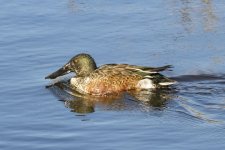
Northern shovelers,
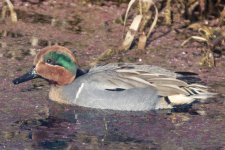
green-winged teals,
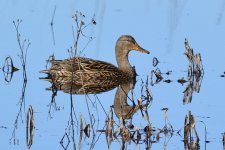
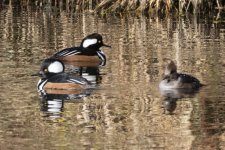
and mallards in the scattered ponds. We also spotted a few American wigeons and wood ducks. There were also several flocks of coots. The diving ducks were well-represented too with ring-necked ducks, buffleheads, and hooded mergansers.
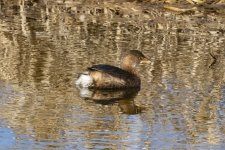
Several pied-billed grebes dove for lunch in the canal that parallels the road that separates Bull Lake from Horse Lake and bisects Quigley Lake (site 2 on the River ‘S’ map).
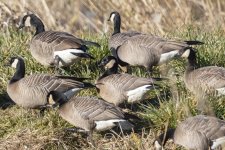
We had seen and heard Vs of Canada geese flying overhead and encountered small groups feeding and resting at the edges of several ponds. A flock of cackling geese, smaller cousins of Canada geese, were grazing on grass shoots along the dike between Rest Lake and Schwartz Lake (site 12). In addition to being smaller (and having slightly different coloration), cackling geese tend to form very tight flocks when foraging on the ground.
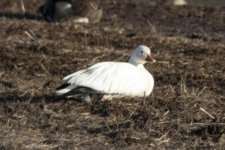
A lone snow goose (who should be with its numerous buddies in the Skagit fields) mingled with some pintails and Canada geese in Schwarz Lake.
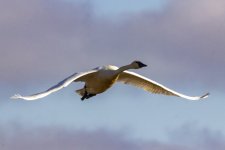
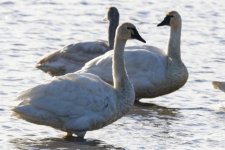
Pairs and threesomes of tundra swans flew from Rest Lake to South Big Lake to join the birds already there. There were probably a hundred or more swans in the waters of the two lakes.
Steve
On Wednesday, we saw a gap of decent weather in the forecast and decided to go for it. Our destination would be the River ‘S’ Unit at Ridgefield NWR, on the bank of the Columbia River near Vancouver, WA. In this section, you drive on a gravel road that winds around a series of ponds, grassy fields, marsh, forest, and canals in the refuge. Your car is your “blind” during this 4-mile auto route. The NWS forecast was for above-freezing temperatures and partly cloudy skies – no precipitation. But as we prepared to leave Olympia, a high fog sat overhead. And with the below-freezing morning temperatures, the moisture in the fog fell as fine ice pellets. These pellets coated the 4Runner and the roads. But once we were south of Tumwater, the fog was gone and the sun began to break out through the clouds.
By the time, we reached Ridgefield, we were in bright sun, well, as bright as the sun gets on the shortest day of the year. While the air temperatures were in the upper 30’s, there was a biting wind. Over 3 hours, we would drive the 4-mile loop (see https://ridgefieldfriends.org/wp-co...-PRINTING_RIVERS-Updated-1-14-2020.pdf?x25981) for a nice map of the loop) twice with the windows down (better for picture taking and viewing with binocs). The heat in the 4Runner was on high and that helped cut the cold a bit.
We did not hear any shotguns firing and the branch road off the Loop Road to an area that allows waterfowl hunting was closed this day. That probably relaxed the waterfowl and everything else in the refuge. On our loops, we spied lots of dabbling ducks: Northern pintails (drake and a female Northern shoveler hen),
Northern shovelers,
green-winged teals,
and mallards in the scattered ponds. We also spotted a few American wigeons and wood ducks. There were also several flocks of coots. The diving ducks were well-represented too with ring-necked ducks, buffleheads, and hooded mergansers.
Several pied-billed grebes dove for lunch in the canal that parallels the road that separates Bull Lake from Horse Lake and bisects Quigley Lake (site 2 on the River ‘S’ map).
We had seen and heard Vs of Canada geese flying overhead and encountered small groups feeding and resting at the edges of several ponds. A flock of cackling geese, smaller cousins of Canada geese, were grazing on grass shoots along the dike between Rest Lake and Schwartz Lake (site 12). In addition to being smaller (and having slightly different coloration), cackling geese tend to form very tight flocks when foraging on the ground.
A lone snow goose (who should be with its numerous buddies in the Skagit fields) mingled with some pintails and Canada geese in Schwarz Lake.
Pairs and threesomes of tundra swans flew from Rest Lake to South Big Lake to join the birds already there. There were probably a hundred or more swans in the waters of the two lakes.
Steve
Last edited:
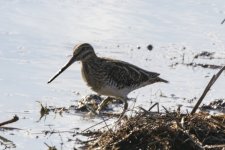
Ridgefield NWR, River ‘S’ Unit, 21 December. Part 2 of 3: One highlight of this visit was an opportunity to have great views of Wilson’s snipes. [Yes, snipes are real birds, not imaginary.]. Snipes are plump, but cryptic, medium-sized shorebirds with very long bills. Powered by large, powerful breast muscles, they are quite fast fliers. As we drove past Ruddy Lake, we saw and heard killdeers running on the muddy shores. This attracted my gaze and against the far bank, we spotted a small flock of dowitchers and several Wilson’s snipes. I have only seen Wilson’s snipes a few times; they can be elusive. When in view, they have three distinctive stripes down their back and striped heads. At Canvasback Lake, we caught a better view of several snipes probing into the mud with their long bills (but in challenging lighting conditions for photography).
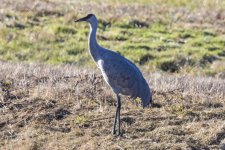
Another highlight was a good view of a pair of sandhill cranes in Long Lake. Ridgefield NWR is a well-known overwintering site for this species. One crane was wading in the lake searching for food, while the other individual kept watch from the bank. They were gone when we went by in our second loop.
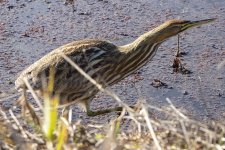
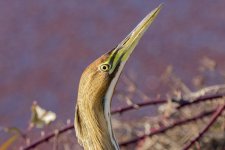
Three species of wading birds also provided great views of their hunting actions. We came upon an American bittern as it was intently stalking the bank of the canal connecting Sora Marsh to Rest Lake (site 11). Normally, these very cautious, cryptic birds are found deep in the rushes where their brown stripes (and slow, deliberate locomotion) blend in with the color of dried reeds. But this bird was up against a green bank and in the open. It was unperturbed as we drove closer and closer as it walked along the canal’s edge just a few feet below my window. Great views and great pictures.
Ridgefield is a great place to see great blue herons and great egrets. You would normally expect to see them along the edges of the canals and lakes searching for aquatic prey, like fish and frogs. And we saw both great blue herons (including this one with a mohawk) and great egrets at these expected locations.
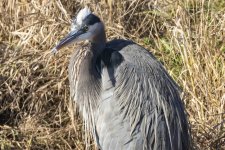
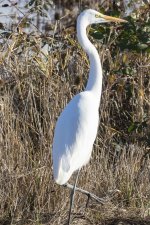
But both great blue herons and great egrets will patiently stalk the grasslands for mammals that they stab with their dagger-like bills.
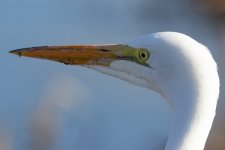
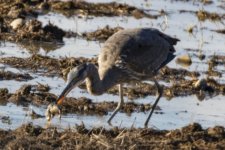
On our first pass, we missed the actual strike, but we watched as a great blue heron washed off a small rodent (vole?) in a puddle before swallowing it.
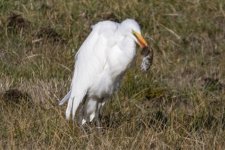
Later, we watched a great egret stab a vole from the grasslands, maneuver the vole in its bloody bill for a minute or two, and then swallow it in one huge gulp.
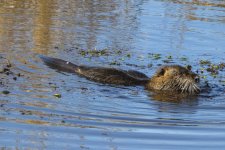
There are some rodents, albeit invasive ones, that don’t need to worry about predation by the biggest herons or egrets. These are the nutria, an introduced, invasive, rodent from South America. On our first circuit, we watched a large adult nutria (up to 20lbs.) graze on grasses on the dike between the Quigley Lakes. On our second pass, it was noshing on aquatic plants in the canal. And the several deer that we saw grazing appeared to not be concerned about predators.
Steve
Another highlight was a good view of a pair of sandhill cranes in Long Lake. Ridgefield NWR is a well-known overwintering site for this species. One crane was wading in the lake searching for food, while the other individual kept watch from the bank. They were gone when we went by in our second loop.
Three species of wading birds also provided great views of their hunting actions. We came upon an American bittern as it was intently stalking the bank of the canal connecting Sora Marsh to Rest Lake (site 11). Normally, these very cautious, cryptic birds are found deep in the rushes where their brown stripes (and slow, deliberate locomotion) blend in with the color of dried reeds. But this bird was up against a green bank and in the open. It was unperturbed as we drove closer and closer as it walked along the canal’s edge just a few feet below my window. Great views and great pictures.
Ridgefield is a great place to see great blue herons and great egrets. You would normally expect to see them along the edges of the canals and lakes searching for aquatic prey, like fish and frogs. And we saw both great blue herons (including this one with a mohawk) and great egrets at these expected locations.
But both great blue herons and great egrets will patiently stalk the grasslands for mammals that they stab with their dagger-like bills.
On our first pass, we missed the actual strike, but we watched as a great blue heron washed off a small rodent (vole?) in a puddle before swallowing it.
Later, we watched a great egret stab a vole from the grasslands, maneuver the vole in its bloody bill for a minute or two, and then swallow it in one huge gulp.
There are some rodents, albeit invasive ones, that don’t need to worry about predation by the biggest herons or egrets. These are the nutria, an introduced, invasive, rodent from South America. On our first circuit, we watched a large adult nutria (up to 20lbs.) graze on grasses on the dike between the Quigley Lakes. On our second pass, it was noshing on aquatic plants in the canal. And the several deer that we saw grazing appeared to not be concerned about predators.
Steve
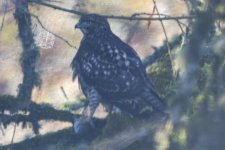
Ridgefield NWR, River ‘S’ Unit, 21 December. Part 3 of 3: The raptors were busy too, many also targeting voles. As expected in an area with lots of ducks, we spotted two adult bald eagles and one juvenile perched in a tree on the far side of a pond. There were also several red-tailed hawks at the refuge. Out of the corner of my eye, I saw one fly into a deep thicket along the bank of a canal; when we got closer, there was enough of a gap in the branches to spy a juvenile red-tailed with a rodent in its talons. It appeared to have ducked into this thicket to have a quiet meal.
Other red-tailed hawks were perched in trees where they could overlook grasslands that might harbor rodents.
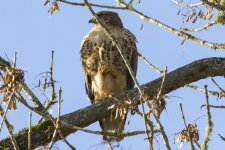
But the most active raptors that we saw were Northern harriers. At one point, we saw three birds as they flew over a copse of trees. More commonly, we saw birds engaged in their unique slow-speed flying just over the marsh and grassy fields. They have broad wings and long tails that facilitate this flying strategy.
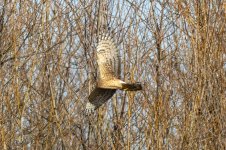
During both circuits, we encountered Northern harriers on the ground between section 13 and the entrance; they were apparently ripping apart on rodents that they had captured in the grasslands.
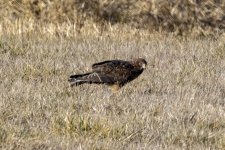
On our second circuit, one Northern harrier decided to bathe in the icy waters of South Big Lake. It wasn’t a quick dip either. It was mid-thigh deep for several minutes.
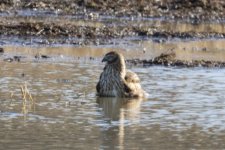
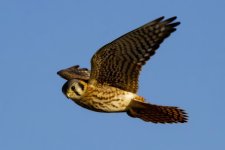
Finally, we had seen several American kestrels hovering over the grass fields as they looked for a meal. I managed to capture a few pictures of one female in mid-hover.
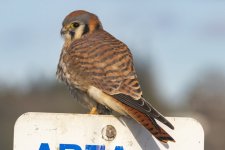
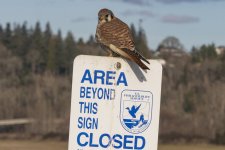
Either this bird or another perched on one of the “Area closed” signs and was very patient as I snapped several close-up pictures.
Steve
Other red-tailed hawks were perched in trees where they could overlook grasslands that might harbor rodents.
But the most active raptors that we saw were Northern harriers. At one point, we saw three birds as they flew over a copse of trees. More commonly, we saw birds engaged in their unique slow-speed flying just over the marsh and grassy fields. They have broad wings and long tails that facilitate this flying strategy.
During both circuits, we encountered Northern harriers on the ground between section 13 and the entrance; they were apparently ripping apart on rodents that they had captured in the grasslands.
On our second circuit, one Northern harrier decided to bathe in the icy waters of South Big Lake. It wasn’t a quick dip either. It was mid-thigh deep for several minutes.
Finally, we had seen several American kestrels hovering over the grass fields as they looked for a meal. I managed to capture a few pictures of one female in mid-hover.
Either this bird or another perched on one of the “Area closed” signs and was very patient as I snapped several close-up pictures.
Steve

Gyrfalcon22
Legend
Great shots Steve! Particularly the Bittern. Like you said, always normally a hard one to see when tucked into the terrain like Arnie in Predator.
I've yet to make it to Ridgefield. Looks like fun and all that Sun!
I've yet to make it to Ridgefield. Looks like fun and all that Sun!

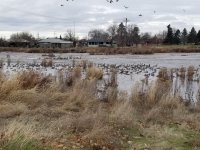
You need to put some decoy's out in the yard!! LOL!Lots of ducks today.
View attachment 46120

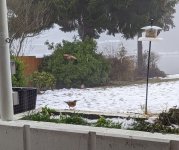
The last few years have seen huge numbers of birds in the Creek. They were really skittish and if I stopped to snap a shot they would start to take off. This was frozen a couple days ago. At least I could get a 3 mile walk in, but no decent pics.