
Navigation
Install the app
How to install the app on iOS
Follow along with the video below to see how to install our site as a web app on your home screen.
Note: This feature may not be available in some browsers.
More options
Style variation
You are using an out of date browser. It may not display this or other websites correctly.
You should upgrade or use an alternative browser.
You should upgrade or use an alternative browser.
Getting started with fly tying
- Thread starter Dez
- Start date


FinLuver
Native Oregonian…1846
I once tied a folded deer hair ant. By the time the fish had their way with the fly, it looked pretty similar to your tie. The fish had it bedraggled into the silhouette of a hopper.Update: tied my first fly! CDC & deer hair caddis - I know it’s not the prettiest. I need to stack the hairs better and work on a cleaner head.
View attachment 174460
Toss that into the water and hang on.

Check out his X-Caddis pattern. That thing works better for me than any caddis I've ever tied or bought.
One thing to watch out for with starter kits is quality. Sometimes, they're pretty good, but they can be inconsistent. Nothing makes tying flies you're proud of harder than starting with lousy materials (especially hackles and hair). Indeed, not being able to look at hooks and materials in person before buying them is what I miss most about my now defunct local fly shop.
Nature's Spirit has the best hair patches in general. They are pricey, but usually worth every penny.
Last edited:

Brute
Legend
He is a great fly tyer...but there will be some long-winded explanations involved (mostly good) during his videos, so be patient...Watch Kelly Galloup tie an elk hair Caddis, It’s a long wait to get to the head, but that’s the way I like to tie them. Well worth the watch Kelly is good at explaining why things are done as well as how to tie.

I did watch that! I haven't tied this with a hackle yet, first one was just CDC, 2nd + 3rd I added dubbing. I've got about 50 hooks I'm going to dedicate to just the caddis so I've got some room to play with different patterns and colors.Check out his X-Caddis pattern. That thing works better for me than any caddis I've ever tied or bought.
One thing to watch out for with starter kits is quality. Sometimes, they're pretty good, but they can be inconsistent. Nothing makes tying flies you're proud of harder than starting with lousy materials (especially hackles and hair). Indeed, not being able to look at hooks and materials in person before buying them is what I miss most about my now defunct local fly shop.
Spirit River has the best hair patches in general. They are pricey, but usually worth every penny.

My tips for a beginner:
Make it easy on yourself to start off!
Unless you have a natural knack for it, being a tying purist (if that's your thing) can wait until you have some confidence in basic techniques.
For example, despite tying for longer than I care to remember, I have always struggled with dubbing, for several reasons. I feel like it's a difficult skill to master, especially keeping it sparse.
My solution was to
A) Just admit it's not gonna happen, and buy dries smaller than #12 if I need them,
and B) use sparse dubbing loops for everything else! (For tiny flies, dubbing loops can be too bulky.)
Look up a YT video on it. SO much easier and durable. No counter-wrapping needed unless you just want the look. An old toothbrush makes a fine dubbing comb.
Once you have the larger EHC down, then try a finer dubbing technique and downsize if you like.
#1 rule to avoid an unfishable fly: Don't crowd the hook eye! You can take 30 min to tie a brilliant fly, then ruin it at the last step by blocking the eye when you tie off
Superglue and head cement are your friend. An unraveling fly is demoralizing.
Reducing frustration is usually a good strategy for keeping at a hobby until you're good enough to enjoy it. And go fish your so-so flies! I guarantee that unless you're fishing hypertechnical, pressured water, the fish will care a whole lot less if they're perfect than you do. If your local trout are finicky, find a bluegill or bass pond! Watching your own fly get an eat is pretty motivating!
As far as getting starting materials without knowing exactly what you want, go to ebay and search "fly tying material lot." You can usually find assortments pretty cheap. Only buy feathers/fur that are in lots with other materials, so you get tying-quality stuff.
Look for a mix of deer/elk hair, bucktail, flash, marabou, smallish hackle feathers, small chenille, and some beads or dumbbell eyes if possible. Bunny strips if you like streamers. Hooks are a bonus.
Once you know what you like, make a list of specific materials and take a trip to a fly shop. You'll be more comfortable dropping $100 on materials if you know you'll use them.
Don't be afraid to rip everything off the hook if you screw up. Fish will eat an ugly fly, but not if there's no eye to tie it on with!
I've even burned stuff off with a lighter once the larger materials are cut down.
And like @Brute said - videos, videos, videos! There are usually dozens of ways to tie any one pattern, so find one that seems more intuitive to you.
Have fun, and show us what you tie!
Make it easy on yourself to start off!
Unless you have a natural knack for it, being a tying purist (if that's your thing) can wait until you have some confidence in basic techniques.
For example, despite tying for longer than I care to remember, I have always struggled with dubbing, for several reasons. I feel like it's a difficult skill to master, especially keeping it sparse.
My solution was to
A) Just admit it's not gonna happen, and buy dries smaller than #12 if I need them,
and B) use sparse dubbing loops for everything else! (For tiny flies, dubbing loops can be too bulky.)
Look up a YT video on it. SO much easier and durable. No counter-wrapping needed unless you just want the look. An old toothbrush makes a fine dubbing comb.
Once you have the larger EHC down, then try a finer dubbing technique and downsize if you like.
#1 rule to avoid an unfishable fly: Don't crowd the hook eye! You can take 30 min to tie a brilliant fly, then ruin it at the last step by blocking the eye when you tie off
Superglue and head cement are your friend. An unraveling fly is demoralizing.
Reducing frustration is usually a good strategy for keeping at a hobby until you're good enough to enjoy it. And go fish your so-so flies! I guarantee that unless you're fishing hypertechnical, pressured water, the fish will care a whole lot less if they're perfect than you do. If your local trout are finicky, find a bluegill or bass pond! Watching your own fly get an eat is pretty motivating!
As far as getting starting materials without knowing exactly what you want, go to ebay and search "fly tying material lot." You can usually find assortments pretty cheap. Only buy feathers/fur that are in lots with other materials, so you get tying-quality stuff.
Look for a mix of deer/elk hair, bucktail, flash, marabou, smallish hackle feathers, small chenille, and some beads or dumbbell eyes if possible. Bunny strips if you like streamers. Hooks are a bonus.
Once you know what you like, make a list of specific materials and take a trip to a fly shop. You'll be more comfortable dropping $100 on materials if you know you'll use them.
Don't be afraid to rip everything off the hook if you screw up. Fish will eat an ugly fly, but not if there's no eye to tie it on with!
I've even burned stuff off with a lighter once the larger materials are cut down.
And like @Brute said - videos, videos, videos! There are usually dozens of ways to tie any one pattern, so find one that seems more intuitive to you.
Have fun, and show us what you tie!
Lots of good stuff in that last post. I second that dubbing small flies is tough to master. Always use less dubbing than you think you need. If it doesn't dub onto the thread easily and without bulking up, you have too much.
Don't "rush the head" is also huge. That's the mistake most newbies make most. You can always add more thread wraps at the end, but if you don't leave enough room in front of the head, you're screwed every time.
Another key is to take your time. If something doesn't want to work right after you tie it in, back off and try to tie it in again. You can almost always back up, and you should do so any time you aren't happy with the way something is going.
Don't "rush the head" is also huge. That's the mistake most newbies make most. You can always add more thread wraps at the end, but if you don't leave enough room in front of the head, you're screwed every time.
Another key is to take your time. If something doesn't want to work right after you tie it in, back off and try to tie it in again. You can almost always back up, and you should do so any time you aren't happy with the way something is going.

I haven't seen it mentioned before but craft stores are a great source of materials and they are cheap. Also a carpet store with rug samples is a great source and free. Once you get more experienced you can move onto buying specific materials from a fly shop. Any friends go bird or animal hunting e.g. pheasant, grouse, deer or elk? Great source of materials. Buying quality hair and feathers is an investment but well worth it.

I like watching this guy:I learned to tie on YouTube...and now have organized an extensive YouTube catalog of the various types of fly pattern videos for reference i.e. shrimp flies, caddis, baetis, terrestrials, etc....something to consider...

Davie McPhail
With 40 years in fly fishing and fly tying, I have been most fortunate in being able to ‘learn on the job’ and develop many good and productive fishing flies.The videos which I record at home are edited by me and I very much hope you enjoy them. If you do, then I would encourage you to subscribe...
 m.youtube.com
Also got a lot out of this book when I started tying more regularly:
Brute
Legend
Yes…im a big fan of “trrrimm avay da vayst”I like watching this guy:
Davie McPhail
With 40 years in fly fishing and fly tying, I have been most fortunate in being able to ‘learn on the job’ and develop many good and productive fishing flies.The videos which I record at home are edited by me and I very much hope you enjoy them. If you do, then I would encourage you to subscribe...
Also got a lot out of this book when I started tying more regularly:
Loops are awesome. Durable and super buggy. Like you, I almost always prefer a dubbing loop to chenille. Much less bulk, and if you use ice dub, you get the bonus of not needing to incorporate flash materials (unless you want to, of course).I 2nd or 3rd the importance of learning how to do a dubbing loop. I use it for so many patterns. A bugger with a dubbing loop body is just so superior to using chenille for example.
Dubbing loops also enable the use of rabbit fur/arctic fox/etc. without having to deal with the annoying bulk of the hide, but I can't say it's easy to hold those materials in the loop while trimming away the hide. That gets back to the patientce thing....
That guy is great. I like his patterns and techniques a lot.I like watching this guy:
Davie McPhail
With 40 years in fly fishing and fly tying, I have been most fortunate in being able to ‘learn on the job’ and develop many good and productive fishing flies.The videos which I record at home are edited by me and I very much hope you enjoy them. If you do, then I would encourage you to subscribe...
Also got a lot out of this book when I started tying more regularly:
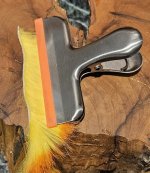
Chip clips are your friend here!Dubbing loops also enable the use of rabbit fur/arctic fox/etc. without having to deal with the annoying bulk of the hide, but I can't say it's easy to hold those materials in the loop while trimming away the hide. That gets back to the patientce thing....
Clip, trim, place in loop

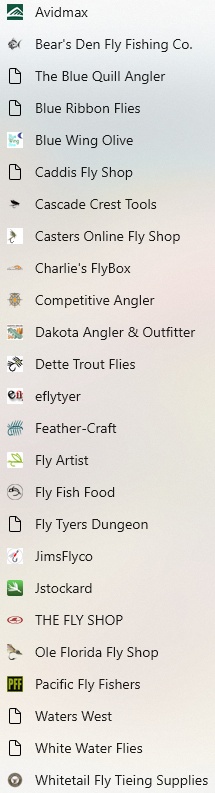
Here's a few places to spend money atAny tips on where to get materials?

and wax on the thread
Yup. I need to get one of those clips. I've been using a D-loop plyer, and it works, but it orients my hands parallel to each other, where the clip makes them perpendicular, which provides a significant ergonomic advantage when securing the loop around the fur exactly where you want it.
FinLuver
Native Oregonian…1846
Two Rivers Fly ShopHere's a few places to spend money at
Watershed Fly Shop
Home Waters Fly Shop
The Caddis Fly Shop
The Royal Treatment Fly Fishing