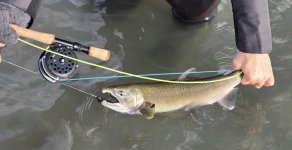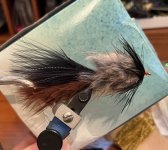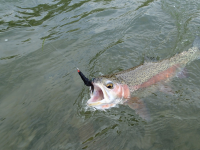
There is common refrain in the TV crime series NCIS New Orleans. As the boss assigns pressing leads to his team he usually finishes with the imperative: “Go Learn Something”. As I was sitting at my tying desk this morning cranking out Pine Squirrel Buggers for this year’s SW Montana trout season, I thought about what I’d learned over the last decade about why my Pine Squirrel Buggers were so effective.
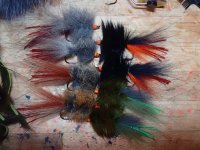
I don’t know exactly when I tied my first Pine Squirrel Bugger but I wrote about them for the first time over a decade ago.
https://www.jsflyfishing.com/blogs/fly-tying/try-tying-these-pine-squirrel-buggers
I can say unequivocally that the pattern has been the most productive over the last decade on all the SW Montana (including YNP) waters I’ve fished. So productive in fact that I have to tie 100s of extra flies each season to hand out to other anglers I meet along the river.
Although it’s tough to prioritize what the Pine Squirrel Buggers might imitate, I think there are three choices—leeches, sculpin and possibly large salmon fly nymphs. Of course leech patterns are common for still-water applications but don’t generate the same enthusiasm for river and stream situations. You don’t usually see leeches like you see bait fish, terrestrials and aquatic insects along and in the water. As I started successfully fishing the Pine Squirrel Buggers across the rivers and streams of SW Montana I observed some common conditions that indicated probable suitable leech environment. On more than one occasion on a favorite section of the Madison as a medium to large rainbow or brown came to hand they were regurgitating a dark olive gray leech approximately 3-4 inches long. Once, the leech was still alive and had probably been consumed minutes before I connected with the trout. Although the river was flowing well, there were plenty of spots along the edges that had slow to still weedy backwaters—ideal habitat for typical leeches. On other occasions where I was fishing a typical meadow reach that sported a lot of rivulets and springs that fed the main stem, it was not hard to spot the leeches moving around in the small rivulets. Again, dark gray-green in color. Another piece of the puzzle was learning that there are leech species that are predators by nature feeding on small invertebrates. Some of those species are excellent swimmers and will enter flowing water to feed on emerging aquatic insects. That fact alone, explains why a leech like pattern (think woolly bugger) tossed into a pod of rising fish is usually effective.
Basic Pine Squirrel Bugger pattern
Hook: #2-6 Barbless Streamer
Thread: UTC 140
Tail: Arctic Fox or Finn Raccoon Fur layered to generate contrast
Flash: Any suitable flash or silicon legs layered between fur tail material
Body: Zonked Pine Squirrel wrapped from tail to hook eye
Rib: BR or Med wire counter wrapped from tail to hook eye
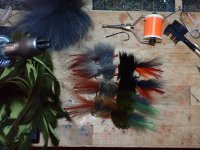
Blacks, Browns and Gray-greens are most effective. Unweighted flies fished with long sink tips and short, stout leaders.
There may be better leech patterns out there, but for my $$, the Pine Squirrel Bugger can’t be beat.






 the above I found Mike's SBS on the tie.