“Go Learn Something”

Mike Cline

Life of the Party
Forum Supporter
1776279528065.png
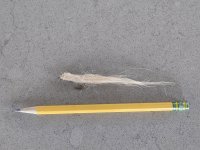
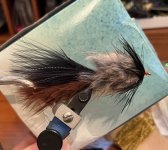
There is common refrain in the TV crime series NCIS New Orleans. As the boss assigns pressing leads to his team he usually finishes with the imperative: “Go Learn Something”. As I was sitting at my tying desk this morning cranking out Pine Squirrel Buggers for this year’s SW Montana trout season, I thought about what I’d learned over the last decade about why my Pine Squirrel Buggers were so effective.
P4150845.jpeg

I don’t know exactly when I tied my first Pine Squirrel Bugger but I wrote about them for the first time over a decade ago.
https://www.jsflyfishing.com/blogs/fly-tying/try-tying-these-pine-squirrel-buggers

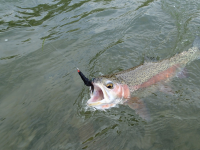
I can say unequivocally that the pattern has been the most productive over the last decade on all the SW Montana (including YNP) waters I’ve fished. So productive in fact that I have to tie 100s of extra flies each season to hand out to other anglers I meet along the river.

Although it’s tough to prioritize what the Pine Squirrel Buggers might imitate, I think there are three choices—leeches, sculpin and possibly large salmon fly nymphs. Of course leech patterns are common for still-water applications but don’t generate the same enthusiasm for river and stream situations. You don’t usually see leeches like you see bait fish, terrestrials and aquatic insects along and in the water. As I started successfully fishing the Pine Squirrel Buggers across the rivers and streams of SW Montana I observed some common conditions that indicated probable suitable leech environment. On more than one occasion on a favorite section of the Madison as a medium to large rainbow or brown came to hand they were regurgitating a dark olive gray leech approximately 3-4 inches long. Once, the leech was still alive and had probably been consumed minutes before I connected with the trout. Although the river was flowing well, there were plenty of spots along the edges that had slow to still weedy backwaters—ideal habitat for typical leeches. On other occasions where I was fishing a typical meadow reach that sported a lot of rivulets and springs that fed the main stem, it was not hard to spot the leeches moving around in the small rivulets. Again, dark gray-green in color. Another piece of the puzzle was learning that there are leech species that are predators by nature feeding on small invertebrates. Some of those species are excellent swimmers and will enter flowing water to feed on emerging aquatic insects. That fact alone, explains why a leech like pattern (think woolly bugger) tossed into a pod of rising fish is usually effective.

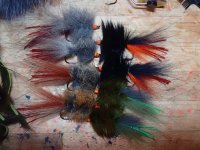
Basic Pine Squirrel Bugger pattern

Hook: #2-6 Barbless Streamer
Thread: UTC 140
Tail: Arctic Fox or Finn Raccoon Fur layered to generate contrast
Flash: Any suitable flash or silicon legs layered between fur tail material
Body: Zonked Pine Squirrel wrapped from tail to hook eye
Rib: BR or Med wire counter wrapped from tail to hook eye
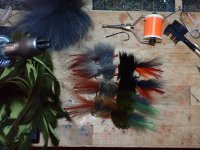
P4150846.jpeg
Blacks, Browns and Gray-greens are most effective. Unweighted flies fished with long sink tips and short, stout leaders.

There may be better leech patterns out there, but for my $$, the Pine Squirrel Bugger can’t be beat.
 
Quite honestly I would not call that a leech pattern. I wouldn't call a normal bugger a leech either. Leeches are skinny.

I think buggers are so effective cause they move well and trigger a wtf is that response. The only way the fish can find out is to eat it.
 
Quite honestly I would not call that a leech pattern. I wouldn't call a normal bugger a leech either. Leeches are skinny.

I think buggers are so effective cause they move well and trigger a wtf is that response. The only way the fish can find out is to eat it.
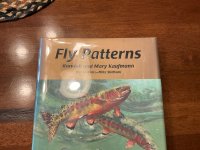
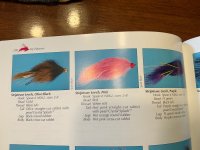
Many fly tying gurus would probably dispute that characterization. Just one example. In Randall and Mary Kaufmann’s Fly Patterns, Tie Thousands of Flies (2008), the index lists 80+ leech patterns, a great many bear some resemblance to the Pine Squirrel Bugger.
IMG_1168.jpeg

IMG_1167.jpeg
When you characterize leeches as “skinny” you fail to understand their true nature. Leeches are Annelids (segmented worms), the same Phylum as earthworms. As they move they contract and expand. An expanded leech may indeed look skinny, while a contracted leech may indeed look plump. A well fed leech can be very plump. On the issue of why a trout might find a leech pattern enticing. During a recent TV episode an old man asked his son-in-law lying in bed in the morning if he would go fishing with him. The son-in-law objected at the time—5:00AM. The old man wisely said: The fish don’t know what time it is!
 
@Mike Cline I agree. I watched a bunch of leeches swim in a biology lab aquarium one time, and I was amazed at both ends of the spectrum...how long and skinny or how short and fat the same leech could be as it moved through the water. It was pretty amazing!
 
I definitely could see how the zonker strip will breath more than traditional hackle. Do you usually tie them hot headed or plain?
Both, there’s actually no downside to the Flo orange thread head as an “egg-sucking leech” has opportunities of some species spawning throughout the season.
 
nice looking flies....lots of extra micro movement that those zonker strips provide doesn't hurt I'm sure.

It's interesting how many times fish will 'eat' something only to expel it on discovering that it wasn't indeed food (personally I've seen this too many times to count with back eddy fish where you can just sit and watch them). They don't have hands to touch anything, so they naturally have to use their mouth to touch everything that could possibly be food...hence, @_WW_ 's comment about everything is food until proven otherwise.
 
When you characterize leeches as “skinny” you fail to understand their true nature.
Trust me, I have seen more leeches than 99% of fly fisherman. Growing up we camped with a great walleye angler - RIP Ron Erdman. He used leeches as bait. The leeches you can buy in a bait store in MN are twice as big as anything I have seen in Oregon - I keep a good number of LMB and they eat a lot of leeches in the lake I pull them from. Of the 1000s of leeches I have seen in my life not one had the body mass of a 3" long chunky "leech" pattern. Final point - when a leech really wants to get somewhere they flatten out and elongate their bodies and swim like a snake.

I am not trying to say you don't have a very effective fly pattern. I am just saying I would classify it more as an attractor instead of a leech. Doesn't really matter what you call it. In my opinion (that is all we have as we are not fish) patterns like a sparse marabou leech or leather leech do a better job of imitating the true food source. The only thing in my box I think of as a leech is "the stick." One day my son and I pulled up at the boat landing with about 10 gallons of illegally planted bass. A guy asked what we caught them on and my son showed him the wet fly on his rod. The guy said something along the lines of "what the hell - that is just a stick."

20260416_074258.jpg
 
@Mike Cline - Thanks for sharing (once again) your squirrel zonker leech pattern. I'm going to wrap up a couple later today (if the wind ever stops blowing) and get out and try them. Merci'!
 
Trust me, I have seen more leeches than 99% of fly fisherman. Growing up we camped with a great walleye angler - RIP Ron Erdman. He used leeches as bait. The leeches you can buy in a bait store in MN are twice as big as anything I have seen in Oregon - I keep a good number of LMB and they eat a lot of leeches in the lake I pull them from. Of the 1000s of leeches I have seen in my life not one had the body mass of a 3" long chunky "leech" pattern. Final point - when a leech really wants to get somewhere they flatten out and elongate their bodies and swim like a snake.

I am not trying to say you don't have a very effective fly pattern. I am just saying I would classify it more as an attractor instead of a leech. Doesn't really matter what you call it. In my opinion (that is all we have as we are not fish) patterns like a sparse marabou leech or leather leech do a better job of imitating the true food source. The only thing in my box I think of as a leech is "the stick." One day my son and I pulled up at the boat landing with about 10 gallons of illegally planted bass. A guy asked what we caught them on and my son showed him the wet fly on his rod. The guy said something along the lines of "what the hell - that is just a stick."

View attachment 182184
There are 81+ species of leeches in North America across four families, eight of which occur in Montana. Having fished N. Minnesota shield lakes for over 10 summers in the 1990s, I am very familiar with the black bait leech you describe. Unfortunately, it is just one of 81+ species and not overly representative of most of those.
 
Quite honestly I would not call that a leech pattern. I wouldn't call a normal bugger a leech either. Leeches are skinny.

I think buggers are so effective cause they move well and trigger a wtf is that response. The only way the fish can find out is to eat it.
Many fly tying gurus would probably dispute that characterization. Just one example. In Randall and Mary Kaufmann’s Fly Patterns, Tie Thousands of Flies (2008), the index lists 80+ leech patterns, a great many bear some resemblance to the Pine Squirrel Bugger.
View attachment 182139

View attachment 182140
When you characterize leeches as “skinny” you fail to understand their true nature. Leeches are Annelids (segmented worms), the same Phylum as earthworms. As they move they contract and expand. An expanded leech may indeed look skinny, while a contracted leech may indeed look plump. A well fed leech can be very plump. On the issue of why a trout might find a leech pattern enticing. During a recent TV episode an old man asked his son-in-law lying in bed in the morning if he would go fishing with him. The son-in-law objected at the time—5:00AM. The old man wisely said: The fish don’t know what time it is!
I'm sure these leech/buggers that Mike tied are much thinner when wet. Mike, do you put the squirrel in a dubbing loop or palmer with the leather on?
 
I'm sure these leech/buggers that Mike tied are much thinner when wet. Mike, do you put the squirrel in a dubbing loop or palmer with the leather on?
All the tailing materials are tied on from about an 1/8” back from the hook eye. This creates a thick, smooth base along the hook shank for the zonked squirrel. The strip of zonked squirrel is tied in at the hook bend—just a short section skin side up with the fur facing backwards. The first wrap covers the tie in point while subsequent wraps should be made without over lapping the edges of the skin. Finish the last wrap about 1/8” behind the hook eye. Secure firmly with thread wraps before trimming and wrapping the wire.
 
All the tailing materials are tied on from about an 1/8” back from the hook eye. This creates a thick, smooth base along the hook shank for the zonked squirrel. The strip of zonked squirrel is tied in at the hook bend—just a short section skin side up with the fur facing backwards. The first wrap covers the tie in point while subsequent wraps should be made without over lapping the edges of the skin. Finish the last wrap about 1/8” behind the hook eye. Secure firmly with thread.
It reminds me of a Slumpbuster.
 
Ok, to quote Seinfeld in one of his ads for a certain credit card company, " I'm a,little light on the lingo" . Is there a dictionary or glossary of fly tying terms available somewhere? Zonked, zonkered, palmered, are all foreign to me.
Mike,
1. I take it Pine Squirrel flows and moves better than feathers?
2. Size 2 down to size ?
Rich

Edit: ok, 30 seconds after I posted 📫 the above I found Mike's SBS on the tie.
Still, my question about the glossary of tying terms remains.
 
This style fly is simple to tie, uses inexpensive materials, looks great in the water and has endless color options, and catches the heck out of fish.

But they do hold a lot of water and are not the nicest to cast.

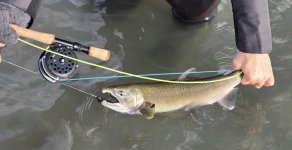
I still fish ‘em though. Work on salmons too.


1777041007317.jpeg
This one has muskrat instead of pine squirrel, but same idea.
 
Back
Top