Billie Frank Jr. - Nisqually NWR & McLane Creek Nature Area. Part 6: Woodpeckers. On a bird walk, I have my hearing focused on any sign of life: a ripple in a pond, a flash in my peripheral vision, a scratching sound in the undergrowth, or an unnatural “drum” sound in the trees. The later is a tip-off that there is a woodpecker in the vicinity. Now seeing the bird is another story. The bird may be tapping from inside a tree hollow. And woodpeckers are very adept at keeping to the far side of a branch or trunk when they detect your presence. Patience and good luck work in my favor on occasion.
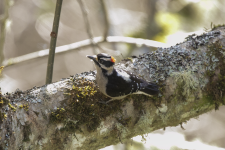
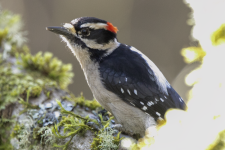
Downy woodpeckers are the smallest woodpecker species in the U.S. at under an ounce, length of almost 7” and a wingspan of 12”. It is its “tiny” size that is one of the better characters to separate downy and hairy woodpeckers (weight = 2.3oz, length = 9.25”, and wingspan = 15”). Because they are so light, downy woodpeckers can exploit thinner branches and smaller trees and shrubs in their search for prey. Befitting their size, their hammering is much quieter (and more superficial) and they are more likely to glean insects than to dig them out. I had heard a high pitched “pik” call along the Twin Barns Boardwalk and suspected a downy was in the vicinity. This little guy was searching for newly-emerged midges among the branches of a willow shrub. He was only a few feet away at eye level (and just beyond the minimal focusing distance of my 150-600mm lens). just stayed very still (except for clicking the camera shutter), he continued foraging.
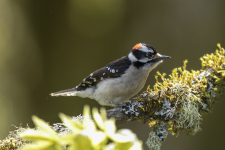
Eventually, he moved deeper into the willows and I moved on.
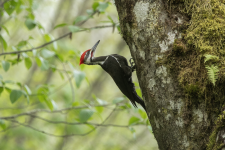
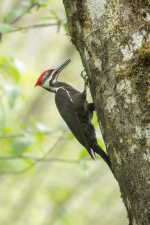
At the other end of the size spectrum, the pileated woodpecker (weight = 10oz, length = 16.5”, wing span = 29”) is the largest extant woodpecker in North America (assuming that the ivory-billed woodpecker is in fact extinct). Their loud rattling calls echo through the forest, but you really know that they are in the vicinity when they are destroying a decaying tree in search of carpenter ants or burrowed beetles. It sounds like someone hammering the wood with a chisel, which is not far from the truth. There is at least one pair at Nisqually but they can be quite camera shy. I found this bird at McLane Creek on the trunk of a rotting snag. Atypically, it kept at its excavation while I watched and filmed. When it eventually flew off, there was a pile of wood fragments across the trail.
Northern flickers have very diverse foraging habits. They will probe in the grass for grubs and ants. They will also eat nuts, berries, and seeds. They will also “hawk” insects on the wing. Their calls are similar too, but higher pitched, the calls of pileated woodpeckers. They also make a “wicka-wicka-wicka” call. I often see them around my house. In the spring, males will often drum rhythmically and loudly to establish their territory drive off other male flickers, and attract mates. They like to drum on surfaces, like metal roofs, that produce especially loud sounds, much to the annoyance of the home owner.
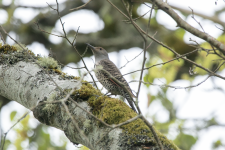
At Nisqually, it is more common to hear the rattling call of a northern flicker perched in the canopy of a tree. If you do see one, you may only have a brief view before it bursts into flight and you catch the flash of color under its wings and tail as the bird flies off to a more secluded spot. If the underwing color is red/orange, the individual is the red-shafted subspecies so common in the Western U.S. and B.C.; if the underwing color is yellow, the individual is the yellow-shafted subspecies common in the eastern half of the U.S., across Canada, and into Alaska. Hence, a local common name for this species in the Southeastern U.S. is “yellow hammer”. The two subspecies do interbreed where their ranges overlap and produce individuals that have a mix of characteristics. This female (lacking the red mustache of a male red-shafted or the black mustache of the male yellow-shafted) is a red-shafted as you can see from the reddish color peaking out under the flight feathers.
Sapsuckers, like this male red-breasted sapsucker,
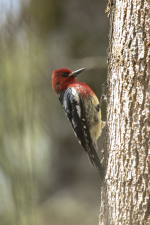
commonly include tree sap in their diet as their common name indicates. In fact, the deciduous trees along our driveway are riddled with rows of shallow, regular pits that this species carves in the bark. The sap is lapped up with the bird’s brush-like tongue for lapping up the sap. Sapsuckers will also eat insects that are attracted to these sap wells. They will also search crevices in the bark for insects.
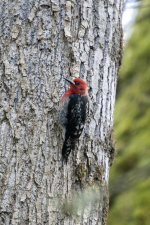
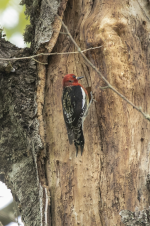
I often encounter red-breasted sapsuckers during my birding walks at McLane Creek. On one walk, I heard a male hammering high up on a snag. A week later, it had dug out a new nesting cavity here. While I watched, it periodically headed into the newly-formed nest cavity to hammer out some final touches.
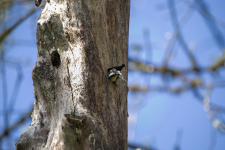
While watching this sapsucker at work, I also noticed a chestnut-backed chickadee visiting a smaller nest hole further down the snag.
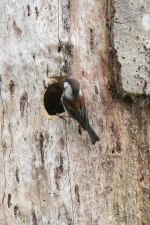
This might have previously been the nest cavity for a downy woodpecker, based on its diameter. It just required some cleaning to be a suitable nesting spot for this chickadee and his mate.
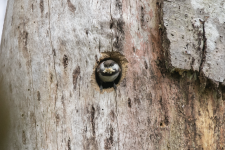
Nest cavities abandoned by woodpeckers provide critical nesting habitat for many other bird species, including chickadees and titmice, swallows and swifts, nuthatches and wrens, warblers and bluebirds, and ducks and owls. For this reason, protection of snag habitat is essential to maintain bird diversity in PNW forests.
Steve