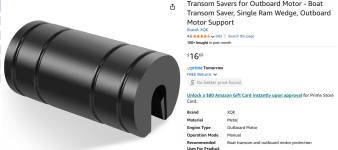
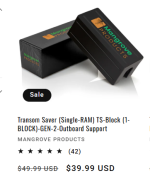
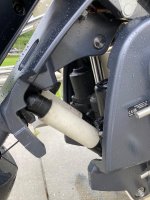
Well, in this case, it's really not even a transom saver. The wedges/bumps are really just to keep the motor from coming down. It's more of a tilt/trim unit and skeg saver.

However, I think having the motor up, with the weight of the upper unit directly over the transom or even ahead of the transom, balanced with the lower unit, is probably best for the transom. Not as much wagging back and forth on our crappy concrete highways.
Probably less wag if the motor is straight down, but then you're going to drag it.
I think my Lowe transom is fine. My Valco was another story. The 25 2-stroke was probably a bit heavy for it even though it was within (at max) the HP rating. I had the true bolted to the trailer style transom saver on that one. But I always wondered if that sort of pressure on your lower unit is bad. And, the fact my anchor point was the trailer means if the trailer and boat are moving independently from a bad bump or loose tie-downs then that could put more pressure on the transom (and lower unit) than not having one.
I saw a Bayliner cruising along I90 east going up the hill there in Factoria. The concrete was terrible back then and the boat was bouncing hard. The 9.9 kicker was bouncing so hard it ripped off and skidded across the freeway in front of me. Bad day. Probably hard to put a saver on a kicker, but I had the same thing almost happen with a 9.9 on my old 12' boat when the saver came un-bungeed.
This is one of those old arguments that will never be solved unless somebody like Myth Busters does a show on it.



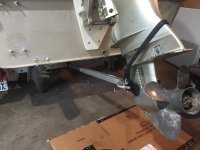


 I had to use a damn 2x4 to pry the thing out.