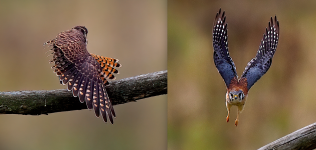
Got any bird pics?

That is a beautiful shot, apart from just the great bird clarity, the scrolling detail on the branch is fantastic- what system are yo
Thanks.
That's a trick question as I pulled out my old DSLR Pentax K3iii and long telephoto lens for that original crossbill photo because I was feeling nostalgic and hadn't used that dinosaur in over a year. It required a tripod and patience. I was lucky to get that bird sitting long enough to focus, recompose and get the shot.

For the photo you reference, and the majority of my current wildife and bird photography, I moved on to a mirrorless system which is an absolute game changer. Since I emphasize bird photography, I went with a micro four thirds (MFT) sensor with the OM systems (formerly Olympus) OM-1 with a 150-400 TC F 4.5 lens.
 
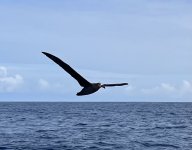
I think that we saw the same species on our Saturday trip.
Steve
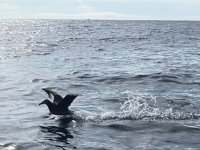
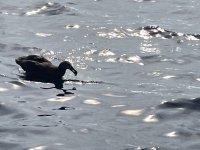
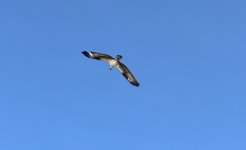
I do too. We were heading fish and had a whole pelagic bird pecking order going down out behind the boat. Al B. Tross was on top and didn’t want anybody else getting his share of tuna guts. Al also did several circles of the boat setting up nicely for even a semi decent phone pic.
 
Good thing Al B. Tross didn't poop on you, seabirds are famous for that. Bombs away!
 
Good thing Al B. Tross didn't poop on you, seabirds are famous for that. Bombs away!
Would’ve fit right in with the tuna blood and other various bilge that the chocolate lab on board consumed and then vomited.
 
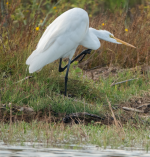
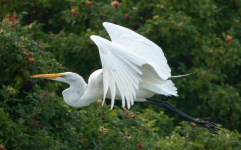
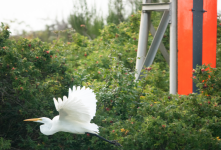
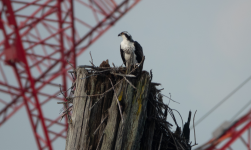
I don't know if this is the same one, but an Egret generally shows at the same place each year
1725319983946.png1725320030567.png1725320056614.png
Shooting from the kayak often lets you paddle to a point where you can get a weird complex background. This guy just fledged, the orangey-red eyes are a giveaway
1725320619538.png1725320086843.png1725320113323.png
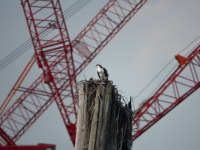
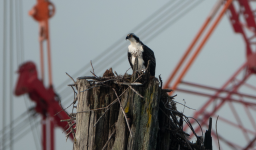
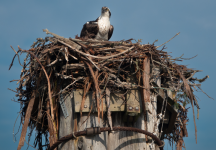
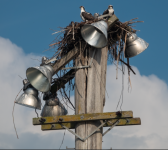
The nesting is a matter of convenience, this is close to a lumber yard
1725320171621.png
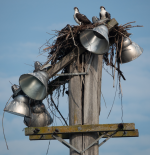
Been meaning to check on this nest for about two months, it's one of the weirder ones....
1725320333928.png
 

Attachments

  • 1725320147335.png
    1725320147335.png
    658.2 KB · Views: 0
I took out of state guests on a whale watching tour out of Port Townsend on Monday and decided at the end of the day to look for the Red-footed booby that has been the rarity talk of the town since August. Thankfully, it was an easy find in Fort Worden and put on a good display in perfect light.


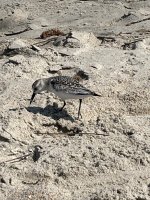
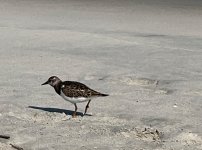
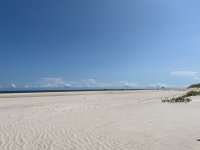
Decided I needed a two hour break at the beach. Maybe six other people on 3/4 mile of sand. And these guys for entertainment…along with many others.

SanderlingIMG_0646.jpeg


Ruddy Turnstone
IMG_0656.jpeg

And always fun watching these guys hunt.
IMG_3263.jpeg

A lot to be said for solitude:
IMG_0610.jpegIMG_0609.jpeg
 
Nisqually Wildlife Refuge, 19 September 2024, Part 1 of 2. Yesterday was a special day for me at Nisqually Wildlife Refuge. The morning hadn’t started out very auspiciously as I left behind my binoculars and there was a threat of fog obscuring everything. But the balance of the morning went well, even spectacular.
As I was walking back to the parking lot along the N-S dike between the freshwater and saltwater marsh, I scanned the edges of the freshwater marsh in the hopes of seeing a Virginia rail or a sora. With water levels so low, I thought that I might have a chance. I had a brief glimpse of a sora here about two weeks earlier.
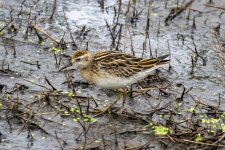
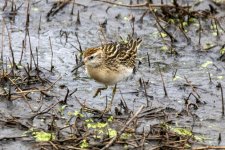
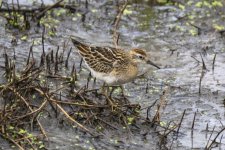
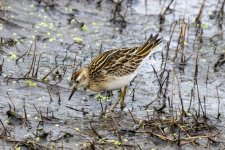
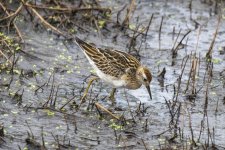
Instead, a single large sandpiper flew into view and began to probe the mud for a meal. It is quite rare to see a single sandpiper anywhere and also rare to see them in the freshwater marsh side of the dike. Having just observed Western and least sandpipers, I could see that this bird was bigger than a Western sandpiper. It had a very dark cap and a white eye-brow line. I knew that it was special and shot a slew of pictures.
SharpTailedSandpiper9344Trim.jpg
SharpTailedSandpiper9369Trim.jpg
SharpTailedSandpiper9367Trim.jpg
SharpTailedSandpiper9357Trim.jpg
SharpTailedSandpiper9356Trim.jpg
Back home, the identification process began. That rich brown cap really showed up in the photographs; that was the first hint that this was a special bird, a juvenile sharp-tailed sandpiper. The white supercilium (eyebrow stripe) and white eye ring added more confidence to the id. The fact that the bird was on the freshwater marsh side also was consistent with descriptions of its typical habitat.
This species breeds in the tundra of Russia and migrates to Australia and New Zealand for the Northern winter. According to eBird, while the sharp-tailed sandpiper is a regular migrant in Alaska, it is rare along the Pacific Coast of Canada and the U.S. Boy, was I a happy birder…. And a lifer to boot.

Steve

 
Congrats on the red hot sighting Steve! Are you networked with other birders or did you contact the refuge? I'm sure there are lots of folks around that would love to see this bird.
I agree that it would attract attention from other birders. Yes, I called the refuge this morning and I have posted it on the Pacific Northwest Birding group on Facebook. I tried to post the sighting on eBird, but I have run into a technical snafu.
Steve
 
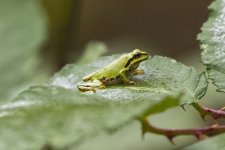
Nisqually Wildlife Refuge, 19 September 2024, Part 2 of 2. While the official start of fall is Sunday, the smell of fallen leaves as I walk through the trees of the Twin Barns trail say fall. The explosive growth of licorice ferns on the trunks of the big-leaf maples says fall. The appearance of Pacific tree frogs on large blackberry leaves says fall.
A01PacificTreeFrog9125.jpg
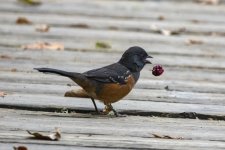
Birds, like spotted towhees,
A02SpottedTowhee9388.jpg
song sparrows,
A03SongSparrowonDock9164.jpg
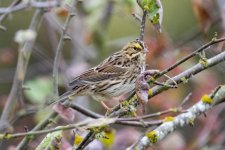
and savannah sparrows
A04SavannahSparrow9151.jpg
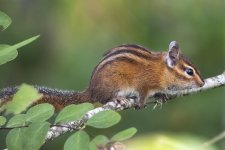
(and Townsend’s chipmunks)
A05TownsendsChipmunk9133.jpg
eating fruits and seeds, the bounty of the summer, say fall. The return of migratory shorebirds (Western sandpipers,
A06WesternSandpipers9184.jpg
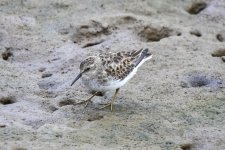
least sandpipers,
A07LeastSandpiper9219.jpg
and greater yellowlegs)
A08GreaterYellowlegs9173.jpg
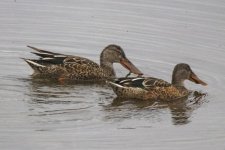
and ducks (Northern shoveler hens)
A09NorthernShovelerHen9152.jpg
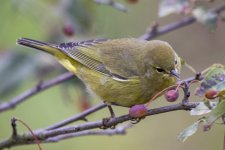
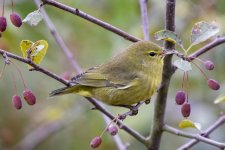
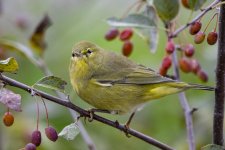
says fall. Species that will be migrating south soon, such as this orange-crowned warbler, are feeding like crazy to fill their fuel tanks and that says fall.
A10OrangeCrownedWarbler9275.jpg
A11OrangeCrownedWarbler9305.jpg
A12OrangeCrownedWarbler9311.jpg
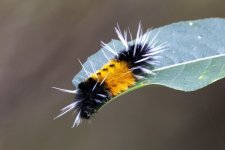
The caterpillar of the yellow-spotted tussock moth that will shortly be building a cocoon as it pupates through the winter to emerge as an adult in the spring knows that it is fall.
A13YellowSpottedTussockMoth9129.jpg
Steve
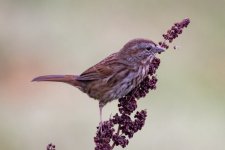
 
Last edited:
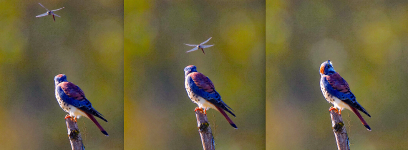
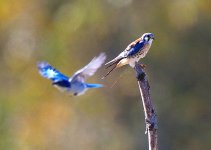
Birds are picking up. My newest backyard perch has become a male kestrel's preferred feeding post. This dragonfly better watch out as this is about a 99% insect feeding kestrel. Grasshoppers are his number one meal right now.
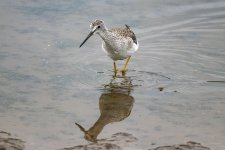
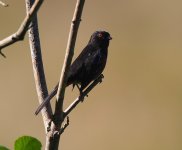
This towhee is in full Halloween form. The extra-dark appearing plumage is caused by a branch shadow shading him.

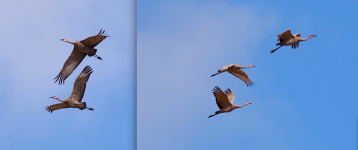
A colt Sandhill crane with its parents I assume.

Bottom has both a male and female kestrel using the older perch out about 50 yards from my deck

Screenshot 2024-10-01 at 9.38.53 PM.png


Screenshot 2024-10-03 at 4.09.16 PM.png


towredred2024.jpg

Screenshot 2024-10-02 at 2.13.22 PM.png
 
Back
Top