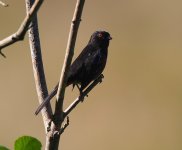
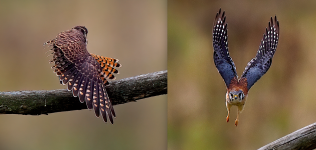
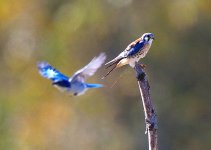
Nisqually Wildlife Refuge, 19 September 2024, Part 1 of 2. Yesterday was a special day for me at Nisqually Wildlife Refuge. The morning hadn’t started out very auspiciously as I left behind my binoculars and there was a threat of fog obscuring everything. But the balance of the morning went well, even spectacular.
As I was walking back to the parking lot along the N-S dike between the freshwater and saltwater marsh, I scanned the edges of the freshwater marsh in the hopes of seeing a Virginia rail or a sora. With water levels so low, I thought that I might have a chance. I had a brief glimpse of a sora here about two weeks earlier.
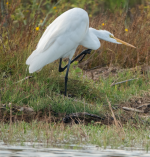
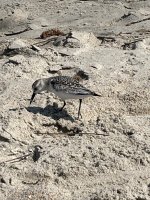
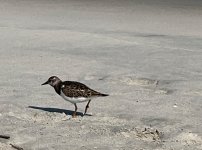
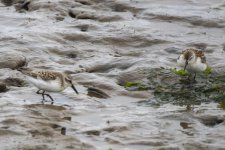
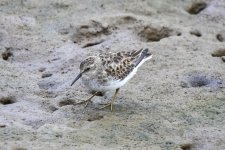
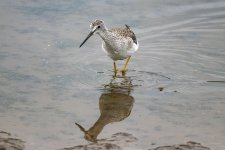
Instead, a single large sandpiper flew into view and began to probe the mud for a meal. It is quite rare to see a single sandpiper anywhere and also rare to see them in the freshwater marsh side of the dike. Having just observed Western and least sandpipers, I could see that this bird was bigger than a Western sandpiper. It had a very dark cap and a white eye-brow line. I knew that it was special and shot a slew of pictures.
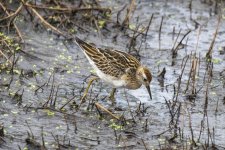
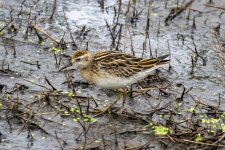
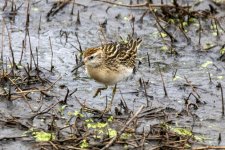
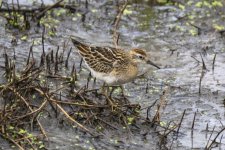
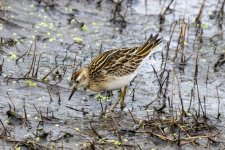
Back home, the identification process began. That rich brown cap really showed up in the photographs; that was the first hint that this was a special bird, a juvenile sharp-tailed sandpiper. The white supercilium (eyebrow stripe) and white eye ring added more confidence to the id. The fact that the bird was on the freshwater marsh side also was consistent with descriptions of its typical habitat.
This species breeds in the tundra of Russia and migrates to Australia and New Zealand for the Northern winter. According to eBird, while the sharp-tailed sandpiper is a regular migrant in Alaska, it is rare along the Pacific Coast of Canada and the U.S. Boy, was I a happy birder…. And a lifer to boot.
Steve