I don't think hatchery plants would do much good because our primary problem is the ocean. Putting more in doesn't produce more out. Some of our streams are cranking out maximum numbers of smolts already. They just aren't coming back from the ocean.
I agree. I think the changes in forestry and mining, along with all the other environmental improvements in the last 40 years actually have spawning waters in pretty decent shape. It's the ocean (and getting there & back) that seems to be the problem these days.
Japan and Russia are planting BILLIONs (yes, with a B) of chum and pinks EVERY year. Russia is also trawling the hell out of the Pacific to help pay for their war with Ukraine. You think they're checking to see what sort of salmonid it is? And now China, North Korea and South Korea are on the salmon farming band wagon. And Alaska commercial fisheries caught so many fish last year that the market is still flooded, even without fish from Japan and Russia. Canada buying out their own BC commercial fisheries might help our fish.
Our fish go north more than ever so they are in Canadian, Alaskan, Japanese and Russian waters. We can't control what happens to them there.
I applaud your effort
@Denwor54 and thank you for doing it.
My input would be a focus on enforcement-
We need more than 1 officer for 2 or 3 counties. They've always been light, but it seems ridiculously light these days.
If angling opportunities decrease, license sales (and fees) decrease so I would have to think enforcement will decrease. I'm not sure how it could be any worse than now, but you get my point.
We can't assume that just because the river is closed no poaching is happening.
I agree with
@Creatch’r that it might be better to leave it open with the current regs so there are more legal and responsible anglers on the river to put some pressure on the poachers. More eyes with phones calling things in.
There are success stories of closures bringing fish back, but it's few are far. The Cedar trout fishery comes to mind, but we all know there was poaching while it was closed. Some would say the Skagit. That is debatable. Do I think it should be closed when there are low numbers. Sure, I can agree with that. But what about all the seasons after C & R were established that had lots of wild fish? Including 2013-2017 when we couldn't fish it?
Thanks to WW and many others on here for Occupy Skagit!
Those peaks in returns weren't because we couldn't fish it. There is no correlation between C&R seasons open and reduced returns. Here's a good graph from Swing The Fly:
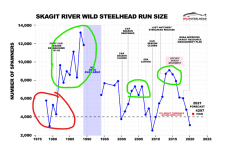
The big spike in the 80s after a C&R season is established. 5 seasons in the 2000s after C&R reopened. The eventual downturn from each of these peaks is not because of C&R fishing. The decline from 2015 to 2018 wasn't because of a C&R season, because we didn't have any. 2018 & 2019 had C&R seasons, but it was already down. Then 2020 was too low to have a season. The drought in 2015 is probably the main reason for the decline.
And how do we explain the jump from 79 into the 80s?
So I guess my point is that while we need to close rivers when the run is too low, we can also argue that C&R seasons do not have much of an impact on the returns. If those C&R seasons had adequate enforcement then I would argue the number used to determine open or closed could be a touch lower than present. I'm glad the Skagit has the attention it's getting. Now we need that attention on all the other S rivers.
This is like the old days of the Steelhead forum. Haha! The only difference is nobody is threatening bodily harm.

Good thread
@Denwor54