Worrisome Trend?

Not to put too much on personal opinions or experiences, but mine have been of too many people fishing on ever decreasing fishing opportunities, at least on the fisheries I am involved in.

The article seems a bit misleading as it claims statistics of less than half of all licensed anglers renewing their fishing license each year and goes on that to argue why and how to turn around a perceived "trend". Yet, no source is provided to substantiate the claim of so many anglers quiting. Only reference is to an American Sportfishing Association (ASA) study on reasons why people start fishing.

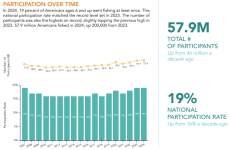
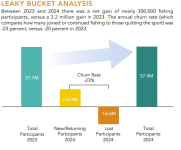
Going to the ASA website there are annual reports dating back to 2007 that show increasing trends (or at the very least stable numbers, depending on timeframe, demographics, type of fishing, etc) in fishing participation and that the % people quiting fishing has been surpassed by new or returning anglers. Towards the end of the report they list barriers to fishing with crowding of fishing spots the leading obstacle.

Some graphics from the latest report and link to the full report below:

1761232308454.png

1761232264794.png

 
Last edited:
My home river has >75% fewer fish per mile than it did when I was a kid. Seemingly hasn't stopped angling pressure from continuing to increase (…).

At least in cases where long-time fly fishing folks are walking away, I’d speculate that “fishing just isn’t as fun when there are fewer fish and less solitude, but way more internet hotspotting bros” plays into the decision equation somewhere.
 
I think a lot of folks quit because it's not as easy as they'd like it to be and success isn't as quick to come as it seems to be in magazines, photos, videos, fishing reports, etc. A lot of people are conditioned to expect rapid gratification and rapid skill development with minimal effort. There are a lot of other ways nowadays to get a dopamine fix without the expense of time, money, and effort that fishing requires. My own children, for example, tend to max out their allotted 1 hour of phone use each day before dinnertime. If I didn't limit it, I'm sure they'd be near the national average of 5+ hours a day.

Exacerbating this, especially for fly fishing, is the misconception that the goal is to catch as many fish as possible in the shortest amount of time. Even anglers who exclusively use bait, who I think have the best shot at that goal, tend to agree that they've got additional reasons for fishing.
 
Last edited:
My thoughts on this as a newish returned angler,

First off the stats are misleading like VMP posted. That churn can be completely normal. Tons of people pick up fishing licenses, decide its not for them and then stop, sure. But a lot of that can also be attributed to cases like: I had an OR license last year, this year (so far) I don't because I don't live in OR anymore and I haven't had occasion to go fish there this year. That kind of churn is normal and unavoidable. But saying that 50% of license sales are dropped sure sounds scarier.

I will say that there does seem to be truth to the "Here's the reason why" section. Fishing is indeed hard, especially with dwindling stocks and increased threats to access. I'd also say its hard to even get into fishing and learn when, either because of reality or perception, the existing community is seen as old, gatekeeping and crotchety. I've seen countless posts on the internet (in general not saying here specifically) where someone who is clearly new asks for help only to be met with howls of "hotspotting," "go do your own research," "in the water," or even outright bad advice like pointing people to tresspass on military bases and what not. Thats of course, in between the posts about people having fights at boat ramps because someone did something that was perceived to be slightly incorrect, or screeds about having to share a stretch of river with someone. Of course there are always [fly]fishing shops, but you run into other fun walls there, like the customer who is chatting up the staff (and often the staff that is all to happy to ignore other customers so they can chat) and won't leave despite never buying anything, or the staff that decides the new person doesn't deserve their time.
One thing I've heard people mention is "Join a fly fishing club! Then you'll meet people." Well, when the clubs all have events like "Join us at 2pm on the 1st Wednesday of the month at <bar> for a fly tying get together" I'm pretty sure its obvious who the clubs are run by and what their target audience is. Of course there are groups out there who try and do things a little differently ( I can think of a shop in OR that is reaching out heavily to vets, women, and new folks) but they're also dissed on a lot for blowing spots and bringing too many people to spots.

Now this isn't a purely fishing problem. I could take my rant and replace it with shooting and its basically the exact same issue with shooting spots, gun clubs and gun people. Theres a lot of people out there who learned how to do a thing in a much different world (just as an example 35 years ago there were 100 million less people in this country and no widely available internet) and they're largely decided that things were good the way they were and anything new is unacceptable, and then gatekeep the hobby from younger people who don't/can't do things the way they were done years ago.

Just my $0.02 and observations from the past couple years.

 
I wonder if the analysis claiming the big dropout rate was limited to annual, resident licenses or if it included the huge number of people who buy out-of state licenses for destination fishing trips. Lots of those folks won't be back the next year, if many will likely return in future years.

Also, a lot of resident licenses get bought by people who only fish with a guide or charter once, then don't return for a few years if they return at all.
 
If there is truly a decline I might attribute it to a couple of factors:

Geography of residence plays a huge role in opportunities to fish. As of the 2020 census, 80% of the US population resides urban environments. That’s up from ~50% in the 1950s. Youth that grow up in urban environments are unlikely to experience opportunities to fish as do youth that grow up in rural environments. And even if they do get some opportunity at a local urban pond, they are unlikely to translate that into real fishing opportunities in rural environments unless they are mentored by a serious angler. For adults it is somewhat the same, but the farther way you are from quality angling opportunities, the more expensive it becomes to take advantage of those opportunities or even be aware of them. If you live in Tucson, AZ your inexpensive opportunities are few. If you live in Minneapolis, well they don’t call it the Land of Thousand Lakes for nothing.

I think another factor that is in my opinion is an insidious obstacle to growth or even stability in angling population. The education system, media hyperbole and general negative indoctrination about climate change, blood sports, invasive species, environmental degradation, etc. must have a damping effect on those who might have pursued angling in the past.
 
Pink salmon won't be running in 2026 (even year). Expect a sharp decline in WA fishing licenses.
 
While I question the numbers he cites, the decline is real. And across all "consumptive" outdoor activites as evidenced by decline in Pittman-Robertson and Dingell-Johnson funding in Washington. "Non-consumptive" outdoor activites seem to be growing, though.

There is at least some policy choices that are contributing: public wild bird hunting has essentially vanished, fishing regulations are often difficult to understand for the uninitiated, and for anadromous fish they are approach gibberish. Ongoing conflict between tribal and state wildlife managers, and conflict between mannerless "outdoors people" and property owners result in closures and other actions that are at best puzzling to the observer.

But that ain't all of it. Industry creates new products to the point now it's a bewildering array of gotta have stuff, all of it expensive. That's a barrier to entry that didn't exist.

When my kids were kids we went. I had a bird lease, hunted family ground and some small public water for ducks. Fished everywhere outa a 12' cartopper and an old junk drift boat I fixed up. We had a good time. But since college, and now in their 40's, they don't fish and neither do their kids. Forget about hunting. They can't really afford the stuff or the time. I'm trying to provide that opportunity as much as possible.
In the end I hope it means less crowded rivers and more crowded bike trails. Because one way or another we need folks to love our rivers and wild places to save 'em from the Mike Lee's of the world who will always be there to turn public land into private playgrounds.
 
I see this trend occurring in friends, family, acquaintances.....

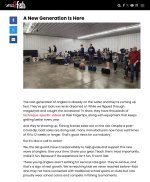
What’s interesting when i read the article, if you keep scrolling down there is another article titled “A new generation is here”.

Personally, I think mentorship young is a key. Many here have mentioned it. But we forget the rest of society. I fish, but don’t have the dedication of some here. I was not mentored by my father who was not mentored by his father. Any mentoring in the 60-70’s was more job related to provide for a family.
I struggled learning to fish, not until the past 20 years adopting it more consistently. Even living in Montana for 8 years, earning money was a big struggle. With no kids of my own, no one to pass it to.
When I look at my neighbors, friends, only 1 occasionally fishes. I looked at joining a local fly club, but it’s across town at a time of rush hour traffic.

IMG_2083.jpeg
 
Back
Top