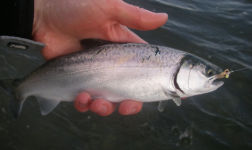
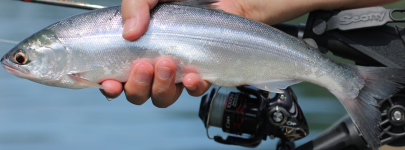
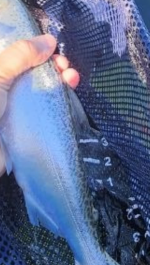
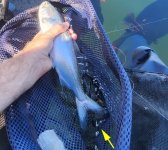
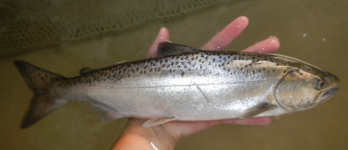
What the heck did I catch?

The only part of this fish that resembles a chinook jack to me is the spotting (though chinook spotting tends to be more peppered-looking), which SOME kokanee can have. The head shape and mouth just don't look at all right to me. The body shape isn't right either from my experience.
 
Last edited:
If I could get my hands on the otolith I'm sure I could prove this fish is a feeding pink salmon. That area has the salinity and micro fauna they crave. Unusual, but this is an El nino year.

This Year it Grows Hot.jpeg
 
Not just a kokanee, but an INVASIVE kokanee. How dare it invade a lake managed specifically for alien warm water species. Write to WDFW. Don't let such an affront stand!

I think Smalma's point is really interesting, that the fish is immature since mature salmon are colored up at this time in preparation for spawning. If this fish has any brethren in that lake, they are going to be sizable specimens come next spring.
 
My research indicates this particular lake has barriers to anadromous passage, so it's not likely this fish came up from the Columbia. Far, far more likely to have come in from "upstream" where the kokanees live.
 
Last edited:
My research indicates this particular lake has barriers to anadramous passage, so it's not likely this fish came up from the Columbia. Far, far more likely to have come in from "upstream" where the kokanees live.
Care to DM me your research because I think it's in error. I will say no more in this public forum.
 
Care to DM me your research because I think it's in error. I will say no more in this public forum.
My research was incomplete - it was a proposed barrier to prevent a planted, non-native predator species from traveling down to the Columbia but never happened. Passage remains open.

But for my own purposes, I refuse to believe a chinook jack wanted anything to do with that place. It just ain't right. But there are many documented cases of stocked fish from upstream coming in through the irrigation network.
 
I'm certainly glad someone mentioned Atlantic Salmon ! (that is always the correct answer) :D
 
Ok I'm going to backtrack a bit. I still don't think chinook jack. I'm decided on that one. BUT... coho jack may have moved in to first place, or tied for first.

1791390073281.png

This solves the spotting problem. The one thing keeping me from committing to it is the anal fin, which matches kokanee

1791390145315.png

Fin on Billy's
1791390172688.png
 
Other than the correct answer is Atlantic Salmon, the part of the fish that has me wondering is the tail. The fork of the tail is extreme. I don't think a chinook would have such a forked tail.... so ya got me.


unknown.jpg
 
Had to sort through a lot of photos online of chinook jacks to find one that's close. I still think it looks more like a kokanee overall, especially the head. But chinook checks other boxes including anal fin, spotting, and tail.
1791392360100.png
Billy's is still a more slender body - even the one in this photo is about as slender as I've seen one. But maybe it's landlocked like a kokanee would be (if it's a chinook) and took on a slightly different look.
 
I was getting out of one of the State Park lakes one morning when a WDFW planting truck pulled up. The hatchery tech dipped fish out of three tanks to plant "counted" fry into this little lake (rainbow, brown and tiger fry). I think he was from Columbia Springs. I don't know if they have kokanee at that facility (sturgeon: yes (or used to)) but as haphazardly as the fry plant "count" was I could see a possible mix up when filling planting tanks.

Y'all can discount my coho ID as Billy's fish is no doubt a cohkokachinookie
 
Billy's is still a more slender body - even the one in this photo is about as slender as I've seen one. But maybe it's landlocked like a kokanee would be (if it's a chinook) and took on a slightly different look.

It looks more like a landlocked chinook to me - but it is hard to tell from the pictures. Years ago, wdfw dumped a bunch of extra chinook smolts into greenlake in Seattle, and they grew up to look like that. Kind of skinny, very bright. They only lasted one season, and then they were gone.
 
It looks more like a landlocked chinook to me - but it is hard to tell from the pictures. Years ago, wdfw dumped a bunch of extra chinook smolts into greenlake in Seattle, and they grew up to look like that. Kind of skinny, very bright. They only lasted one season, and then they were gone.
I could definitely see that being the case here somehow. I've caught dozens of chinook jacks in varying sizes in the past 2mo, so am quite familiar with their traits. This one doesn't fit all of them like I've stated previously, but it could still be one with some differences due to being landlocked.
 
I see more chinook traits than nerka traits in that fish, including the aforementioned spots but also the silvering pattern of the caudal rays and the "windowpane" in the adipose, neither of which a koke usually has...but that's a big ol' goofy pupil. Chinook are typically pretty "beady-eyed".
It's like they took an entire sockeye/kokanee head and stuck it on a skinny chinook body.
 
A pic of the gill rakers would have ended the speculation pretty quick.

@Billy - if you ever see another one, take a peek inside the operculum. Chinook have <30 short, stubby rakers on the first arch, sockeye have >30 long, fine rakers on the first arch. Piscivore vs filter feeder.
 
Looking at the tail on the OP fish would eliminate everything other than Chinook for someone who knows salmon.

If a body of water recieves hatchery plants you can get unexpected "strays".

True story. While fishing Rocky Ford creek between the upper access and trout lodge hatchery I caught an unmistakable 14" chinook. Late 80's timeframe.
 
Back
Top