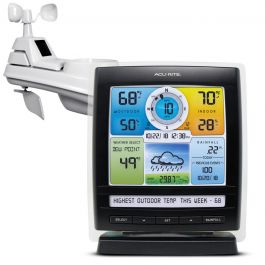
Agree with others that my yard conditions are usually not a great indicator of conditions where I fish. However when combined with the weather station's reporting of static and trending barometric pressure based on my home's altitude, a 3.5 degrees F per 1000 feet differentiational temp relationship, and visual observations including a cloud cap on Mt Rainier, I get a
pretty good idea of what overall conditions
are and
will be like for the S&C King, Pierce, N Lewis, & N Thurston area.
Puget Sound wind conditions are a notable exception.
I'm not saying it is the best but this all in one unit works OK
*for general weather observation, predicting overall conditions for fishing trips in the immediate 4-county area, and the volunteer govt HF ECOMM work I do
*.
Real-Time Weather Conditions: Receive readings for indoor outdoor temperature and humidity, wind speed/direction, barometric pressure, and rainfall Large Color LCD Display with Adjustable Dimmer: Convenient to read and easily view data from various angles Weather Forecast: Provides a hyperlocal...

www.acurite.com
It uses WiFi to link to the mfg website so I can log in with a PC and also has a mobile app to check the weather at the house from anywhere. The manual says they have an "area network" of reporting stations based on nearby IP addresses that's supposed to increase the local forecast accuracy. I get email & text alerts for high and low temps, rainfall accumulation, and wind based on criteria I enter on my PC along with internet (power?) outages. There is also monthly reporting that matches up pretty closely to our central heating-AC system's temps reporting. It
*has on-demand trend reporting charts (trend temp-wind-pressure-rainfall...) but
* does not have the export to .csv reporting that some more expensive systems have. The technical support is pretty good but no longer as good as the outstanding live phone support I got several years ago, and there are replacement parts available.
Sensor placement for any system is IMPORTANT to get valid comparisons with NOAA and other "official" reporting.
- Wind sensors should be high and away from structures & trees; hard to do when there's a forest on our prevailing windward side but I am getting the actual ground wind speed at the house.
- Precip sensors, similar to #1 should be away from obstructions but at least "high" isn't a requirement.
- Temp sensors should be out of direct sunlight and away from heat reflective surfaces like walls, roofs, concrete... Mine has a solar powered cooling fan in the sensor unit but it doesn't really work all that well so I use my computer to do an offset adjustment for the LCD panel. It's close to what my outside central heat-AC sensor reads.
- If the sensors are battery powered you need to be able to reach them for servicing. Mine has a remote battery box available but *they also should be cleaned and calibration checked periodically so* I choose to use the offset adjustments to compensate for less than ideal placement.
*edits