

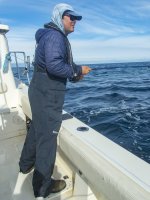
Tuna, 2 September 2025. “It was the best of times, it was the worst of times.” It was certainly a schizophrenic day. The team left the foggy dock at Westport shortly after 6AM. The fishers were @jasmillo,
@SilverFly ,
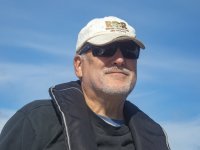
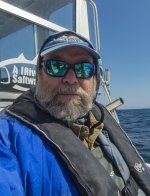
Silverfly’s BIL, and me.
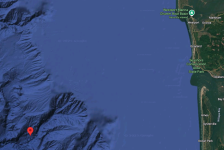
After picking up two brails of live anchovies, Nick maneuvered the boat out of the Westport Harbor and over the Westport bar. As we headed south-west, the cloudy/foggy skies closer to shore transitioned to bright sun offshore. With a gentle westerly swell at 3’, we blasted out to the continental shelf. On the way, we passed killer whales, humpbacks, and flocks of seabirds, such as sooty shearwaters. Two hours later, we were forty miles southwest of Westport over the edge of the continental slope.
This location lies over the Willapa Canyon, thousands of feet below.
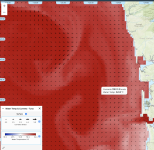
Several studies (see here and here ) indicate that these canyons may facilitate upwelling. This canyon upwelling (albeit much weaker than coastal upwelling driven by the wind and Coriolis effect) pulls cooler, nutrient rich water into the photic zone = more food for albacore tuna. Still, the water temperature where we were fishing was about 64oF according to Nick’s instrument panel and confirmed by the temperature data from the Tuna Fishers product of NANOOS (see here). https://nvs.nanoos.org/Fishers.
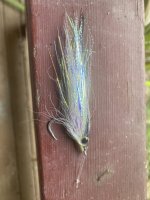
We set out our spread of flylines as Nick started our troll: two shorter lines in the middle and two longer lines on the outside. This is designed to reduce line tangles when Nick has to turn the boat. Each of us used whatever fly tickled their fancy, a mix of squid flies and baitfish flies, all of which took albacore at one point or another. While some fishers changed flies several times, I had tied on a baitfish fly and fished it all day.
Under the relatively calm conditions in the early morning, we could see tuna blasting bait at the surface all around us. @Nick Clayton
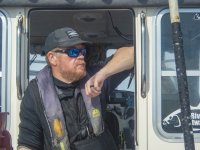
guided the boat through one of those patches. First, @jasmillo's rod when off on the troll, then Kenny and @SilverFly hooked fish on the slide. Calvin, our deck hand,
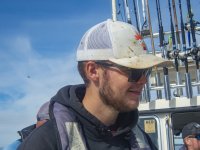
threw out a steady stream of live anchovies to keep the school close to the boat. I hooked up while roll casting and retrieving my fly at the stop.
In my experience albacore that have been hooked close to the boat are more likely to blast off several times; albacore hooked while trolling will make a single long, explosive initial run. Any fish that seems to be coming in too easy will fool you by making a knuckle-buster run or three just to show you whose boss.
Nick wanted to get in on the fun and hooked another albacore from outside the cabin. Five albacore on simultaneously!!! Because you have limited control over a hooked tuna, we executed a ballet of several “overs” and “unders” as the tuna seemed determined collectively to create origami with our flylines. But we were able to boat all five.
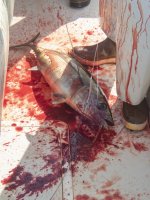
The fish in this school were definitely on the hunt. Several times an albacore would explosively blast an anchovy that Cal was pitching around the boat. We picked up three more albacore before this school decided to stop coming up to the surface. A very successful stop.
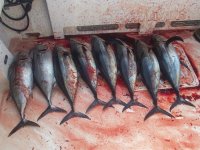
Back on the troll, it wasn’t long before another member of the team called out “fish-on”. While I was actively retrieving my fly and line on the slide, I hooked up and I believe that @jasmillo did as well. Near the end game, @jasmillo's fish managed to break off his fly at the leader and escape. My fish went on several screaming runs, but I eventually brought it close enough for Cal to gaff it.
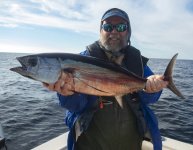
We picked up several fish on this stop, giving us ten fish before 9AM.
Nick would get us back on the troll if we couldn’t bring the albacore up with live anchovies or if the electronics indicated that the school had moved on. If there were jumpers and Nick could motor over that location, we had a great chance of hooking up at least one fish.
We hadn’t traveled very far before another albacore hit a trolled fly in our spread. Kenny, a friend of @SilverFly's, has a wealth of fishing experience but had never flyfished for albacore. He picked it up quickly.
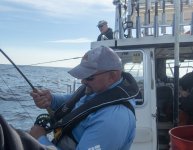
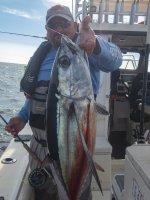
Another fish was hooked on the troll and other fish were hooked while casting from the bow or from the stern. This pattern continued through the morning, albeit not as hot as our first stop.
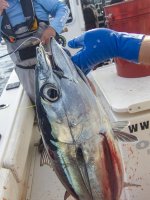
We had boated 17 albacore in the 15-20+ pound range by 11AM. We lost probably another 5-6 fish. The hook pulled free on several and one fish managed to abrade the leader when it swam right under the hull during the end game. This was the best of times.
Now, for the worst of times. The winds were building through the morning to 16 knots
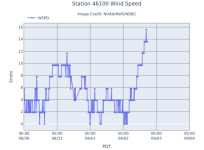
until the sea surface was covered with whitecaps. A confused wind chop mixed with the long-period swell buffeted the boat around.
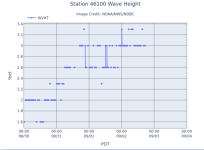
As the whitecaps expanded, the action died, dead, dead, dead. We trolled for three hours from 11AMish to 2PM without a strike. Nick tried everything: mixing speeds, changing directions, searching for bird activity, having Cal throw out a net of live anchovies if albacore were spotted below the boat on the fish finder, all to no avail. And we weren’t the only ones experiencing this lull; all the boats were slow in the early afternoon. Finally, Nick had to call it a day and we prepared to head back to Westport.
Still, it was a great day as everyone caught fish.
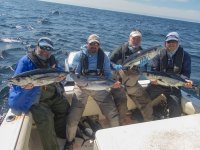
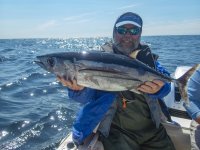
And our totals were comparable to some of All Rivers bait charters.
Atypically, the long 40-mile ride back to Westport was miserable. Normally, the long-period swell from the west is behind us. And Nick can speed us back to port powered by the twin 250 outboards. But today the wind waves from the north interacted with the long-period swells from the west created a messy sea. This forced him to slow down significantly. In spite of Nick’s best efforts, waves would occasionally break on the bow, sending a plume of water over the cabin and down the spray cover to land on @jasmillo and me in the two outside seats. I am still amazed at Cal’s ability to process these tuna into loins and belly-pieces so quickly under these conditions.
All in all, a solid day with old and new friends. Two more trips to come for me.
Steve
@SilverFly ,
Silverfly’s BIL, and me.
After picking up two brails of live anchovies, Nick maneuvered the boat out of the Westport Harbor and over the Westport bar. As we headed south-west, the cloudy/foggy skies closer to shore transitioned to bright sun offshore. With a gentle westerly swell at 3’, we blasted out to the continental shelf. On the way, we passed killer whales, humpbacks, and flocks of seabirds, such as sooty shearwaters. Two hours later, we were forty miles southwest of Westport over the edge of the continental slope.
This location lies over the Willapa Canyon, thousands of feet below.
Several studies (see here and here ) indicate that these canyons may facilitate upwelling. This canyon upwelling (albeit much weaker than coastal upwelling driven by the wind and Coriolis effect) pulls cooler, nutrient rich water into the photic zone = more food for albacore tuna. Still, the water temperature where we were fishing was about 64oF according to Nick’s instrument panel and confirmed by the temperature data from the Tuna Fishers product of NANOOS (see here). https://nvs.nanoos.org/Fishers.
We set out our spread of flylines as Nick started our troll: two shorter lines in the middle and two longer lines on the outside. This is designed to reduce line tangles when Nick has to turn the boat. Each of us used whatever fly tickled their fancy, a mix of squid flies and baitfish flies, all of which took albacore at one point or another. While some fishers changed flies several times, I had tied on a baitfish fly and fished it all day.
Under the relatively calm conditions in the early morning, we could see tuna blasting bait at the surface all around us. @Nick Clayton
guided the boat through one of those patches. First, @jasmillo's rod when off on the troll, then Kenny and @SilverFly hooked fish on the slide. Calvin, our deck hand,
threw out a steady stream of live anchovies to keep the school close to the boat. I hooked up while roll casting and retrieving my fly at the stop.
In my experience albacore that have been hooked close to the boat are more likely to blast off several times; albacore hooked while trolling will make a single long, explosive initial run. Any fish that seems to be coming in too easy will fool you by making a knuckle-buster run or three just to show you whose boss.
Nick wanted to get in on the fun and hooked another albacore from outside the cabin. Five albacore on simultaneously!!! Because you have limited control over a hooked tuna, we executed a ballet of several “overs” and “unders” as the tuna seemed determined collectively to create origami with our flylines. But we were able to boat all five.
The fish in this school were definitely on the hunt. Several times an albacore would explosively blast an anchovy that Cal was pitching around the boat. We picked up three more albacore before this school decided to stop coming up to the surface. A very successful stop.
Back on the troll, it wasn’t long before another member of the team called out “fish-on”. While I was actively retrieving my fly and line on the slide, I hooked up and I believe that @jasmillo did as well. Near the end game, @jasmillo's fish managed to break off his fly at the leader and escape. My fish went on several screaming runs, but I eventually brought it close enough for Cal to gaff it.
We picked up several fish on this stop, giving us ten fish before 9AM.
Nick would get us back on the troll if we couldn’t bring the albacore up with live anchovies or if the electronics indicated that the school had moved on. If there were jumpers and Nick could motor over that location, we had a great chance of hooking up at least one fish.
We hadn’t traveled very far before another albacore hit a trolled fly in our spread. Kenny, a friend of @SilverFly's, has a wealth of fishing experience but had never flyfished for albacore. He picked it up quickly.
Another fish was hooked on the troll and other fish were hooked while casting from the bow or from the stern. This pattern continued through the morning, albeit not as hot as our first stop.
We had boated 17 albacore in the 15-20+ pound range by 11AM. We lost probably another 5-6 fish. The hook pulled free on several and one fish managed to abrade the leader when it swam right under the hull during the end game. This was the best of times.
Now, for the worst of times. The winds were building through the morning to 16 knots
until the sea surface was covered with whitecaps. A confused wind chop mixed with the long-period swell buffeted the boat around.
As the whitecaps expanded, the action died, dead, dead, dead. We trolled for three hours from 11AMish to 2PM without a strike. Nick tried everything: mixing speeds, changing directions, searching for bird activity, having Cal throw out a net of live anchovies if albacore were spotted below the boat on the fish finder, all to no avail. And we weren’t the only ones experiencing this lull; all the boats were slow in the early afternoon. Finally, Nick had to call it a day and we prepared to head back to Westport.
Still, it was a great day as everyone caught fish.
And our totals were comparable to some of All Rivers bait charters.
Atypically, the long 40-mile ride back to Westport was miserable. Normally, the long-period swell from the west is behind us. And Nick can speed us back to port powered by the twin 250 outboards. But today the wind waves from the north interacted with the long-period swells from the west created a messy sea. This forced him to slow down significantly. In spite of Nick’s best efforts, waves would occasionally break on the bow, sending a plume of water over the cabin and down the spray cover to land on @jasmillo and me in the two outside seats. I am still amazed at Cal’s ability to process these tuna into loins and belly-pieces so quickly under these conditions.
All in all, a solid day with old and new friends. Two more trips to come for me.
Steve
Last edited:


