Tuna 2023

Imagine hooking that while bucktailing for coho
Seriously. We've (OK maybe just me) have been hoping to see BFT on the green water edge 20-30 miles offshore, and here one washes up in N Puget Sound. And a big one at that. Blows me away to think that fish swam in the full length of the Strait.

Kinda fits with this study I've posted before that researched history of indigenous bluefin tuna hunting from Neah Bay to Haida Gwaii.
One washing up on Orcas isn't quite so weird after reading this excerpt from the study:
Tuna traveled well inside Nootka Sound into protected inlets and were harpooned at night as they fed at the surface in shallow inshore waters (located by spotters positioned on nearby cliffs). Bioluminescent plankton present in the water made the big fish especially visible at night, even from a distance.

 
Seriously. We've (OK maybe just me) have been hoping to see BFT on the green water edge 20-30 miles offshore, and here one washes up in N Puget Sound. And a big one at that. Blows me away to think that fish swam in the full length of the Strait.

Kinda fits with this study I've posted before that researched history of indigenous bluefin tuna hunting from Neah Bay to Haida Gwaii.
One washing up on Orcas isn't quite so weird after reading this excerpt from the study:


That would be one hell of an experience to see Puget Sound bioluminescent-lit tuna.
 
Still trying to wrap my head around this. Starting pretty early today my phone was blowing up with people sending me various links. Almost assumed it was some fake nonsense at first.

Really blows my mind. Sure would be cool to know the full story of how that thing ended up here.

Guess it's time to get a kite setup for my sound boat.
 
Seriously. We've (OK maybe just me) have been hoping to see BFT on the green water edge 20-30 miles offshore, and here one washes up in N Puget Sound. And a big one at that. Blows me away to think that fish swam in the full length of the Strait.

Kinda fits with this study I've posted before that researched history of indigenous bluefin tuna hunting from Neah Bay to Haida Gwaii.
One washing up on Orcas isn't quite so weird after reading this excerpt from the study:


I am fascinated by this. My uninformed gut feeling is that this behaviour should still be as common as it once was. We still have the huge algae blooms and the squid and herring they draw in, the water is warmer.... is it possible this is still relatively common and we are just missing it at night? Like if you throw that big squimp around Nootka this time of year at midnight, might you knock into a big ass bluefin? Is it legal to try?

This is way too cool. That fish didnt make it, but it doesnt look to have been dead all that long.
 
I am fascinated by this. My uninformed gut feeling is that this behaviour should still be as common as it once was. We still have the huge algae blooms and the squid and herring they draw in, the water is warmer.... is it possible this is still relatively common and we are just missing it at night? Like if you throw that big squimp around Nootka this time of year at midnight, might you knock into a big ass bluefin? Is it legal to try?

This is way too cool. That fish didnt make it, but it doesnt look to have been dead all that long.


I am one hundred percent convinced that they are here most years and in larger numbers than most would think.

Probably many reasons why nobody has really figured out how to target them with the largest being that it's extremely cost prohibitive. Even for those who have a capable boat and gear, its a big financial investment to run a boat out there in search of a fish that may or may not even exist in numbers worth targeting, especially when there are albacore to be caught. I believe albacore anglers encounter a few larger ones every year, but quite frankly most of us aren't geared up for such a fish. Big difference between albacore gear and bluefin gear, and I think the bulk of those encounters end before anyone even really knows what's happening.
The other factor is I don't know exactly what it would take to successfully target them in our waters. Not sure if running a kite with a flying fish like in San Diego is gonna get it done up here. My gut tells me that jigging would likely be the most logical way to approach it, at least unless you actually came into a big foamer patch of them by some miracle. Maybe fishing that green water temp break and jigging on any deeper bait balls or suspicious sonar marks. I dunno. Bluefin, especially larger ones are known to be super boat shy and not eager to eat trolled lures unless they are waaaaay back from the boat. Albacore anglers don't fish long troll spreads, so that too could explain a lack of encounters.

Still, there are smaller bluefin caught in our waters most every year out there, and the occasional larger one does get landed on the rare occasion. I believe it was 2, possibly 3 years ago a 98 lb bluefin was caught by a private boat jigging for albacore about a mile or so from where I was currently fishing.

I've put eyes on a large bluefin offshore a couple of times. They are one hundred percent around.

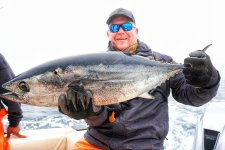
Here's a WA caught bluefin that my customer caught two seasons ago. Was the first for me but a decent handful of them get caught every year out there.

IMG_20210809_204619_508.jpg
 
I am one hundred percent convinced that they are here most years and in larger numbers than most would think.

Probably many reasons why nobody has really figured out how to target them with the largest being that it's extremely cost prohibitive. Even for those who have a capable boat and gear, its a big financial investment to run a boat out there in search of a fish that may or may not even exist in numbers worth targeting, especially when there are albacore to be caught. I believe albacore anglers encounter a few larger ones every year, but quite frankly most of us aren't geared up for such a fish. Big difference between albacore gear and bluefin gear, and I think the bulk of those encounters end before anyone even really knows what's happening.
The other factor is I don't know exactly what it would take to successfully target them in our waters. Not sure if running a kite with a flying fish like in San Diego is gonna get it done up here. My gut tells me that jigging would likely be the most logical way to approach it, at least unless you actually came into a big foamer patch of them by some miracle. Maybe fishing that green water temp break and jigging on any deeper bait balls or suspicious sonar marks. I dunno. Bluefin, especially larger ones are known to be super boat shy and not eager to eat trolled lures unless they are waaaaay back from the boat. Albacore anglers don't fish long troll spreads, so that too could explain a lack of encounters.

Still, there are smaller bluefin caught in our waters most every year out there, and the occasional larger one does get landed on the rare occasion. I believe it was 2, possibly 3 years ago a 98 lb bluefin was caught by a private boat jigging for albacore about a mile or so from where I was currently fishing.

I've put eyes on a large bluefin offshore a couple of times. They are one hundred percent around.

Here's a WA caught bluefin that my customer caught two seasons ago. Was the first for me but a decent handful of them get caught every year out there.

View attachment 72590

I am certain they exist in numbers offshore. Theres no reason they wouldnt. But what the tribes are saying is not offshore, its Nootka sound and Neah Bay. Its spotting them from shore. I'm wondering if this still happens right under our noses.
 
I am certain they exist in numbers offshore. Theres no reason they wouldnt. But what the tribes are saying is not offshore, its Nootka sound and Neah Bay. Its spotting them from shore. I'm wondering if this still happens right under our noses.


Personally I think there is likely very little chance of that.

One factor that I believes limits the encounters with these fish, big ones especially, is there is very, very little fishing of any sort going on in the waters where I believe one would have the best chance at one of these. Almost every reliable report I've heard of people spotting a large tuna has taken place, as Guy mentioned, on that green water edge often 25-35 miles offshore. There just isn't a ton of fishing of any sort going on in that zone. Salmon and bottomfish folks typically aren't that far out, and albacore folks are typically continuing on to find the blue water. That nutrient rich, greener, slightly cooler water just doesn't have a lot of people focusing on it. However, during certain parts of the year their is a lot of traffic out there as boats cruise to and from the albacore grounds. Hence some visual sightings but not a lot of actual fishing encounters.

Contrast that with popular Inshore areas listed in that study, and I just have to assume if there was any sort of numbers of these fish ever coming into those zones we would have been hearing about the occasional random encounter by folks not even considering they could be there. There's just too many people fishing and traversing those waters damn near year round as well as overnight to make me believe there are any to speak of hanging around. I sure believe if there were you'd at least hear of random anglers/boaters reporting sighting of some sort of large tuna like species being seen, or some random Salmon angler or something would have had lighting strike and actually hooked/caught one. Even though I don't think our gear or techniques used in our waters would be an effective method of targeting such a fish, weird shit happens and someone would have caught one or at least had verified hookups by now.

But, no doubt that's just a guess
 
Personally I think there is likely very little chance of that.

One factor that I believes limits the encounters with these fish, big ones especially, is there is very, very little fishing of any sort going on in the waters where I believe one would have the best chance at one of these. Almost every reliable report I've heard of people spotting a large tuna has taken place, as Guy mentioned, on that green water edge often 25-35 miles offshore. There just isn't a ton of fishing of any sort going on in that zone. Salmon and bottomfish folks typically aren't that far out, and albacore folks are typically continuing on to find the blue water. That nutrient rich, greener, slightly cooler water just doesn't have a lot of people focusing on it. However, during certain parts of the year their is a lot of traffic out there as boats cruise to and from the albacore grounds. Hence some visual sightings but not a lot of actual fishing encounters.

Contrast that with popular Inshore areas listed in that study, and I just have to assume if there was any sort of numbers of these fish ever coming into those zones we would have been hearing about the occasional random encounter by folks not even considering they could be there. There's just too many people fishing and traversing those waters damn near year round as well as overnight to make me believe there are any to speak of hanging around. I sure believe if there were you'd at least hear of random anglers/boaters reporting sighting of some sort of large tuna like species being seen, or some random Salmon angler or something would have had lighting strike and actually hooked/caught one. Even though I don't think our gear or techniques used in our waters would be an effective method of targeting such a fish, weird shit happens and someone would have caught one or at least had verified hookups by now.

But, no doubt that's just a guess

I've given this far more thought than is healthy, but, based on my shore-based reading, I would agree with this "guess".

My theory as to why the large BFT historically came into nearshore waters, comes down to 2 things:

1) There were simply a LOT more BFT back then. Doesn't take a biology degree to know that a larger population naturally needs a larger range.

2) These fish needed a LOT of high nutrient food, which there was plenty to be found in nearshore waters back then. 150 years ago, places like Nootka Sound were loaded with not just herring, but far more salmon than we have today. The study claims the midden samples put the average bluefin in the 300# range, with the largest estimated at 600+. Tuna that size would have no problem eating a 10# coho. Would love to see that bait ball!
 
I've given this far more thought than is healthy, but, based on my shore-based reading, I would agree with this "guess".

My theory as to why the large BFT historically came into nearshore waters, comes down to 2 things:

1) There were simply a LOT more BFT back then. Doesn't take a biology degree to know that a larger population naturally needs a larger range.

2) These fish needed a LOT of high nutrient food, which there was plenty to be found in nearshore waters back then. 150 years ago, places like Nootka Sound were loaded with not just herring, but far more salmon than we have today. The study claims the midden samples put the average bluefin in the 300# range, with the largest estimated at 600+. Tuna that size would have no problem eating a 10# coho. Would love to see that bait ball!


Hah Man, can you imagine sliding in to cast flies at some jumping coho when suddenly 300+ lb bluefin start crashing on them? Well, ya, I know YOU can imagine that lol.

It really does stretch my brain in exciting ways to think about those fish right in our backyard. Pretty friggen incredible. Just the image of this single fish cruising through the straits puts a big smile on my face.

The mysteries of the salt are pretty damned incredible.
 
Last edited:
The more I fish them, the more I believe the Miyawaki Popper is a top 5 all time fly. I don't fish them often enough, but I've got 10 species on it from rivers, lakes, ponds and salt, bluegill to coho.

No disrespect, but it would be in my top five for missed fish. Probably number one.
It certainly gets a lot of follows and splashy takes, but the hookup ratio is not very good. I think mainly due to the design of the stinger hook flopping around way ways back behind the head.
I’ve found at least based on my experiences that surface patterns tied on standard hooks like Nick’s pattern or on tubes have a much better take to hook up ratio. Flies like gurglers, Roger Stephen’s Delia Squid etc.
SF
 
No disrespect, but it would be in my top five for missed fish. Probably number one.
It certainly gets a lot of follows and splashy takes, but the hookup ratio is not very good. I think mainly due to the design of the stinger hook flopping around way ways back behind the head.
I’ve found at least based on my experiences that surface patterns tied on standard hooks like Nick’s pattern or on tubes have a much better take to hook up ratio. Flies like gurglers, Roger Stephen’s Delia Squid etc.
SF
That has also been my experience. Had terrible, terrible hookup ratio on it.

I do plan to try it for tuners, though.
 
No disrespect, but it would be in my top five for missed fish. Probably number one.
It certainly gets a lot of follows and splashy takes, but the hookup ratio is not very good. I think mainly due to the design of the stinger hook flopping around way ways back behind the head.
I’ve found at least based on my experiences that surface patterns tied on standard hooks like Nick’s pattern or on tubes have a much better take to hook up ratio. Flies like gurglers, Roger Stephen’s Delia Squid etc.
SF
Glad to hear I’m not the only one.

I like Leland a lot, and the dude is fishy, but personally I believe he catches so many fish with it because he fishes it so much.
 
No disrespect, but it would be in my top five for missed fish. Probably number one.
It certainly gets a lot of follows and splashy takes, but the hookup ratio is not very good. I think mainly due to the design of the stinger hook flopping around way ways back behind the head.
I’ve found at least based on my experiences that surface patterns tied on standard hooks like Nick’s pattern or on tubes have a much better take to hook up ratio. Flies like gurglers, Roger Stephen’s Delia Squid etc.
SF
I tie the Miyawaki popper on a tube with a #2 B10 Stinger hook and have a pretty decent hookup ratio. Wider gap/lighter wire hook seems to help. I'm looking forward to another season of testing this hypothesis! :D
 
Since I can’t go this year, if any forum supporter wants to borrow a setup or two they can. Dozens of flies for you to use, too.

1 - Scott Sector 8’4” 13wt w/Tibor Pacific and Airflo Big Game line. (and about 10 kajillion feet of backing) Casts like an 11 or 12wt but punches well above its weight-class.

2 - G Loomis Short Stix 7' 6" 11/12 w/Redington Behemoth and Floating Tarpon line. Graphite/fiberglass hybrid rod with an extra cork grip for really putting the pressure on. I love it and have used it mostly for poppers, but works very well for everything with a line/reel swap.

3 - North Fork Composites Iconoglass 8'6" 12wt fiberglass rod w/Redington Behemoth and Airflo Big Game line. Custom built for me and tuna by Terry Turner (over-size grip, extra grip, big guides) this rod is silly amounts of fun when hooked up.


I’m just north of Seattle, 5min from I-5 N/S and 405.
 
Last edited:
Hah Man, can you imagine sliding in to cast flies at some jumping coho when suddenly 300+ lb bluefin start crashing on them? Well, ya, I know YOU can imagine that lol.

It really does stretch my brain in exciting ways to think about those fish right in our backyard. Pretty friggen incredible. Just the image of this single fish cruising through the straits puts a big smile on my face.

The mysteries of the salt are pretty damned incredible.

Trust me, I HAVE imagined that. Nuts to think that fish might have been within 30-40 miles of your place as it was turning north past Victoria. We'll likely never know WHY it ended up there but hopefully we'll get some answers as to why it died. Just a WAG, but maybe not a coincidence one came into the Strait on a pink year? East Sound Orcas though ... WTF?!
 
Trust me, I HAVE imagined that. Nuts to think that fish might have been within 30-40 miles of your place as it was turning north past Victoria. We'll likely never know WHY it ended up there but hopefully we'll get some answers as to why it died. Just a WAG, but maybe not a coincidence one came into the Strait on a pink year? East Sound Orcas though ... WTF?!
I was reading a few years back about some Stone Age people’s that lived in a cave on the Mediterranean Sea. A time of the year when the big blue fin tuna would swim into the sea to feed or maybe breed I can’t remember which, but the tuna would end up in the shallow water and when the tide sucked out they would get stranded. The Stone Age people would walk out and kill them then because the tuna were so big they had to butcher them to get pieces small enough to carry back to the cave. This may have been what happened to the Orca island bluefin.
 
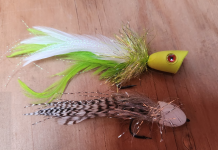
@Nick Clayton - which of these two flies from you should I have tied up on my next trip?

View attachment 72688


The bottom one.

The top one is one of several variations of "poppers" I've tried with limited success. When they are absolutely fired up and in the mood that they'd eat your boot if you hung it in the water, that top one will produce. But across the board in most normal scenarios the bottom one is my go to.
 
Back
Top